John Bedson's unholy crew is being challenged on this site.
I am currently a Christadelphian, and it is a great pity that we have to wash our dirty linen in public, but this particular brand of dirty linen consists of dispute about the theory of evolution, which Bedson, Gilmore, the Burke brothers, Pogson and several others declare with one voice to be true - in fact, that is the name of the Bedson site.
I hereby issue a challenge to all and sundry, ex-Christadelphian or otherwise, to come here and debate the subject fairly. As the owner of this blog, I reserve the right to terminate any offensive, abusive or otherwise disgraceful conversations. Two warnings will be given, and termination will follow.
I am no politician, and as such, will have no hesitation in terminating the objectionable.
The subject to be debated is the subject of my little book: 'How Does Instinct Evolve?'
In my opinion, that book finishes the theory off forever, and is a major contribution to the debate on the subject of whether or not evolution could, or did occur. It is a revolutionary argument, which like Pasteur's single-handed demolition of the theory of the spontaneous origin of life, is my single-handed demolition of the theory of evolution.
If my argument is correct, and there is no reason to suppose that it isn't, then evolution could not even start, far less produce the multi-faceted multitudes of life-forms on earth today.
So the gauntlet is hurled into your faces, members of the opposition. Give me a man to fight with me, and we'll take it from there. You may recognise the quotation. Or not.
Tuesday, 6 May 2014


Wednesday, 13 November 2013
MCCARTHY'S FOLLY
In a very curious article, It might in fact, be a joke - but I doubt it. It wasn't published on 1st April...
http://www.macroevolution.net/human-origins-2.html#.Un4AfuLflGk
McCarthy goes to town, and produces a magnificent list of the features which humans do NOT HAVE IN COMMON with any other primates, and I reproduce it here. Dr McCarthy, if you ever read this, and wish me to remove it from this blog, I will be more than happy to do so. But here it is for the time being, in my appreciation of its excellence:
The really odd thing is the McCarthy completely fails to recognise that this is a magnificent list in support of creation rather than the usual boring evolutionary nonsense.
He can not, and neither can any palaeoanthropologist, account for the origin of these features, and as a result, evolution is again left high and dry ; or is that deep and sunk?
A list of traits distinguishing humans from other primates
DERMAL FEATURES
Naked skin (sparse pelage)
Panniculus adiposus (layer of subcutaneous fat)
Panniculus carnosus only in face and neck
In "hairy skin" region:
- Thick epidermis
- Crisscrossing congenital lines on epidermis
- Patterned epidermal-dermal junction
Large content of elastic fiber in skin
Thermoregulatory sweating
Richly vascularized dermis
Normal host for the human flea (Pulex irritans)
Dermal melanocytes absent
Melanocytes present in matrix of hair follicle
Epidermal lipids contain triglycerides and free fatty acids
FACIAL FEATURES
Lightly pigmented eyes common
Protruding, cartilaginous mucous nose
Narrow eye opening
Short, thick upper lip
Philtrum/cleft lip
Glabrous mucous membrane bordering lips
Eyebrows
Heavy eyelashes
Earlobes
FEATURES RELATING TO BIPEDALITY
Short, dorsal spines on first six cervical vertebrae
Seventh cervical vertebrae:
- long dorsal spine
- transverse foramens
Fewer floating and more non-floating ribs
More lumbar vertebrae
Fewer sacral vertebrae
More coccygeal vertebrae (long "tail bone")
Centralized spine
Short pelvis relative to body length
Sides of pelvis turn forward
Sharp lumbo-sacral promontory
Massive gluteal muscles
Curved sacrum with short dorsal spines
Hind limbs longer than forelimbs
Femur:
- Condyles equal in size
- Knock-kneed
- Elliptical condyles
- Deep intercondylar notch at lower end of femur
- Deep patellar groove with high lateral lip
- Crescent-shaped lateral meniscus with two tibial insertions
Short malleolus medialis
Talus suited strictly for extension and flexion of the foot
Long calcaneus relative to foot (metatarsal) length
Short digits (relative to chimpanzee)
Terminal phalanges blunt (ungual tuberosities)
Narrow pelvic outlet
ORGANS
Diverticulum at cardiac end of stomach
Valves of Kerkring present in small intestines
Mesenteric arterial arcades
Multipyramidal kidneys
Heart auricles level
Tricuspid valve of heart
Laryngeal sacs absent
Vocal ligaments
Prostate encircles urethra
Bulbo-urethral glands present
Os penis (baculum) absent.
Hymen
Absence of periodic sexual swellings in female
Ischial callosities absent
Nipples low on chest
Bicornuate uterus (occasionally present in humans)
Labia majora
CRANIAL FEATURES
Brain lobes: frontal and temporal prominent
Thermoregulatory venous plexuses
Well-developed system of emissary veins
Enlarged nasal bones
Divergent eyes (interior of orbit visible from side)
Styloid process
Large occipital condyles
Primitive premolar
Large, blunt-cusped (bunodont) molars
Thick tooth enamel
Helical chewing
BEHAVIORAL/PHYSIOLOGICAL
Nocturnal activity
Particular about place of defecation
Good swimmer, no fear of water
Extended male copulation time
Female orgasm
Short menstrual cycle
Snuggling
Tears
Alcoholism
Terrestrialism (Non-arboreal)
Able to exploit a wide range of environments and foods
RARE OR ABSENT IN NONHUMAN PRIMATES:
Heart attack
Atherosclerosis
Cancer (melanoma)
That is a pretty extensive list, and it can be added to, if we look hard enough.
But I have had difficulty in restraining my laughter and my sense of the comic, when I read his possible 'explanation' of the origin of these features. He is a geneticist , and claims to know about hybridisation.
There is only one other animal which possesses these characteristics, and with which our 'common ancestor' hybridised in order to produce Homo sapiens. Here is the text in full. Now stop laughing!!!!
So how does he resolve the problem? Quite comically is the answer.
Which animal is it? Which??? Come on Dr McCarthy! Spill the beans!
Sapiens?????? !!!!!
Of course, this might explain how snoring evolved!!!!....
In a very curious article, It might in fact, be a joke - but I doubt it. It wasn't published on 1st April...
http://www.macroevolution.net/human-origins-2.html#.Un4AfuLflGk
McCarthy goes to town, and produces a magnificent list of the features which humans do NOT HAVE IN COMMON with any other primates, and I reproduce it here. Dr McCarthy, if you ever read this, and wish me to remove it from this blog, I will be more than happy to do so. But here it is for the time being, in my appreciation of its excellence:
The really odd thing is the McCarthy completely fails to recognise that this is a magnificent list in support of creation rather than the usual boring evolutionary nonsense.
He can not, and neither can any palaeoanthropologist, account for the origin of these features, and as a result, evolution is again left high and dry ; or is that deep and sunk?
A list of traits distinguishing humans from other primates
DERMAL FEATURES
Naked skin (sparse pelage)
Panniculus adiposus (layer of subcutaneous fat)
Panniculus carnosus only in face and neck
In "hairy skin" region:
- Thick epidermis
- Crisscrossing congenital lines on epidermis
- Patterned epidermal-dermal junction
Large content of elastic fiber in skin
Thermoregulatory sweating
Richly vascularized dermis
Normal host for the human flea (Pulex irritans)
Dermal melanocytes absent
Melanocytes present in matrix of hair follicle
Epidermal lipids contain triglycerides and free fatty acids
FACIAL FEATURES
Lightly pigmented eyes common
Protruding, cartilaginous mucous nose
Narrow eye opening
Short, thick upper lip
Philtrum/cleft lip
Glabrous mucous membrane bordering lips
Eyebrows
Heavy eyelashes
Earlobes
FEATURES RELATING TO BIPEDALITY
Short, dorsal spines on first six cervical vertebrae
Seventh cervical vertebrae:
- long dorsal spine
- transverse foramens
Fewer floating and more non-floating ribs
More lumbar vertebrae
Fewer sacral vertebrae
More coccygeal vertebrae (long "tail bone")
Centralized spine
Short pelvis relative to body length
Sides of pelvis turn forward
Sharp lumbo-sacral promontory
Massive gluteal muscles
Curved sacrum with short dorsal spines
Hind limbs longer than forelimbs
Femur:
- Condyles equal in size
- Knock-kneed
- Elliptical condyles
- Deep intercondylar notch at lower end of femur
- Deep patellar groove with high lateral lip
- Crescent-shaped lateral meniscus with two tibial insertions
Short malleolus medialis
Talus suited strictly for extension and flexion of the foot
Long calcaneus relative to foot (metatarsal) length
Short digits (relative to chimpanzee)
Terminal phalanges blunt (ungual tuberosities)
Narrow pelvic outlet
ORGANS
Diverticulum at cardiac end of stomach
Valves of Kerkring present in small intestines
Mesenteric arterial arcades
Multipyramidal kidneys
Heart auricles level
Tricuspid valve of heart
Laryngeal sacs absent
Vocal ligaments
Prostate encircles urethra
Bulbo-urethral glands present
Os penis (baculum) absent.
Hymen
Absence of periodic sexual swellings in female
Ischial callosities absent
Nipples low on chest
Bicornuate uterus (occasionally present in humans)
Labia majora
CRANIAL FEATURES
Brain lobes: frontal and temporal prominent
Thermoregulatory venous plexuses
Well-developed system of emissary veins
Enlarged nasal bones
Divergent eyes (interior of orbit visible from side)
Styloid process
Large occipital condyles
Primitive premolar
Large, blunt-cusped (bunodont) molars
Thick tooth enamel
Helical chewing
BEHAVIORAL/PHYSIOLOGICAL
Nocturnal activity
Particular about place of defecation
Good swimmer, no fear of water
Extended male copulation time
Female orgasm
Short menstrual cycle
Snuggling
Tears
Alcoholism
Terrestrialism (Non-arboreal)
Able to exploit a wide range of environments and foods
RARE OR ABSENT IN NONHUMAN PRIMATES:
Heart attack
Atherosclerosis
Cancer (melanoma)
That is a pretty extensive list, and it can be added to, if we look hard enough.
But I have had difficulty in restraining my laughter and my sense of the comic, when I read his possible 'explanation' of the origin of these features. He is a geneticist , and claims to know about hybridisation.
There is only one other animal which possesses these characteristics, and with which our 'common ancestor' hybridised in order to produce Homo sapiens. Here is the text in full. Now stop laughing!!!!
...as it turns out, many features that distinguish humans from chimpanzees also distinguish them from all other primates. Features found in human beings, but not in other primates, cannot be accounted for by hybridization of a primate with some other primate. If hybridization is to explain such features, the cross will have to be between a chimpanzee and a nonprimate — an unusual, distant cross to create an unusual creature.So there's his problem. It's also the problem of every evolutionist palaeoanthropologist in sight!
So how does he resolve the problem? Quite comically is the answer.
Let's begin, then, by considering the list in the sidebar at right, which is a condensed list of traits distinguishing humans from chimpanzees — and all other nonhuman primates. Take the time to read this list and to consider what creature — of any kind — it might describe.That's the list above. Have another look at it to familiarise yourself with the extent of the impossibility. Now here's his solution:
...it's clear that the other parent in this hypothetical cross that produced the first human would be an intelligent animal with a protrusive, cartilaginous nose, a thick layer of subcutaneous fat, short digits, and a naked skin.
...Nevertheless, even initially, these two flies in the theoretical ointment fail to obscure the remarkable fact that a single nonprimate has all of the simple, non-synergistic traits distinguishing humans from their primate kin. Such a finding is strongly consistent with the hypothesis that this particular animal once hybridized with the chimpanzee to produce the first humans. In a very simple manner, this assumption immediately accounts for a large number of facts that otherwise appear to be entirely unrelated.
Which animal is it? Which??? Come on Dr McCarthy! Spill the beans!
What is this other animal that has all these traits?
Not satisfied with this nonsense, he goes boldly on, where none has gone before:The answer is Sus scrofa, the ordinary pig.
... Is it not rational then also, if pigs have all the traits that distinguish humans from other primates, to suppose that humans are also related to pigs? Let us take it as our hypothesis, then, that humans are the product of ancient hybridization between pig and chimpanzee.There. Did you know that you're distantly related to chimpanzees and pigs? Or maybe not so distantly! About 3 million years ago, next November, the unnatural act between a pig and a chimpanzee took place , which resulted in the human race. Homo sapiens..
Sapiens?????? !!!!!
Of course, this might explain how snoring evolved!!!!....
Sunday, 1 July 2012
I was interested to read some comments by Nobel Prize winning scientists, and I append them here for your perusal.
"I would rather believe in fairy tales than in such wild speculation. I have said for years that speculations about the origin of life lead to no useful purpose as even the simplest living system is far too complex to be understood in terms of the extremely primitive chemistry scientists have used in their attempts to explain the unexplainable. God cannot be explained away by such naive thoughts." (Sir Ernst B. Chain, Medicine, 1945)
"When confronted with the marvels of life and the universe, one must ask why and not just how. The only possible answers are religious. For me that means Protestant Christianity, to which I was introduced as a child and which has withstood the tests of a lifetime. But religion is a great backyard for doing science. In the words of Psalm 19, "The heavens declare the glory of God and the firmament showeth His handiwork." Thus scientific research is a worshipful act in that it reveals the wonders of God's creation." (Arthur L. Schawlow, Physics, 1981)
"Upon splitting the atom, I made a startling realization: while atomic nuclei could be transmutated into different elements, their constituent parts remained as they were at the moment of Creation. The idea then current among biologists that random mutations could produce truly novel structures became to me the most absurd thing. It was at that moment that I understood that I was Born Again." (Sir John Cockcroft, Physics, 1951)
"To postulate that the development and survival of the fittest is entirely a consequence of chance mutations seems to me a hypothesis based on no evidence and irreconcilable with the facts. These classical evolutionary theories are a gross over-simplification of an immensely complex and intricate mass of facts, and it amazes me that they are swallowed so uncritically and readily, and for such a long time, by so many scientists without a murmur of protest." (Sir Ernst B. Chain, Medicine, 1945)
"To improve a living organism by random mutation is like saying you could improve a Swiss watch by dropping it and bending one of its wheels or axis. Improving life by random mutations has the probability of zero." (Albert Szent-Gyorgi, Medicine, 1937)
"It is not difficult for me to have this faith, for it is incontrovertible that where there is a plan there is intelligence - an orderly, unfolding universe testifies to the truth of the most majestic statement ever uttered - 'In the beginning, God.'" (Dr. Arthur H. Compton, Physics)
Source: http://objectiveministries.org/creation/dawkinswatch.html
"I would rather believe in fairy tales than in such wild speculation. I have said for years that speculations about the origin of life lead to no useful purpose as even the simplest living system is far too complex to be understood in terms of the extremely primitive chemistry scientists have used in their attempts to explain the unexplainable. God cannot be explained away by such naive thoughts." (Sir Ernst B. Chain, Medicine, 1945)
"When confronted with the marvels of life and the universe, one must ask why and not just how. The only possible answers are religious. For me that means Protestant Christianity, to which I was introduced as a child and which has withstood the tests of a lifetime. But religion is a great backyard for doing science. In the words of Psalm 19, "The heavens declare the glory of God and the firmament showeth His handiwork." Thus scientific research is a worshipful act in that it reveals the wonders of God's creation." (Arthur L. Schawlow, Physics, 1981)
"Upon splitting the atom, I made a startling realization: while atomic nuclei could be transmutated into different elements, their constituent parts remained as they were at the moment of Creation. The idea then current among biologists that random mutations could produce truly novel structures became to me the most absurd thing. It was at that moment that I understood that I was Born Again." (Sir John Cockcroft, Physics, 1951)
"To postulate that the development and survival of the fittest is entirely a consequence of chance mutations seems to me a hypothesis based on no evidence and irreconcilable with the facts. These classical evolutionary theories are a gross over-simplification of an immensely complex and intricate mass of facts, and it amazes me that they are swallowed so uncritically and readily, and for such a long time, by so many scientists without a murmur of protest." (Sir Ernst B. Chain, Medicine, 1945)
"To improve a living organism by random mutation is like saying you could improve a Swiss watch by dropping it and bending one of its wheels or axis. Improving life by random mutations has the probability of zero." (Albert Szent-Gyorgi, Medicine, 1937)
"It is not difficult for me to have this faith, for it is incontrovertible that where there is a plan there is intelligence - an orderly, unfolding universe testifies to the truth of the most majestic statement ever uttered - 'In the beginning, God.'" (Dr. Arthur H. Compton, Physics)
Source: http://objectiveministries.org/creation/dawkinswatch.html
Saturday, 17 September 2011
A Summary of Refutations of Evolution
This article was written as a summary of a debate with some Christadelphians, notably one gentleman named Gilmore.
It presents a detailed summary of objections to the theory, which I raised in the course of the debate, and to which there has never been any refutation. Enjoy.
SUMMARY OF REFUTATIONS inc Rock lobster’s eye
I have presented a huge number of facts which are inexplicable on any theory of evolution.
The evolution team, with no answers at their disposal, have resorted to silly responses, have presented no facts that are contrary to the evidence I have presented, are incapable of doing so, and now have to fall back on other methods of upholding their straw hut.
Each point brought up by that armchair supporter Gilmore, who has no qualifications in evolutionary biology, palaeontology, genomics or any other relevant science such as he required me to have(and by implication others on my side), without which we are deemed to be uninformed, armchair critics, has now been refuted quite comprehensively.
The Endogenous Retroviruses
1 The endogenous retroviruses, whose genomes can be read both forward and backward, cannot, by virtue of that single fact, be the products of any chance construction. Therefore, for whatever reasons, they were divinely constructed and inserted, and provide no proof of common descent from anything.
The Chromosomal Similarities between Primates and Humans
2 The fact that the primates have 2 chromosomes more than humans cannot be explained on any grounds of common descent, similarities notwithstanding. As we all know from experience, a single chromosome added to the normal human complement produces the abnormality known as Down's syndrome. If common ancestor A had a smaller number of chromosomes than either primates or humans, then the addition of the chromosomes required to make up the number of 46 or 48 chromosomes would, as observation shows very clearly, have resulted in the decimation or entire destruction of both groups: humans and primates.
If A had more chromosomes than either primates or humans, then the necessary LOSS of chromosomes, would be no less destructive, and could not have produced viable groups.
That does not leave much room for manoeuvre.
Tiktaalik
3 Tiktaalik was described by its discoverers Ahlberg and Clack as having typical features of fish, most notably large gill arches, which showed that it was an aquatic animal, not a tetrapod in waiting.
In addition, there has never been any adequate accounting for the method by which a fish of any description could have emerged on to land and survived. Latimeria failed to save that plank from extinction. Further, tetrapod tracks have been found which predate Tiktaalik, which therefore could not be any sort of ancestral tetrapod, since its descendants were walking around in Australia before Tiktaalik existed.
There is the further fact that the pectoral fins of fish are the larger than the pelvic fins, and neither are attached to the axial skeleton. In a true tetrapod, the hind limbs are larger than the forelimbs in EVERY instance, AND ATTACHED to the axial skeleton very securely.
I was fascinated to see the diagrams, which perfectly illustrate Denton’s point that the missing parts of an organism, BOTH SOFT AND HARD, can make complete nonsense of a reconstruction. (Denton, Evolution: A Theory in Crisis) And that the reconstruction depends entirely on the prejudices of the re-constructor! The amount of guesswork that has to go into this particular example (Tiktaalik) IS GREATER THAN 90% OF THE WHOLE ANIMAL!
In addition, I may also mention a previous article on Tiktaalik in this blog, where Nature announced tetrapod fossil footprints 18 million years OLDER than Tiktaalik.
There is also the curious fact that the pentadactyl forelimb is built on exactly the same plan as the pentadactyl hindlimb. Homology would require that the hind limb evolved from the forelimb or vice versa. But no such claim is ever made!
Speciation
4 Some speciation does occur, but never above genus level, and certainly not at or above family level. Such speciation is invariably the result of reproductive isolation for whatever reason. The other name for reproductive isolation is inbreeding to one extent or another, and inbreeding has curious effects to say the least, which may result in speciation to a limited extent.
This, however, is and has never been, a problem to creationism, because Adam named the 'kinds' - and those could not have been species since there are millions of those. Therefore, if we interpret 'families', superfamilies or orders as being the 'kinds' referred to in Genesis, then there has been, is, and will never be any 'evolution.' Variation aplenty - but only within very severe limits, as Luther Burbank and other authors such as Cuvier and Owen have pointed out.
Parasites and Hosts
5 The extremely close relationship existing between some parasites and hosts, is so close that if two birds are closely similar and might be the same species, then the only feature which can be called upon to distinguish between them is the species difference between the parasites.
This is a hallmark of creation, not evolution.
Those, I think were Gilmore's main points.
The Other Side
On the other side, there are innumerable, unrefuted and unaccounted-for phenomena, and I mention a few of the more serious ones:
Instinct
1 The biggest, and least explicable of them all, is the intangible phenomenon of instinct, which powers the behaviour of all living organisms. We have the basic, instinctive functions of life itself. Animals and plants eat, move, respond, reproduce and so on as a direct result of the possession of the instincts which power those behaviours. Without the instincts, the apparatus for any or all of those behaviours is entirely useless. Without the apparatus, the instincts are equally useless: and that leads to the inexorable conclusion that both instinct and apparatus were created simultaneously: and no amount of fudging will obscure that simple fact.
It is the spectacular example which most convincingly destroys any possibility of evolution having occurred. And we have many such to hand – not one of which can be explained by any theory of evolution and common descent, and which await any reasonable response.
I may remark on the equally spectacular and utter failure of talkorigins to even begin handling this subject.
Those spectacular and specific examples (of which many are already on this blog)include:
1 The yucca moth
2 The bucket orchid
3 The swallows of Capistrano
4 The migration of the red knot and arctic tern
5 The fungus growing ant (genus Atta)
Cellular Level
2 At cellular level, we await reasonable explanations of the origins of meiosis and mitosis
Molecular Level
3 We also, at molecular level, await any reasonable explanations of the origins of the endogenous retrovirus DNA sequences which can be read both forward and backward, and still make sense in the construction of the proteins for which they code.
On the same point, we also await explanations of the findings of the Oxford biochemical geneticists who discovered that a viral DNA sequence could be read starting at point A and producing a protein, and also be read starting at a different point B to produce a different and equally functional protein.
We may also remind readers of the Tool Kit Proteins, which having performed one function, break into two parts, each of which subserves another function and then in turn, break and repeat the procedure.
How could such ingenious devices have originated without Divine construction, and by methods of natural selection?
Anatomical Level
4 At anatomical level. we await explanation of the origin of the rock lobster’s eye: which to remind readers, is made up of SQUARE cross-sectioned cells,
a shape almost unheard of in nature, and which uses the principle of REFLECTION on to a retina (into whose origin we won’t inquire too closely at this stage), instead of the REFRACTION principle used in every other known animal eye apart from the scallop, whose eye is even MORE complex and reflection based than the rock lobster’s.
“The eye of the lobster shows a remarkable geometry not found elsewhere in nature – it has tiny facets which are perfectly square, so it looks like perfect graph paper”. Even more intriguing is that each of the sides of these square tubes are like mirrors that reflect the incoming light. This light is focused on the retina flawlessly. The sides of the tube are lodged at such perfect angles that they all focus on to a single point” http://www.scribd.com/doc/7800502/Harun-Ya...esign-in-Nature
Embryological Level
5 At embryological level we await any explanations of the origins of the vast differences between the amphibian and reptile egg. Denton is particularly cruel on the point:
“Every textbook of evolution asserts that reptiles evolved from amphibia but none explains how the major distinguishing adaptation of the reptiles, the amniotic egg, came about gradually as a result of a successive accumulation of small changes. The amniotic egg of the reptile is vastly more complex and utterly different to that of an amphibian. There are hardly two eggs in the whole animal kingdom which differ more fundamentally… The origin of the amniotic egg and the amphibian - reptile transition is just another of the major vertebrate divisions for which clearly worked out evolutionary schemes have never been provided. Trying to work out, for example, how the heart and aortic arches of an amphibian could have been gradually converted to the reptilian and mammalian condition raises absolutely horrendous problems.(Michael Denton, Evolution: A Theory In Crisis, Adler and Adler, 1986, pp. 218-219)
The Birds Lung
6 We await any sort of convincing explanations of the origin of the one-way flow of the air in the lungs of all 10,000 species or so of birds, completely unparalleled in the animal kingdom, and therefore incapable of having originated by natural selection from anything else. The origin of flight itself, is also another evolutionary nightmare, occurring as it does in FOUR distinct and entirely unrelated groups of animals, viz. the birds, the bats, the insects and the pterosaurs.
Palaeontology
7 We await any explanations of the fact that the palaeontological record consists of series of spectacular bursts of creation of species, genera, up to phyla as in the Cambrian. We also wait for explanations of the phenomenal number of new species right up to phyla in the Cambrian layer, which is the oldest but one of the fossil bearing strata.
Non-speciation by Lenski
8 I may remind them of Lenski’s failure to produce a single new species from E. coli in 31,500 generations of the organism. At that rate of non-production of new species, we are entitled to question the likelihood of the vast number of Cambrian species evolving in the given time frame. After all, 0 new species in 25 years equates to 0 new species in 250 million years.
The Plant Kingdom
9 I may remark here that the limitation imposed upon the introduction of new material has prevented me from introducing these major causes of evolutionist insomnia which are presented in accounting for the origin of any of the major plant groups. I have in mind specifically, the origin of the angiosperms (about half of the plant kingdom), which Darwin called ‘that abominable mystery’. He had good reason to do so, since to this day, there is no adequate accounting for the origin of about half of the whole plant kingdom. The other half fares no better either.
I don’t know whether the evolution supporters know any of the relevant facts, but I do recommend that they perform some searches on the evolution of the angiosperms. Here is a good starting point: http://www.inhs.uiuc.edu/~karyla/angio where the author states:
“The flowering plants arose in the early Cretaceous (120-130 mya); however, no fossils showing a transition from gymnosperm to angiosperm have been discovered. This makes the origin of the angiosperms mysterious. From the fossil record we do know that the angiosperms underwent a rapid radiation and by the end of the Cretaceous (65-70 mya) most flowering plant families had evolved.”
Summary
That is but a sprinkling of the available material. Any claims that these points have been “answered” must include intelligently selected quotations from the relevant ‘answers’, and not merely fraudulent and strident claims that ‘they have been answered here.’ Some critical faculties should be exercised before the word ‘answered’ may be applied, and some assessment of the quality of the ‘answers’ given.
Given the inability of the theory to account for so many huge facts – and these are but a selection - I submit that supporters of the view should seriously review their position in the light of these intractable FACTS, and abandon this ‘science falsely so-called.’
It presents a detailed summary of objections to the theory, which I raised in the course of the debate, and to which there has never been any refutation. Enjoy.
SUMMARY OF REFUTATIONS inc Rock lobster’s eye
I have presented a huge number of facts which are inexplicable on any theory of evolution.
The evolution team, with no answers at their disposal, have resorted to silly responses, have presented no facts that are contrary to the evidence I have presented, are incapable of doing so, and now have to fall back on other methods of upholding their straw hut.
Each point brought up by that armchair supporter Gilmore, who has no qualifications in evolutionary biology, palaeontology, genomics or any other relevant science such as he required me to have(and by implication others on my side), without which we are deemed to be uninformed, armchair critics, has now been refuted quite comprehensively.
The Endogenous Retroviruses
1 The endogenous retroviruses, whose genomes can be read both forward and backward, cannot, by virtue of that single fact, be the products of any chance construction. Therefore, for whatever reasons, they were divinely constructed and inserted, and provide no proof of common descent from anything.
The Chromosomal Similarities between Primates and Humans
2 The fact that the primates have 2 chromosomes more than humans cannot be explained on any grounds of common descent, similarities notwithstanding. As we all know from experience, a single chromosome added to the normal human complement produces the abnormality known as Down's syndrome. If common ancestor A had a smaller number of chromosomes than either primates or humans, then the addition of the chromosomes required to make up the number of 46 or 48 chromosomes would, as observation shows very clearly, have resulted in the decimation or entire destruction of both groups: humans and primates.
If A had more chromosomes than either primates or humans, then the necessary LOSS of chromosomes, would be no less destructive, and could not have produced viable groups.
That does not leave much room for manoeuvre.
Tiktaalik
3 Tiktaalik was described by its discoverers Ahlberg and Clack as having typical features of fish, most notably large gill arches, which showed that it was an aquatic animal, not a tetrapod in waiting.
In addition, there has never been any adequate accounting for the method by which a fish of any description could have emerged on to land and survived. Latimeria failed to save that plank from extinction. Further, tetrapod tracks have been found which predate Tiktaalik, which therefore could not be any sort of ancestral tetrapod, since its descendants were walking around in Australia before Tiktaalik existed.
There is the further fact that the pectoral fins of fish are the larger than the pelvic fins, and neither are attached to the axial skeleton. In a true tetrapod, the hind limbs are larger than the forelimbs in EVERY instance, AND ATTACHED to the axial skeleton very securely.
I was fascinated to see the diagrams, which perfectly illustrate Denton’s point that the missing parts of an organism, BOTH SOFT AND HARD, can make complete nonsense of a reconstruction. (Denton, Evolution: A Theory in Crisis) And that the reconstruction depends entirely on the prejudices of the re-constructor! The amount of guesswork that has to go into this particular example (Tiktaalik) IS GREATER THAN 90% OF THE WHOLE ANIMAL!
In addition, I may also mention a previous article on Tiktaalik in this blog, where Nature announced tetrapod fossil footprints 18 million years OLDER than Tiktaalik.
There is also the curious fact that the pentadactyl forelimb is built on exactly the same plan as the pentadactyl hindlimb. Homology would require that the hind limb evolved from the forelimb or vice versa. But no such claim is ever made!
Speciation
4 Some speciation does occur, but never above genus level, and certainly not at or above family level. Such speciation is invariably the result of reproductive isolation for whatever reason. The other name for reproductive isolation is inbreeding to one extent or another, and inbreeding has curious effects to say the least, which may result in speciation to a limited extent.
This, however, is and has never been, a problem to creationism, because Adam named the 'kinds' - and those could not have been species since there are millions of those. Therefore, if we interpret 'families', superfamilies or orders as being the 'kinds' referred to in Genesis, then there has been, is, and will never be any 'evolution.' Variation aplenty - but only within very severe limits, as Luther Burbank and other authors such as Cuvier and Owen have pointed out.
Parasites and Hosts
5 The extremely close relationship existing between some parasites and hosts, is so close that if two birds are closely similar and might be the same species, then the only feature which can be called upon to distinguish between them is the species difference between the parasites.
This is a hallmark of creation, not evolution.
Those, I think were Gilmore's main points.
The Other Side
On the other side, there are innumerable, unrefuted and unaccounted-for phenomena, and I mention a few of the more serious ones:
Instinct
1 The biggest, and least explicable of them all, is the intangible phenomenon of instinct, which powers the behaviour of all living organisms. We have the basic, instinctive functions of life itself. Animals and plants eat, move, respond, reproduce and so on as a direct result of the possession of the instincts which power those behaviours. Without the instincts, the apparatus for any or all of those behaviours is entirely useless. Without the apparatus, the instincts are equally useless: and that leads to the inexorable conclusion that both instinct and apparatus were created simultaneously: and no amount of fudging will obscure that simple fact.
It is the spectacular example which most convincingly destroys any possibility of evolution having occurred. And we have many such to hand – not one of which can be explained by any theory of evolution and common descent, and which await any reasonable response.
I may remark on the equally spectacular and utter failure of talkorigins to even begin handling this subject.
Those spectacular and specific examples (of which many are already on this blog)include:
1 The yucca moth
2 The bucket orchid
3 The swallows of Capistrano
4 The migration of the red knot and arctic tern
5 The fungus growing ant (genus Atta)
Cellular Level
2 At cellular level, we await reasonable explanations of the origins of meiosis and mitosis
Molecular Level
3 We also, at molecular level, await any reasonable explanations of the origins of the endogenous retrovirus DNA sequences which can be read both forward and backward, and still make sense in the construction of the proteins for which they code.
On the same point, we also await explanations of the findings of the Oxford biochemical geneticists who discovered that a viral DNA sequence could be read starting at point A and producing a protein, and also be read starting at a different point B to produce a different and equally functional protein.
We may also remind readers of the Tool Kit Proteins, which having performed one function, break into two parts, each of which subserves another function and then in turn, break and repeat the procedure.
How could such ingenious devices have originated without Divine construction, and by methods of natural selection?
Anatomical Level
4 At anatomical level. we await explanation of the origin of the rock lobster’s eye: which to remind readers, is made up of SQUARE cross-sectioned cells,
a shape almost unheard of in nature, and which uses the principle of REFLECTION on to a retina (into whose origin we won’t inquire too closely at this stage), instead of the REFRACTION principle used in every other known animal eye apart from the scallop, whose eye is even MORE complex and reflection based than the rock lobster’s.
“The eye of the lobster shows a remarkable geometry not found elsewhere in nature – it has tiny facets which are perfectly square, so it looks like perfect graph paper”. Even more intriguing is that each of the sides of these square tubes are like mirrors that reflect the incoming light. This light is focused on the retina flawlessly. The sides of the tube are lodged at such perfect angles that they all focus on to a single point” http://www.scribd.com/doc/7800502/Harun-Ya...esign-in-Nature
Embryological Level
5 At embryological level we await any explanations of the origins of the vast differences between the amphibian and reptile egg. Denton is particularly cruel on the point:
“Every textbook of evolution asserts that reptiles evolved from amphibia but none explains how the major distinguishing adaptation of the reptiles, the amniotic egg, came about gradually as a result of a successive accumulation of small changes. The amniotic egg of the reptile is vastly more complex and utterly different to that of an amphibian. There are hardly two eggs in the whole animal kingdom which differ more fundamentally… The origin of the amniotic egg and the amphibian - reptile transition is just another of the major vertebrate divisions for which clearly worked out evolutionary schemes have never been provided. Trying to work out, for example, how the heart and aortic arches of an amphibian could have been gradually converted to the reptilian and mammalian condition raises absolutely horrendous problems.(Michael Denton, Evolution: A Theory In Crisis, Adler and Adler, 1986, pp. 218-219)
The Birds Lung
6 We await any sort of convincing explanations of the origin of the one-way flow of the air in the lungs of all 10,000 species or so of birds, completely unparalleled in the animal kingdom, and therefore incapable of having originated by natural selection from anything else. The origin of flight itself, is also another evolutionary nightmare, occurring as it does in FOUR distinct and entirely unrelated groups of animals, viz. the birds, the bats, the insects and the pterosaurs.
Palaeontology
7 We await any explanations of the fact that the palaeontological record consists of series of spectacular bursts of creation of species, genera, up to phyla as in the Cambrian. We also wait for explanations of the phenomenal number of new species right up to phyla in the Cambrian layer, which is the oldest but one of the fossil bearing strata.
Non-speciation by Lenski
8 I may remind them of Lenski’s failure to produce a single new species from E. coli in 31,500 generations of the organism. At that rate of non-production of new species, we are entitled to question the likelihood of the vast number of Cambrian species evolving in the given time frame. After all, 0 new species in 25 years equates to 0 new species in 250 million years.
The Plant Kingdom
9 I may remark here that the limitation imposed upon the introduction of new material has prevented me from introducing these major causes of evolutionist insomnia which are presented in accounting for the origin of any of the major plant groups. I have in mind specifically, the origin of the angiosperms (about half of the plant kingdom), which Darwin called ‘that abominable mystery’. He had good reason to do so, since to this day, there is no adequate accounting for the origin of about half of the whole plant kingdom. The other half fares no better either.
I don’t know whether the evolution supporters know any of the relevant facts, but I do recommend that they perform some searches on the evolution of the angiosperms. Here is a good starting point: http://www.inhs.uiuc.edu/~karyla/angio where the author states:
“The flowering plants arose in the early Cretaceous (120-130 mya); however, no fossils showing a transition from gymnosperm to angiosperm have been discovered. This makes the origin of the angiosperms mysterious. From the fossil record we do know that the angiosperms underwent a rapid radiation and by the end of the Cretaceous (65-70 mya) most flowering plant families had evolved.”
Summary
That is but a sprinkling of the available material. Any claims that these points have been “answered” must include intelligently selected quotations from the relevant ‘answers’, and not merely fraudulent and strident claims that ‘they have been answered here.’ Some critical faculties should be exercised before the word ‘answered’ may be applied, and some assessment of the quality of the ‘answers’ given.
Given the inability of the theory to account for so many huge facts – and these are but a selection - I submit that supporters of the view should seriously review their position in the light of these intractable FACTS, and abandon this ‘science falsely so-called.’
Wednesday, 16 February 2011
HO DAWKINS! HO RUSE! HO THEOBALD! HO HO HO!
HIDING FROM A HIDING I SEE!
I'm glad to see a few crawling out from their hidey holes to attack the thesis I am presenting. Welcome! And good luck - you'll need it!
Unfortunately, none seems able to address the question being asked on this humble blog!
So I again challenge any R-E-A-L-L-Y S-E-N-I-O-R evolutionists to come forth and debate this vital topic.
Ho Dawkins of Oxford! Ho Ruse! Ho Theobald of Talk Origins!
Ho Anybody! Ho ho ho!
This is the internet - you MUST have seen, and be seeing this challenge.
So where are you guys?
Come forth and defend your miserable theory! Let the Sword of Instinct slice your hopeless defence into little pieces and serve them up for breakfast.
After you get your faces out of the cornflakes, that is.
Then perhaps you can explain to your poor, misled and misguided undergraduate and postgraduate students why you couldn't answer a few simple but very serious questions.
Go to the naked scientist forum for a taster of the questions you have to answer - then put my book on your required reading booklists. If the universities don't apply the boot to your tender spots, that is!
Isn't Biology pathetic! Can't face a few nasty questions!
Here's the forum link:
(http://www.thenakedscientists.com/forum/index.php?topic=16535)
Hey! I just noticed - there have been over 54 THOUSAND VIEWS of my thread!
Heck, I must have made those organisers a real packet if they get paid on clicks! They threw me off because they couldn't answer the points I raised.
What a surprise! (Hey you organisers of naked scientists - if I am misrepresenting you, then either come over here and argue the toss, or let me back on to carry on ruining evolution theory for you!)
I'm glad to see a few crawling out from their hidey holes to attack the thesis I am presenting. Welcome! And good luck - you'll need it!
Unfortunately, none seems able to address the question being asked on this humble blog!
So I again challenge any R-E-A-L-L-Y S-E-N-I-O-R evolutionists to come forth and debate this vital topic.
Ho Dawkins of Oxford! Ho Ruse! Ho Theobald of Talk Origins!
Ho Anybody! Ho ho ho!
This is the internet - you MUST have seen, and be seeing this challenge.
So where are you guys?
Come forth and defend your miserable theory! Let the Sword of Instinct slice your hopeless defence into little pieces and serve them up for breakfast.
After you get your faces out of the cornflakes, that is.
Then perhaps you can explain to your poor, misled and misguided undergraduate and postgraduate students why you couldn't answer a few simple but very serious questions.
Go to the naked scientist forum for a taster of the questions you have to answer - then put my book on your required reading booklists. If the universities don't apply the boot to your tender spots, that is!
Isn't Biology pathetic! Can't face a few nasty questions!
Here's the forum link:
(http://www.thenakedscientists.com/forum/index.php?topic=16535)
Hey! I just noticed - there have been over 54 THOUSAND VIEWS of my thread!
Heck, I must have made those organisers a real packet if they get paid on clicks! They threw me off because they couldn't answer the points I raised.
What a surprise! (Hey you organisers of naked scientists - if I am misrepresenting you, then either come over here and argue the toss, or let me back on to carry on ruining evolution theory for you!)
Thursday, 1 July 2010
Some amazing facts about Velvet worms
Velvet worms
Source: Vishesh Jain, Wonders of Evolution, on www.harkerbio.com
Readers please note that Vishesh Jain is a believer in evolution, and in no way does he support the opinion I express on this blog.
While spiders shoot silk, velvet worms shoot stringy goo.
Admittedly, velvet worm slime is far from silk molecularly, and spider silk departs from spinnarets on their abdomen while velvet worms use oral tubes.
Nevertheless, the slime is amazing.
Without congealing within the worm's own body, the slime is still a quick-hardening, sticky substance that sprays from two oral tubes, intertwining and lacing over its prey. This substance does not adhere to the water-repellent skin of the velvet worm, which can therefore safely approach its victim, bite a hole in its skin, and suck out its vital systems after digesting them with powerful saliva....
If you're still curious about that "weird sex," velvet worms use spermatophores, or packets of sperm, to transfer the male gametes to the female. Now this is weird enough, but there are several arthropods that do it too.
What really begs explanation is that the spermatophores are transferred from spikes on the the head of the male to the back or sides of the female. Enzymes in the female's body then break down both the spermatophore casing and the female's own skin, allowing the sperm to flow through this self-inflicted wound to her reproductive organs.
For one reason or another, the wound usually escapes infection, and velvet worms have apparently been successful enough to survive hundreds of millions of years without modification.
Velvet worms give birth in a variety of forms, ranging from oviparous(egg-laying) to ovoviviparous(egg-hatching within the body and then live-bearing) to viviparous(live-bearing). Weird.
by Vishesh Jain
Source: Vishesh Jain, Wonders of Evolution, on www.harkerbio.com
Readers please note that Vishesh Jain is a believer in evolution, and in no way does he support the opinion I express on this blog.
While spiders shoot silk, velvet worms shoot stringy goo.
Admittedly, velvet worm slime is far from silk molecularly, and spider silk departs from spinnarets on their abdomen while velvet worms use oral tubes.
Nevertheless, the slime is amazing.
Without congealing within the worm's own body, the slime is still a quick-hardening, sticky substance that sprays from two oral tubes, intertwining and lacing over its prey. This substance does not adhere to the water-repellent skin of the velvet worm, which can therefore safely approach its victim, bite a hole in its skin, and suck out its vital systems after digesting them with powerful saliva....
If you're still curious about that "weird sex," velvet worms use spermatophores, or packets of sperm, to transfer the male gametes to the female. Now this is weird enough, but there are several arthropods that do it too.
What really begs explanation is that the spermatophores are transferred from spikes on the the head of the male to the back or sides of the female. Enzymes in the female's body then break down both the spermatophore casing and the female's own skin, allowing the sperm to flow through this self-inflicted wound to her reproductive organs.
For one reason or another, the wound usually escapes infection, and velvet worms have apparently been successful enough to survive hundreds of millions of years without modification.
Velvet worms give birth in a variety of forms, ranging from oviparous(egg-laying) to ovoviviparous(egg-hatching within the body and then live-bearing) to viviparous(live-bearing). Weird.
by Vishesh Jain
Friday, 25 June 2010
An interesting 'how does instinct evolve' fact about orchids
Here is a quote from the Naked Scientists Forum (http://www.thenakedscientists.com/HTML/content/latest-questions/question/2605/) - beautifully written till we get to the last idiotic sentence. But you must judge for yourself. I've broken it up into smaller paragraphs for easier reading.
There was a wonderful paper written by a lady called Jennifer Brodmann, who is a researcher at the University of Ulm, and she was on the Chinese island of Hainan looking at an orchid called Dendrobium sinense.
Now, this is a really interesting orchid because no one knew what pollinated it. It makes these beautiful flowers. It's a white flower with a red centre, but it's rewardless.
In other words, the flower doesn't give anybody anything if they come and visit it. So she decided to do a stakeout and she watched this flower , 121 hours of footage to see what came by. And 35 insects paid a visit of which the majority - over 30 - were a kind of hornet.
And she thought, "That's interesting." At closer inspection, revealed that these hornets didn't come in and spend much time loitering there. They flew in and pounced on the flower and then abruptly left.
But when they looked more closely, they saw that as the hornet was doing the pouncing, it was actually depositing a bit of pollen on the orchid, fertilizing it and also picking up some pollen to take to another flower.
So they thought, "There must be something which is attracting this hornet to this flower." So they made extracts of all the chemicals that come out of the flower and they found one really interesting one.
It's eicosen-1-ol. And this particular molecule is a pheromone made by bees. And, in fact, it's an alarm pheromone that bees make when they want to tell other bees about something exciting going on.
And what they realized is that this hornet species eats bees and it feeds the bees to its young hornet larvae.
So what the orchid is doing is making itself smell like a bee to attract a hornet, to get itself fertilised. And it's doing it by making the same chemicals that the bees would and, thereby, fooling the hornet, so a wonderful example of sexual kind of subversion going on.
The point is that the plant has evolved to have the same genetic pathway or the same synthetic pathway that can produce these chemicals because this is the way in which it gets itself pollinated, and very effectively too by the look of it.
If you want to read it, it was actually published in Current Biology, last year, Jennifer Brodmann, a wonderful bit of science.
Here's the evolutionary madness in full swing!
The plant somehow 'evolved/ figured out' how to perform this miraculous piece of biochemical wizardry!
BEFORE it did so, it wasn't pollinated at all. Remember what Brodmann found from her stakeout:
"And 35 insects paid a visit of which the majority - over 30 - were a kind of hornet."
Only hornets/wasps did the job.
Therefore, in the time BEFORE any wasps/hornets appeared on the scene, the plant was unable to be pollinated! And therefore couldn't exist!
But it did somehow (heh heh!), and then, miracle of miracles, it performed this miraculous biochemical feat, producing this wonderful chemical which attracted the wasps/ hornets and conned them into fertilising its flowers.
Do you see the role that instinct plays in all this?
The wasps MUST HAVE HAD the instincts in them which caused them to be attracted to the chemical - whether produced by the flower or not. How did they get that instinct? And how did it enter their genome?
The plant MUST HAVE HAD THE INSTINCTS and biochemical mechanisms IMPLANTED completely in ONE GO - or it would have perished! No instinct, no chemical. No chemical, no fertilisation. No fertilisation, extinction followeth immediately.
So dear evolutionary friends, explain to us how this happened.
It is a huge pity that this utterly brilliant piece of research, which deals with the wonders of the natural world, and not with test tube Biology, should be made to serve such an idiotic theory.
Just to remind you of the stupidity:
"So what the orchid is doing is making itself smell like a bee to attract a hornet, to get itself fertilised.
Heh heh heh! It knows what a bee smells like, you see, and has figured out that if it makes itself smell like one - how to do that, one wonders! - then it'll get pollinated!!!
And it's doing it by making the same chemicals that the bees would and, thereby, fooling the hornet, so a wonderful example of sexual kind of subversion going on.
Heh heh heh! It figured out how to make the chemicals, guys! I bet there are millions of graduate chemistry students who couldn't figure that one out! And look! It knows about 'subversion'! Quite a brain in that little plant!
The point is that the plant has evolved to have the same genetic pathway or the same synthetic pathway that can produce these chemicals because this is the way in which it gets itself pollinated, and very effectively too by the look of it.
Oooooh! Just look! The plant 'evolved' to have the same 'genetic pathway' or the 'same synthetic pathway' to get itself pollinated!!!!!
Somebody - allegedly intelligent - wrote that nonsense! Should get a PhD in fairy tale writing.
Come on BenV, how can you remain attached to such nonsense?
There was a wonderful paper written by a lady called Jennifer Brodmann, who is a researcher at the University of Ulm, and she was on the Chinese island of Hainan looking at an orchid called Dendrobium sinense.
Now, this is a really interesting orchid because no one knew what pollinated it. It makes these beautiful flowers. It's a white flower with a red centre, but it's rewardless.
In other words, the flower doesn't give anybody anything if they come and visit it. So she decided to do a stakeout and she watched this flower , 121 hours of footage to see what came by. And 35 insects paid a visit of which the majority - over 30 - were a kind of hornet.
And she thought, "That's interesting." At closer inspection, revealed that these hornets didn't come in and spend much time loitering there. They flew in and pounced on the flower and then abruptly left.
But when they looked more closely, they saw that as the hornet was doing the pouncing, it was actually depositing a bit of pollen on the orchid, fertilizing it and also picking up some pollen to take to another flower.
So they thought, "There must be something which is attracting this hornet to this flower." So they made extracts of all the chemicals that come out of the flower and they found one really interesting one.
It's eicosen-1-ol. And this particular molecule is a pheromone made by bees. And, in fact, it's an alarm pheromone that bees make when they want to tell other bees about something exciting going on.
And what they realized is that this hornet species eats bees and it feeds the bees to its young hornet larvae.
So what the orchid is doing is making itself smell like a bee to attract a hornet, to get itself fertilised. And it's doing it by making the same chemicals that the bees would and, thereby, fooling the hornet, so a wonderful example of sexual kind of subversion going on.
The point is that the plant has evolved to have the same genetic pathway or the same synthetic pathway that can produce these chemicals because this is the way in which it gets itself pollinated, and very effectively too by the look of it.
If you want to read it, it was actually published in Current Biology, last year, Jennifer Brodmann, a wonderful bit of science.
Here's the evolutionary madness in full swing!
The plant somehow 'evolved/ figured out' how to perform this miraculous piece of biochemical wizardry!
BEFORE it did so, it wasn't pollinated at all. Remember what Brodmann found from her stakeout:
"And 35 insects paid a visit of which the majority - over 30 - were a kind of hornet."
Only hornets/wasps did the job.
Therefore, in the time BEFORE any wasps/hornets appeared on the scene, the plant was unable to be pollinated! And therefore couldn't exist!
But it did somehow (heh heh!), and then, miracle of miracles, it performed this miraculous biochemical feat, producing this wonderful chemical which attracted the wasps/ hornets and conned them into fertilising its flowers.
Do you see the role that instinct plays in all this?
The wasps MUST HAVE HAD the instincts in them which caused them to be attracted to the chemical - whether produced by the flower or not. How did they get that instinct? And how did it enter their genome?
The plant MUST HAVE HAD THE INSTINCTS and biochemical mechanisms IMPLANTED completely in ONE GO - or it would have perished! No instinct, no chemical. No chemical, no fertilisation. No fertilisation, extinction followeth immediately.
So dear evolutionary friends, explain to us how this happened.
It is a huge pity that this utterly brilliant piece of research, which deals with the wonders of the natural world, and not with test tube Biology, should be made to serve such an idiotic theory.
Just to remind you of the stupidity:
"So what the orchid is doing is making itself smell like a bee to attract a hornet, to get itself fertilised.
Heh heh heh! It knows what a bee smells like, you see, and has figured out that if it makes itself smell like one - how to do that, one wonders! - then it'll get pollinated!!!
And it's doing it by making the same chemicals that the bees would and, thereby, fooling the hornet, so a wonderful example of sexual kind of subversion going on.
Heh heh heh! It figured out how to make the chemicals, guys! I bet there are millions of graduate chemistry students who couldn't figure that one out! And look! It knows about 'subversion'! Quite a brain in that little plant!
The point is that the plant has evolved to have the same genetic pathway or the same synthetic pathway that can produce these chemicals because this is the way in which it gets itself pollinated, and very effectively too by the look of it.
Oooooh! Just look! The plant 'evolved' to have the same 'genetic pathway' or the 'same synthetic pathway' to get itself pollinated!!!!!
Somebody - allegedly intelligent - wrote that nonsense! Should get a PhD in fairy tale writing.
Come on BenV, how can you remain attached to such nonsense?
Tuesday, 15 June 2010
The Herring Gull Chick and its Mother's Red Spot
by Wilfred Alleyne
How Well-Researched Modern Science
Helps You to See That
DARWIN DIDN’T KNOW THE ANSWER TO
The Most Completely Overlooked and Fatal Question
Evolution Has Ever Had to Face!
A Herring Gull Chick Taps the Red Spot on Its Mother’s Beak. The Mother Then Regurgitates Fish She Has Caught – So the Chick Can Eat and Survive.
But How Does the Chick Know about Tapping Her Beak? And How Does the Mother Know About Regurgitating?
INSTINCT!
( A BBC video showing this is here: http://www.bbc.co.uk/programmes/p007xvj5)
But How Did this Instinct Start? And How did it get into the Bird?
The instinct was there in the very first Herring Gull – however many millions of years ago that may be. And it was there complete and fully formed: or there would be no Herring Gulls today.
If the chick didn’t tap, it would have starved. If the mother didn’t regurgitate, again the chick would have starved. BOTH BEHAVIOURS had to appear at exactly the same time.
How did this happen?
THIS MAY BE THE MOST STARTLING AND DEVASTATING COLLECTION OF SCIENTIFIC FACTS YOU HAVE EVER READ, DEAR FRIEND...
After all...
Whoever heard of a new-born baby making a 3000+ mile journey home – on its own? Underwater, at that!
That is exactly what young eels do. Their parents migrate from rivers in Europe 3000+ miles south and southwest, down the west coast of Africa, then turn right and swim to the Sargasso Sea. They spawn there, THEN THEY ALL DIE, AND NEVER RETURN to Europe.
The young eels then swim home to Europe, which is 3000+ miles away. With no guides, no adults to lead them home.
http://news.bbc.co.uk/earth/hi/earth_news/newsid_8273000/8273877.stm)
How can they possibly manage such a navigational feat? INSTINCT is the only answer that can be given.
But how did the instinct start? And how did it get into the fish in the first place?
And it had to be there perfectly right from the word ‘go’ – or eels would be extinct too.
They HAVE to get to freshwater – there’s none in the Atlantic Ocean - or they would never reach sexual maturity, and the species would perish. So if the navigational instinct misdirected them, they would swim till they died in salt water, in the Falklands, the Azores, the Arctic Ocean or some other unsuitable place.
‘Extinct’ is probably not too strong a description.
Those are just two of the many startling illustrations of instinct in action found in this book. They are beautiful, bizarre, unbelievably complex examples – and evolution cannot account for the origin of a single one of them.
In every case as you will see, if the instinct is absent, or imperfect, species extinction would immediately follow.
HOWEVER, AND THIS IS THE ORIGINAL SCIENTIFIC DISCOVERY MADE AND DETAILED IN THIS REMARKABLE BOOK:
WITHOUT INSTINCT, LIFE ITSELF WOULD BE IMPOSSIBLE.
Not only these virtuoso displays of startling behaviour like those above, but EVERY SINGLE FUNCTION, of EVERY SINGLE LIVING CELL, in EVERY LIVING ORGANISM depends absolutely on instinct for its survival.
Evolution argues about how legs, wings, lungs and every other organ could have evolved. Did birds’ wings evolve from reptile forelimbs? Did feathers evolve from scales? Did fish develop legs and walk on land?
All the scientific papers written to prove any of the above cases, and many others, are now irrelevant in the light of this discovery. Imagine that! A single discovery uprooting a major scientific theory!
This happens from time to time. A very recent discovery (published in the January 2010 issue of Nature journal – one of the most prestigious scientific journals on the planet) showed that a major plank of the evolution of four-limbed animals (called Tiktaalik) was totally mistaken. Hailed as the first species of fish to walk on land, and one possible ancestor of all tetrapods, imagine the absolute horror all round when tetrapod tracks, some 18 or more million years older than Tiktaalik were found!
The Law of Asynctropy, first formally stated in this book, at a single blow destroys all such arguments and makes them totally irrelevant to the facts of every case ever presented as support for the theory of evolution...
It is the most powerful and destructive single piece of evidence ever raised against evolution, which is helpless in the face of the Law.
Take Respiration as the most important example possible.
Today, we can possibly mix all of the chemicals found in the respiratory cycle in a test tube. But respiration will not take place. The powering instinct is absent, the driving force is missing.
This simple fact has huge spin-off consequences for the existence of life itself, and for the inadequacy of evolution theory, which are drawn out in full in the text.
Instinct crosses the barrier of death, somehow.
As in the case of the eels above, there are innumerable examples where the parents die, and the offspring do the same marvellous things that the parents did, WITHOUT EVER SEEING THEM! The young of the Yucca moth (Pronuba spp) does just that.
Just as remarkably, a wasp (Eumenes spp) somehow knows the gender of its young before it collects food for it to eat when it hatches! And provides an escape route for it if the prey gets too frisky in the mud igloo the mother somehow knows how to build!
And just to add more fuel to the fire, the mother anaesthetises the grubs it catches for the young – why? So the young wasp can have fresh, non-putrefying food to eat.
She then dies. The young wasp never sees its parents – but goes on to do exactly the same things the parents did.
The naturalist who first made these observations was stunned at the ingenuity displayed – but this is not intelligence, but instinct in action.
And we’re back to the original problem. How did the instinct originate? And in some ways even worse, how did it ever enter the genome? (Assuming, of course, that it is located there. If it isn’t then the problems for evolution become even more horrendous than they are already).
Again notice – if the instinct was absent or incomplete in any way, then the species would have perished immediately it first appeared on the planet. If the young couldn’t feed, then a single generation was all that could ever have existed.
If it only had putrefying food, it would perish – and without training in anaesthesiology – the mother is able to inject a non-lethal, paralysing dose of venom into the grubs which are going to be eaten by the young wasp.
And all of that so far, is meaningless without the ‘igloo’ she builds. The young would have to forage for itself, the food grubs would scatter to the four winds, and the species would be extinct.
The full development of this concept is given in the text.
SO FAR, WE HAVE ONLY MENTIONED EXAMPLES FROM THE ANIMAL WORLD. THE PLANT KINGDOM PRESENTS NO SMALLER PROBLEMS.
One of the very biggest problems for evolution, is that plants ‘act’ with purpose. This is most obvious in the reproduction of plants (and animals, as shown in the Section on ‘Reproduction’ in the text).
That wonderful, and extremely common species called Vallisneria is a pest because of its reproductive success. But the way it reproduces is simply mind-blowing. The female flower - UNDERWATER! – produces a stigma which grows up to the surface of the water, and there is produces a substance which creates a small depression in the water round it. The male flower .... well, you’ll just have to read the book, as that would be giving the wonderful game away!
There are other huge problems too. The second biggest, is the fact that the land plants we see everywhere are supposed to have evolved from the algae (like the seaweeds). How did they get on to land and survive? The process as one evolutionist says ‘ must have been very difficult’!
Plants produce roots, which normally grow downwards into the soil and shoots which grow upwards. They could have done the exact oposite – and perished.
What makes them do this? Instinct. And how did that originate and enter the genome?
The flowering plants appear with extraordinary abruptness in the fossil record. Darwin rightly called their appearance ‘that abominable mystery’. That mystery still remains, and the instinctive behaviour of plants is an embarrassment to the evolutionary botanists. Why do they produce flowers, with pollen and ovaries?
Instinctively, in order to reproduce – because they do not learn how to do so – it is inbuilt into them, and that is a definition of instinct. But where does it come from, and how did it enter the genome?
We could go on, drawing wonderful example after wonderful example from the text, and from nature. But you owe it to yourself to read it.
Read it, and ask your evolutionary friends, teachers and professors for comment and explanation of these facts. Make sure they get a complimentary copy (it’s cheap enough for the time being), and let their cup overflow.
Are you tired of the failure of conventional biology to explain how evolution could have occurred?
Do you need examples to confound the evolutionary establishment?
Why not buy a copy today, and equip your armoury with these armour-piercing shells and bombs that can blow evolution sky-high?
Share the facts and concepts with your children. If you believe in evolution, then forewarn them of the coming deluge.
If you don’t, then here is your battle-axe with well-sharpened blade. Teach them about these facts, and let them go fearlessly into the world of evolution theory and demonstrate its inability to provide explanations for these fatal facts.
It is probably not overstating the case to say that just as Darwin’s Origin of Species overturned the existing scientific world opinion, just so this book will destroy Darwinism and everything that goes with it.
As a special introductory price, this will only cost you £4.97. Go here to order.
How Well-Researched Modern Science
Helps You to See That
DARWIN DIDN’T KNOW THE ANSWER TO
The Most Completely Overlooked and Fatal Question
Evolution Has Ever Had to Face!
A Herring Gull Chick Taps the Red Spot on Its Mother’s Beak. The Mother Then Regurgitates Fish She Has Caught – So the Chick Can Eat and Survive.
But How Does the Chick Know about Tapping Her Beak? And How Does the Mother Know About Regurgitating?
INSTINCT!
( A BBC video showing this is here: http://www.bbc.co.uk/programmes/p007xvj5)
But How Did this Instinct Start? And How did it get into the Bird?
The instinct was there in the very first Herring Gull – however many millions of years ago that may be. And it was there complete and fully formed: or there would be no Herring Gulls today.
If the chick didn’t tap, it would have starved. If the mother didn’t regurgitate, again the chick would have starved. BOTH BEHAVIOURS had to appear at exactly the same time.
How did this happen?
THIS MAY BE THE MOST STARTLING AND DEVASTATING COLLECTION OF SCIENTIFIC FACTS YOU HAVE EVER READ, DEAR FRIEND...
After all...
Whoever heard of a new-born baby making a 3000+ mile journey home – on its own? Underwater, at that!
That is exactly what young eels do. Their parents migrate from rivers in Europe 3000+ miles south and southwest, down the west coast of Africa, then turn right and swim to the Sargasso Sea. They spawn there, THEN THEY ALL DIE, AND NEVER RETURN to Europe.
The young eels then swim home to Europe, which is 3000+ miles away. With no guides, no adults to lead them home.
http://news.bbc.co.uk/earth/hi/earth_news/newsid_8273000/8273877.stm)
How can they possibly manage such a navigational feat? INSTINCT is the only answer that can be given.
But how did the instinct start? And how did it get into the fish in the first place?
And it had to be there perfectly right from the word ‘go’ – or eels would be extinct too.
They HAVE to get to freshwater – there’s none in the Atlantic Ocean - or they would never reach sexual maturity, and the species would perish. So if the navigational instinct misdirected them, they would swim till they died in salt water, in the Falklands, the Azores, the Arctic Ocean or some other unsuitable place.
‘Extinct’ is probably not too strong a description.
Those are just two of the many startling illustrations of instinct in action found in this book. They are beautiful, bizarre, unbelievably complex examples – and evolution cannot account for the origin of a single one of them.
In every case as you will see, if the instinct is absent, or imperfect, species extinction would immediately follow.
HOWEVER, AND THIS IS THE ORIGINAL SCIENTIFIC DISCOVERY MADE AND DETAILED IN THIS REMARKABLE BOOK:
WITHOUT INSTINCT, LIFE ITSELF WOULD BE IMPOSSIBLE.
Not only these virtuoso displays of startling behaviour like those above, but EVERY SINGLE FUNCTION, of EVERY SINGLE LIVING CELL, in EVERY LIVING ORGANISM depends absolutely on instinct for its survival.
Evolution argues about how legs, wings, lungs and every other organ could have evolved. Did birds’ wings evolve from reptile forelimbs? Did feathers evolve from scales? Did fish develop legs and walk on land?
All the scientific papers written to prove any of the above cases, and many others, are now irrelevant in the light of this discovery. Imagine that! A single discovery uprooting a major scientific theory!
This happens from time to time. A very recent discovery (published in the January 2010 issue of Nature journal – one of the most prestigious scientific journals on the planet) showed that a major plank of the evolution of four-limbed animals (called Tiktaalik) was totally mistaken. Hailed as the first species of fish to walk on land, and one possible ancestor of all tetrapods, imagine the absolute horror all round when tetrapod tracks, some 18 or more million years older than Tiktaalik were found!
The Law of Asynctropy, first formally stated in this book, at a single blow destroys all such arguments and makes them totally irrelevant to the facts of every case ever presented as support for the theory of evolution...
It is the most powerful and destructive single piece of evidence ever raised against evolution, which is helpless in the face of the Law.
Take Respiration as the most important example possible.
Today, we can possibly mix all of the chemicals found in the respiratory cycle in a test tube. But respiration will not take place. The powering instinct is absent, the driving force is missing.
This simple fact has huge spin-off consequences for the existence of life itself, and for the inadequacy of evolution theory, which are drawn out in full in the text.
Instinct crosses the barrier of death, somehow.
As in the case of the eels above, there are innumerable examples where the parents die, and the offspring do the same marvellous things that the parents did, WITHOUT EVER SEEING THEM! The young of the Yucca moth (Pronuba spp) does just that.
Just as remarkably, a wasp (Eumenes spp) somehow knows the gender of its young before it collects food for it to eat when it hatches! And provides an escape route for it if the prey gets too frisky in the mud igloo the mother somehow knows how to build!
And just to add more fuel to the fire, the mother anaesthetises the grubs it catches for the young – why? So the young wasp can have fresh, non-putrefying food to eat.
She then dies. The young wasp never sees its parents – but goes on to do exactly the same things the parents did.
The naturalist who first made these observations was stunned at the ingenuity displayed – but this is not intelligence, but instinct in action.
And we’re back to the original problem. How did the instinct originate? And in some ways even worse, how did it ever enter the genome? (Assuming, of course, that it is located there. If it isn’t then the problems for evolution become even more horrendous than they are already).
Again notice – if the instinct was absent or incomplete in any way, then the species would have perished immediately it first appeared on the planet. If the young couldn’t feed, then a single generation was all that could ever have existed.
If it only had putrefying food, it would perish – and without training in anaesthesiology – the mother is able to inject a non-lethal, paralysing dose of venom into the grubs which are going to be eaten by the young wasp.
And all of that so far, is meaningless without the ‘igloo’ she builds. The young would have to forage for itself, the food grubs would scatter to the four winds, and the species would be extinct.
The full development of this concept is given in the text.
SO FAR, WE HAVE ONLY MENTIONED EXAMPLES FROM THE ANIMAL WORLD. THE PLANT KINGDOM PRESENTS NO SMALLER PROBLEMS.
One of the very biggest problems for evolution, is that plants ‘act’ with purpose. This is most obvious in the reproduction of plants (and animals, as shown in the Section on ‘Reproduction’ in the text).
That wonderful, and extremely common species called Vallisneria is a pest because of its reproductive success. But the way it reproduces is simply mind-blowing. The female flower - UNDERWATER! – produces a stigma which grows up to the surface of the water, and there is produces a substance which creates a small depression in the water round it. The male flower .... well, you’ll just have to read the book, as that would be giving the wonderful game away!
There are other huge problems too. The second biggest, is the fact that the land plants we see everywhere are supposed to have evolved from the algae (like the seaweeds). How did they get on to land and survive? The process as one evolutionist says ‘ must have been very difficult’!
Plants produce roots, which normally grow downwards into the soil and shoots which grow upwards. They could have done the exact oposite – and perished.
What makes them do this? Instinct. And how did that originate and enter the genome?
The flowering plants appear with extraordinary abruptness in the fossil record. Darwin rightly called their appearance ‘that abominable mystery’. That mystery still remains, and the instinctive behaviour of plants is an embarrassment to the evolutionary botanists. Why do they produce flowers, with pollen and ovaries?
Instinctively, in order to reproduce – because they do not learn how to do so – it is inbuilt into them, and that is a definition of instinct. But where does it come from, and how did it enter the genome?
We could go on, drawing wonderful example after wonderful example from the text, and from nature. But you owe it to yourself to read it.
Read it, and ask your evolutionary friends, teachers and professors for comment and explanation of these facts. Make sure they get a complimentary copy (it’s cheap enough for the time being), and let their cup overflow.
Are you tired of the failure of conventional biology to explain how evolution could have occurred?
Do you need examples to confound the evolutionary establishment?
Why not buy a copy today, and equip your armoury with these armour-piercing shells and bombs that can blow evolution sky-high?
Share the facts and concepts with your children. If you believe in evolution, then forewarn them of the coming deluge.
If you don’t, then here is your battle-axe with well-sharpened blade. Teach them about these facts, and let them go fearlessly into the world of evolution theory and demonstrate its inability to provide explanations for these fatal facts.
It is probably not overstating the case to say that just as Darwin’s Origin of Species overturned the existing scientific world opinion, just so this book will destroy Darwinism and everything that goes with it.
As a special introductory price, this will only cost you £4.97. Go here to order.
Saturday, 12 June 2010
Hey Dawkins, Ruse, whoever supports evolution come forth and debate!
Hey you evolutionists - stop slithering around, and come out and fight like men!
I have an increasingly interesting track record.
I regard these as Medals of Honor, won in the heat of battle! I have now been thrown off
1 The Richard Dawkins forum. not surprising, where I challenged him or his supporters to emerge from hiding and debate like a man. I repeat the challenge.
Dawkins, Dawkins, Dawkins, if you ever read this, stop skulking in the undergrowth and come forth and fight for your pestilential theory. You might like to read my new book here: www.howdoesinstinctevolve.com and scare yourself silly. It's only £4.97, and I'm sure professorial salaries can run to that.
If any reader is interested in reading high quality abuse and vilification then go here:
http://forum.richarddawkins.net/viewtopic.php?f=46&t=109119
These guys are really foul-mouthed. Understandable: when you've nothing to say, abuse is the next best thing.
They really can't stand any informed opposition and intelligent questioning of their theory. Poking the sacred cow with a sharp stick in the behind is not the done thing, obviously.
2 I have been thrown off Physics Forum. Trolling, they say. No answers either! Well, what's new?
3 I have been thrown off the Naked Scientists forum (http://www.thenakedscientists.com/forum/index.php?topic=16535.0)where they couldn't stand the facts either. But give them their due, they took the blows for a few months before becoming punch drunk.
(Hey, BenV, this is your old friend, Asyncritus again. I should have the democratic right of reply to all these comments that are being made by the readers, as a few of them are at my expense. I've now got your forum nearly 45,000 views of my thread.
Interest is obviously very high - higher than in any other topic or even section of the board - and you've shut me up! Now act like a man. Show some guts and get me back on there so I can lay about me with the sword of instinct!)
4 I engaged in a debate on the Bible Truth Discussion Forum, with Bible-believing Christadelphians, believe it or not, but the debate got shut down just when I'd got the opposition sweating profusely.
5 The saga continues.
But anyone really wishing to read the arguments which I present about instinct, and which are not on this blog, should get a copy of the book here:
www.howdoesinstinctevolve.com
It is truly the finish of the theory. It proves that every living function is based on instinct, and since instinct is immaterial it cannot be subject to the usual alleged evolutionary processes.
Therefore evolution is incapable of explaining something which is a universal feature of all life - it's even more essential than DNA, which only functions when the instincts are present.
Worth looking at.
I have an increasingly interesting track record.
I regard these as Medals of Honor, won in the heat of battle! I have now been thrown off
1 The Richard Dawkins forum. not surprising, where I challenged him or his supporters to emerge from hiding and debate like a man. I repeat the challenge.
Dawkins, Dawkins, Dawkins, if you ever read this, stop skulking in the undergrowth and come forth and fight for your pestilential theory. You might like to read my new book here: www.howdoesinstinctevolve.com and scare yourself silly. It's only £4.97, and I'm sure professorial salaries can run to that.
If any reader is interested in reading high quality abuse and vilification then go here:
http://forum.richarddawkins.net/viewtopic.php?f=46&t=109119
These guys are really foul-mouthed. Understandable: when you've nothing to say, abuse is the next best thing.
They really can't stand any informed opposition and intelligent questioning of their theory. Poking the sacred cow with a sharp stick in the behind is not the done thing, obviously.
2 I have been thrown off Physics Forum. Trolling, they say. No answers either! Well, what's new?
3 I have been thrown off the Naked Scientists forum (http://www.thenakedscientists.com/forum/index.php?topic=16535.0)where they couldn't stand the facts either. But give them their due, they took the blows for a few months before becoming punch drunk.
(Hey, BenV, this is your old friend, Asyncritus again. I should have the democratic right of reply to all these comments that are being made by the readers, as a few of them are at my expense. I've now got your forum nearly 45,000 views of my thread.
Interest is obviously very high - higher than in any other topic or even section of the board - and you've shut me up! Now act like a man. Show some guts and get me back on there so I can lay about me with the sword of instinct!)
4 I engaged in a debate on the Bible Truth Discussion Forum, with Bible-believing Christadelphians, believe it or not, but the debate got shut down just when I'd got the opposition sweating profusely.
5 The saga continues.
But anyone really wishing to read the arguments which I present about instinct, and which are not on this blog, should get a copy of the book here:
www.howdoesinstinctevolve.com
It is truly the finish of the theory. It proves that every living function is based on instinct, and since instinct is immaterial it cannot be subject to the usual alleged evolutionary processes.
Therefore evolution is incapable of explaining something which is a universal feature of all life - it's even more essential than DNA, which only functions when the instincts are present.
Worth looking at.
Thursday, 3 June 2010
A fish walking on land!
Let's discuss this business of a fish coming on to land.
Have you ever seen a fish on land after a fisherman has caught it? I have. I've caught many, dropped them on the bank - and they died. You know the expression - 'like a fish out of water'.
Now what makes you think there's any survival advantage in dying when the fish has dried out?
Look at it the other way. How long would you survive if you tried to live underwater? Not very long at all, unless you had diving equipment of some sort. Do you think, for example, that if somebody held your head underwater for 1 minute today, 2 minutes tomorrow, 3 mins the day after that, and so on, after a year like that you'd be able to live underwater? I very much doubt it, because you'd drown somewhere around 7 minutes.
Why do you think things would be different for a fish?
Here's the problem stated very nicely:
"In trying to decipher the evolution of tetrapods from fish, scientists face formidable problems. The transition from water to land occurred long ago, and various family trees suggested by the fossil record are so tangled that scientists acknowledge they may never be able to sort them out definitively".
For a fish to come out on to dry land - which is what we're talking about - it has to have breathing apparatus, like lungs. No fish has lungs - not even the lungfish. Their lungs are totally different to our lungs, and bear no relationship to them.
You ever heard about the coelacanth?
Well. once upon a time, in this sea far away, there lived a fish called Latimeria. Scientists thought that it was a very special fish which could walk out on to land and somehow breathe air! Hoo boy! This great fish was the ancestor of all the land animals or something. It got out and walked in swamps and such places.
And then you'll never guess what happened.
Evolutionists needed evidence to back up the supposed transition of vertebrates from the sea to dry land. For that reason, they took the fossil coelacanth, whose anatomy they believed was ideally suited to this scenario, and began using it for propaganda purposes. They interpreted the creature's fins as "feet about to walk," and a fossilized fat-filled swimbladder in its body as "a primitive lung." The coelacanth was literally a savior for evolutionists bedeviled by such a lack of evidence. Evolutionists had at last laid hands on "one" of the countless missing links that should have numbered in the millions.
Heh heh!
And then.... ta daaaa!
This evolutionist excitement was short-lived,when a living coelacanth specimen was captured by fishermen in 1938. This inflicted a terrible disappointment on evolutionists.
James Leonard Brierley Smith, an instructor in the Rhodes University Chemistry Department and also honorary director of various fish museums on the South Coast of England, expressed his astonishment in the face of this captured coelacanth:
"Although I had come prepared, that first sight hit me like a white-hot blast and made me feel shaky and queer, my body tingled. I stood as if striken to stone. Yes, there was not a shadow of doubt, scale by scale, bone by bone, fin by fin, it was true Coelacanth."
The discovery of this imaginary missing link, once believed to have close links to man's alleged ancestors, in the form of a living fossil, was a most significant disaster for Darwinist circles.
The coelacanth, the greatest supposed proof of the theory of evolution, had suddenly been demolished.
The most important potential candidate in the fictitious transition from the sea to dry land turned out to be an exceedingly complex life form still alive in deep waters and bearing no intermediate-form characteristics at all. This living specimen dealt a heavy blow to Darwin's theory of evolution.
So back to the old drawing board and some more idiotic inventions.
Don't you see how stupid this whole thing is? You take any goldfish and drop him on the floor, then let me know what happens. If he gets up and walks off into the distance, you are the greatest scientific discoverer of all time, and you'll get 25 Nobel prizes for your discovery.
But I think you'll have a big pile of dead stinking goldfish on your floor before that happens. Try it, and see. Let me know how long he can survive out of water. grin
Here's another nice creationist site for you to laugh at: http://www.harunyahya.com/books/darwinism/atlas_creation_II/atlas_creation_II_05.php
Have you ever seen a fish on land after a fisherman has caught it? I have. I've caught many, dropped them on the bank - and they died. You know the expression - 'like a fish out of water'.
Now what makes you think there's any survival advantage in dying when the fish has dried out?
Look at it the other way. How long would you survive if you tried to live underwater? Not very long at all, unless you had diving equipment of some sort. Do you think, for example, that if somebody held your head underwater for 1 minute today, 2 minutes tomorrow, 3 mins the day after that, and so on, after a year like that you'd be able to live underwater? I very much doubt it, because you'd drown somewhere around 7 minutes.
Why do you think things would be different for a fish?
Here's the problem stated very nicely:
"In trying to decipher the evolution of tetrapods from fish, scientists face formidable problems. The transition from water to land occurred long ago, and various family trees suggested by the fossil record are so tangled that scientists acknowledge they may never be able to sort them out definitively".
For a fish to come out on to dry land - which is what we're talking about - it has to have breathing apparatus, like lungs. No fish has lungs - not even the lungfish. Their lungs are totally different to our lungs, and bear no relationship to them.
You ever heard about the coelacanth?
Well. once upon a time, in this sea far away, there lived a fish called Latimeria. Scientists thought that it was a very special fish which could walk out on to land and somehow breathe air! Hoo boy! This great fish was the ancestor of all the land animals or something. It got out and walked in swamps and such places.
And then you'll never guess what happened.
Evolutionists needed evidence to back up the supposed transition of vertebrates from the sea to dry land. For that reason, they took the fossil coelacanth, whose anatomy they believed was ideally suited to this scenario, and began using it for propaganda purposes. They interpreted the creature's fins as "feet about to walk," and a fossilized fat-filled swimbladder in its body as "a primitive lung." The coelacanth was literally a savior for evolutionists bedeviled by such a lack of evidence. Evolutionists had at last laid hands on "one" of the countless missing links that should have numbered in the millions.
Heh heh!
And then.... ta daaaa!
This evolutionist excitement was short-lived,when a living coelacanth specimen was captured by fishermen in 1938. This inflicted a terrible disappointment on evolutionists.
James Leonard Brierley Smith, an instructor in the Rhodes University Chemistry Department and also honorary director of various fish museums on the South Coast of England, expressed his astonishment in the face of this captured coelacanth:
"Although I had come prepared, that first sight hit me like a white-hot blast and made me feel shaky and queer, my body tingled. I stood as if striken to stone. Yes, there was not a shadow of doubt, scale by scale, bone by bone, fin by fin, it was true Coelacanth."
The discovery of this imaginary missing link, once believed to have close links to man's alleged ancestors, in the form of a living fossil, was a most significant disaster for Darwinist circles.
The coelacanth, the greatest supposed proof of the theory of evolution, had suddenly been demolished.
The most important potential candidate in the fictitious transition from the sea to dry land turned out to be an exceedingly complex life form still alive in deep waters and bearing no intermediate-form characteristics at all. This living specimen dealt a heavy blow to Darwin's theory of evolution.
So back to the old drawing board and some more idiotic inventions.
Don't you see how stupid this whole thing is? You take any goldfish and drop him on the floor, then let me know what happens. If he gets up and walks off into the distance, you are the greatest scientific discoverer of all time, and you'll get 25 Nobel prizes for your discovery.
But I think you'll have a big pile of dead stinking goldfish on your floor before that happens. Try it, and see. Let me know how long he can survive out of water. grin
Here's another nice creationist site for you to laugh at: http://www.harunyahya.com/books/darwinism/atlas_creation_II/atlas_creation_II_05.php
Wednesday, 2 June 2010
The Non-Evolution of the Angiosperms
THE NON-EVOLUTION OF THE ANGIOSPERMS
For those who may not know, the biggest and most fatal difference between an angiosperm (like an apple) and a gymnosperm (like a fir) is the fact that the 'carpels' (the parts that become the seed/s) are INSIDE the 'sporophylls' in the angiosperms, and OUTSIDE the sporophylls in the gymnosperms.
http://biology.clc.uc.edu/graphics/bio106/angio%20cycle.jpg that's an angiosperm
http://dbs.umt.edu/courses/sci226/gifs/images/lab4/img8.gif shows the differences nicely.
How did the change take place? Nobody has a clue.
The difference is like holding a marble in the palm of your hand, and having a tumour growing INSIDE the palm of your hand. The marble simply cannot enter the tissues and become the tumour.
I was interested to hear the comment that the fossil record is the weakest proof of evolution.
Darwin knew this, and not a great deal has changed since his time, except that the gaps have become wider and deeper. Increasing biochemical knowledge has showed that there is nothing 'simple' in nature, and the folly of supposing that some unicell somehow formed itself in a nice warm soup somewhere and evolved into whales, sequoias and man has been heavily underscored by the biochemists at least.
Yet, this is the cornerstone of all evolutionary theory. It is a clear impossibility as we know: because of the protein formation riddle at least.
Such 'transitional fossils' as have been found answer none of the really serious questions such as the origin of life itself, the origins of animals , plants, the protista, the monera and the fungi.
These mighty groups arrive unceremoniously and abruptly in the fossil records as we all know. Attempts to find pre-cambrian fossils are producing some results - but only serve to push the problem one layer down.
As usual, clad in long words, ignorance lies deeply concealed.
For this thread I'd like to present some more facts about plant evolution which the uncommitted readers may not know, and perhaps the committed may not either.
PROKARYOTES AND EUKARYOTES
Plants are eukaryotes ie they have their DNA enclosed in a nuclear membrane. (Bacteria are prokaryotes, whose DNA is NOT enclosed in a nuclear membrane.) That doesn’t sound like much – until you realise that the apparent ‘simplicity’ of the bacterial cell is very deceptive indeed.
Mycoplasma genitalium , which has the smallest genome of any free-living organism, has a genome of 580,000 base pairs (wikipedia). This is an astonishingly large number for such a ‘simple’ organism. Needless to say, the larger prokaryotes are even more complex.
The simplest plants cells ie those containing chlorophyll, present insuperable difficulties for any gradualist theory (the only contender in the field since the Punctuated Equilibrium model was punctured by the gradualist opposition).
What did they evolve from? The answer is ‘nowhere.’ They appear in the fossil record as plant cells ie
1 whose cell walls are made of cellulose, unlike the polysaccharide and PROTEIN walls of the bacteria. How did such an enormous chemical transition take place if eukaryotes evolved from prokaryotes? And in any case, how did the prokaryote ever figure out how to manufacture PROTEIN of all things?
2 The molecular level biological structures are also very different. The DNA in the bacterium lies free in the cytoplasm. The DNA in the plant cell is not free, but is enclosed in a double membrane. Darnell points out that: The differences in the biochemistry of messenger RNA formation in eukaryotes compared to prokaryotes are so profound as to suggest that sequential prokaryotic to eukaryotic cell evolution seems unlikely.
Darnell, "Implications of RNA-RNA Splicing in Evolution of Eukaryotic Cells," Science, vol. 202, 1978, p. 1257.
3 There are other very large differences. The genes in a bacterial cell carry the information needed for its life and reproduction only. The genes in plant cells carry the information for a gigantic number of living processes – all crammed into a microscopic space. Where did the information come from? And how did it get into the genes at all?
Some bacteria actually photosynthesise. This means that they have the information needed to construct chlorophyll, and use it, improbable as that sounds. Where did such information come from? And how did it get into the genome? In the bacterium there are no chloroplasts to contain the chlorophyll, but in the plant cell, there are these structures which are by no means simple.
See http://www.sparknotes.com/testprep/books/sat2/biology/chapter9section2.rhtml
Hoe could such things have come into being?
4 Algae are plants. They are just as complex now as they were when they were first found:
Both blue-green algae and bacteria fossils dating back 3.4 billion years have been found in rocks from S. Africa. Even more intriguing, the pleurocapsalean algae turned out to be almost identical to modern pleurocapsalean algae at the family and possibly even at the generic level.
The oldest fossils so far discovered are objects fossilized in minerals which belong to blue green algae, more than 3 billion years old. No matter how primitive they are, they still represent rather complicated and expertly organized forms of life.
Not only are they the oldest photosynthesisers, but:
Even today, they are the most highly efficient photosynthesizers on the planet, utilizing light energy, carbon dioxide from the air, and hydrogen and oxygen from the water to synthesize a high energy combination of proteins, carbohydrates (starches and sugars), lipids (fats), nucleic acids (DNA and RNA), vitamins, chlorophyll and other pigments.
So we have the remarkable situation that the most ‘primitive’ algae contain the most amazing substances in the universe (eg chlorophyll), which are STILL the top, most efficient photosynthesisers on the planet! All the ‘evolution’ that has taken place since then, has produced nothing better.
This, I may point out, is precisely what we would expect if the Divine Creator produced the design. It simply cannot be improved.
TO TURN TO THE ANGIOSPERMS AGAIN
“Despite these new findings, plenty of mysteries remain. None of the analyses reveals when the first flowering plant appeared on Earth. Amborella is not the first one but, rather, a representative of the first branch from that unknown ancestor.”
You note, the question is ‘when’. The bigger question is not asked: it would be too damaging to the appearance of knowledge. ‘HOW’ is that question. Shtumm.
“Sometime before 140 million years ago, flowering plants, known as angiosperms, diverged from nonflowering seed plants known as gymnosperms. [My comment: Note the assurance of ignorance! They did diverge – but we haven’t a clue how, but we know…] Biologists imagine a tree of life with different groups of animals or plants as branches. Flowering plants branched off from within the branch of seed plants.[Assurance of ignorance again]. The first branch within flowering plants separated Amborella from all the rest.”
http://www.hno.harvard.edu/gazette/1999/12.16/angiosperms.html
Imagine! What a splendid recommendation for a scientific theory. But what else is there if you reject the Creation hypothesis.
"This is probably how the carpel looked in the distant ancestors of flowering plants," Donoghue says. "It’s a neat observation that increases our understanding of how flowering plants originated and what the first ones looked like."
What a pathetic piece of disinformation! ‘Increase our understanding’ indeed! We don’t know anything about how they originated.
WHERE DID THE HIGHER PLANTS COME FROM?
Here’s an article about how the algae ‘waded out’ of the water and became all the plants we see today. Read and have a good laugh. http://news.nationalgeographic.com/news/2001/06/0604_wirealgae.html
“The first tentative moves that got life out of the water and onto the land eons ago were apparently made by slimy green algae, scientists say, [b]and coming ashore wasn't easy.[/b]” (!!!!!) Ho ho ho!
“The ancient history of land plants is becoming evident because of recent advances in techniques for genetic analysis. It's now possible to look at individual genes in algal cells and higher plants and calculate their similarity.”
I said it before, and I’ll say it again. These ‘molecular biologists’ evidently live with their test tubes stuck over their heads or worse. They haven’t a clue about practical biology.
If they had, could they possibly have spewed such garbage? We’ve all seen, I’m sure, seaweed dead on the shore because it was thrown up, dried out, and died. Out of the water, they die from dehydration. And oxygen poisoning – because the concentration of atmospheric oxygen is so much higher than in water. And gaseous diffusion stops because of the dehydration – so they can’t take in the carbon dioxide needed to photosynthesise, nor can they get rid of the carbon dioxide from their own respiration.
The mineral nutrients they need which are normally dissolved in the water of their environment, cannot be obtained, because there is no water around them any more. So they die.
But, as the article says:
“Clues to the history of such organisms lie within the chemical "spelling"—the sequence similarity—of the organisms' genes. The closer they resemble each other, the closer they are related.”
Here is proof positive that this technique is fundamentally flawed. Whichever higher plant the gene sequences show the closest similarity to, the relationship is really non-existent. An alga cannot crawl out, wade out, or anything else from water and survive for any length of time. Certainly not long enough to reproduce and produce a higher taxon. Therefore, if the gene sequences say that the alga’s closest relative is a redwood, then the interpretation of that sequence data is nonsensical.
Most algae reproduce vegetatively. Therefore there is no, or very very reduced possibility of introducing genetic variability. The sexual reproductive methods, are very complex, and show no indication of having evolved. Some useful diagrams are here: http://kentsimmons.uwinnipeg.ca/16cm05/16lab05/lb1pg7.htm
Read, and ask yourself, how did the plant figure out how to do this?
What is common to BOTH types of reproduction, is that water is needed, no, essential. So even if an alga crawled, waded, whatever on to land (and why should it do so anyway?), it could not reproduce. End of evolution.
“He and several colleagues made it clear that today's multicellular plants, such as corn, cabbages and all the other greenery, arose from a single type of algae.”
I wonder how people can say this stuff with a straight face. And why they aren’t pelted with tomatoes and cabbages for talking such rubbish.
One of the reasons I'm arguing from scripture in this debate, is because of the logical, scriptural consequences of Romans 5, which no-one has yet addressed, and I'd like to hear how a TE can possibly square that circle.
[b]Falsification of evolution is impossible[/b]
The great problem with evolution theory, as many writers have pointed out, is that it cannot be falsified. Nothing can falsify it, and that makes it an article of faith. It also puts it on a par with faith in God. Now that I regard as serious.
I say that it cannot be falsified for the following reasons:
1 If it has been seen to occur (it never has, as far as I know) that's proof of evolution(see, it happened!)
2 If it has not been seen to occur, that's proof too. (Never mind, we know it did, pat pat).
3 If it can account for the origin of anything, that's proof. (see, that's proof!)
4 If it can't, then that's proof too. (Ah the evidence hasn't emerged as yet).
It simply cannot be falsified and therefore it is not a scientific theory. Popper says so.
One patronising criticism one hears is 'that's found on a creationist site' as if that invalidates a fact! If one were to say, it's found on [i]talkorigins[/i], and is therefore invalidated, then who knows what wrath will descend? There's a double standard here.
It is also most curious and noteworthy that all of the modern evidence is based on molecular biology. There is no palaeontology or natural history that supports the theory, and to my mind that is the [i]second [/i]most ruinous fact about it.
For those who may not know, the biggest and most fatal difference between an angiosperm (like an apple) and a gymnosperm (like a fir) is the fact that the 'carpels' (the parts that become the seed/s) are INSIDE the 'sporophylls' in the angiosperms, and OUTSIDE the sporophylls in the gymnosperms.
http://biology.clc.uc.edu/graphics/bio106/angio%20cycle.jpg that's an angiosperm
http://dbs.umt.edu/courses/sci226/gifs/images/lab4/img8.gif shows the differences nicely.
How did the change take place? Nobody has a clue.
The difference is like holding a marble in the palm of your hand, and having a tumour growing INSIDE the palm of your hand. The marble simply cannot enter the tissues and become the tumour.
I was interested to hear the comment that the fossil record is the weakest proof of evolution.
Darwin knew this, and not a great deal has changed since his time, except that the gaps have become wider and deeper. Increasing biochemical knowledge has showed that there is nothing 'simple' in nature, and the folly of supposing that some unicell somehow formed itself in a nice warm soup somewhere and evolved into whales, sequoias and man has been heavily underscored by the biochemists at least.
Yet, this is the cornerstone of all evolutionary theory. It is a clear impossibility as we know: because of the protein formation riddle at least.
Such 'transitional fossils' as have been found answer none of the really serious questions such as the origin of life itself, the origins of animals , plants, the protista, the monera and the fungi.
These mighty groups arrive unceremoniously and abruptly in the fossil records as we all know. Attempts to find pre-cambrian fossils are producing some results - but only serve to push the problem one layer down.
As usual, clad in long words, ignorance lies deeply concealed.
For this thread I'd like to present some more facts about plant evolution which the uncommitted readers may not know, and perhaps the committed may not either.
PROKARYOTES AND EUKARYOTES
Plants are eukaryotes ie they have their DNA enclosed in a nuclear membrane. (Bacteria are prokaryotes, whose DNA is NOT enclosed in a nuclear membrane.) That doesn’t sound like much – until you realise that the apparent ‘simplicity’ of the bacterial cell is very deceptive indeed.
Mycoplasma genitalium , which has the smallest genome of any free-living organism, has a genome of 580,000 base pairs (wikipedia). This is an astonishingly large number for such a ‘simple’ organism. Needless to say, the larger prokaryotes are even more complex.
The simplest plants cells ie those containing chlorophyll, present insuperable difficulties for any gradualist theory (the only contender in the field since the Punctuated Equilibrium model was punctured by the gradualist opposition).
What did they evolve from? The answer is ‘nowhere.’ They appear in the fossil record as plant cells ie
1 whose cell walls are made of cellulose, unlike the polysaccharide and PROTEIN walls of the bacteria. How did such an enormous chemical transition take place if eukaryotes evolved from prokaryotes? And in any case, how did the prokaryote ever figure out how to manufacture PROTEIN of all things?
2 The molecular level biological structures are also very different. The DNA in the bacterium lies free in the cytoplasm. The DNA in the plant cell is not free, but is enclosed in a double membrane. Darnell points out that: The differences in the biochemistry of messenger RNA formation in eukaryotes compared to prokaryotes are so profound as to suggest that sequential prokaryotic to eukaryotic cell evolution seems unlikely.
Darnell, "Implications of RNA-RNA Splicing in Evolution of Eukaryotic Cells," Science, vol. 202, 1978, p. 1257.
3 There are other very large differences. The genes in a bacterial cell carry the information needed for its life and reproduction only. The genes in plant cells carry the information for a gigantic number of living processes – all crammed into a microscopic space. Where did the information come from? And how did it get into the genes at all?
Some bacteria actually photosynthesise. This means that they have the information needed to construct chlorophyll, and use it, improbable as that sounds. Where did such information come from? And how did it get into the genome? In the bacterium there are no chloroplasts to contain the chlorophyll, but in the plant cell, there are these structures which are by no means simple.
See http://www.sparknotes.com/testprep/books/sat2/biology/chapter9section2.rhtml
Hoe could such things have come into being?
4 Algae are plants. They are just as complex now as they were when they were first found:
Both blue-green algae and bacteria fossils dating back 3.4 billion years have been found in rocks from S. Africa. Even more intriguing, the pleurocapsalean algae turned out to be almost identical to modern pleurocapsalean algae at the family and possibly even at the generic level.
The oldest fossils so far discovered are objects fossilized in minerals which belong to blue green algae, more than 3 billion years old. No matter how primitive they are, they still represent rather complicated and expertly organized forms of life.
Not only are they the oldest photosynthesisers, but:
Even today, they are the most highly efficient photosynthesizers on the planet, utilizing light energy, carbon dioxide from the air, and hydrogen and oxygen from the water to synthesize a high energy combination of proteins, carbohydrates (starches and sugars), lipids (fats), nucleic acids (DNA and RNA), vitamins, chlorophyll and other pigments.
So we have the remarkable situation that the most ‘primitive’ algae contain the most amazing substances in the universe (eg chlorophyll), which are STILL the top, most efficient photosynthesisers on the planet! All the ‘evolution’ that has taken place since then, has produced nothing better.
This, I may point out, is precisely what we would expect if the Divine Creator produced the design. It simply cannot be improved.
TO TURN TO THE ANGIOSPERMS AGAIN
“Despite these new findings, plenty of mysteries remain. None of the analyses reveals when the first flowering plant appeared on Earth. Amborella is not the first one but, rather, a representative of the first branch from that unknown ancestor.”
You note, the question is ‘when’. The bigger question is not asked: it would be too damaging to the appearance of knowledge. ‘HOW’ is that question. Shtumm.
“Sometime before 140 million years ago, flowering plants, known as angiosperms, diverged from nonflowering seed plants known as gymnosperms. [My comment: Note the assurance of ignorance! They did diverge – but we haven’t a clue how, but we know…] Biologists imagine a tree of life with different groups of animals or plants as branches. Flowering plants branched off from within the branch of seed plants.[Assurance of ignorance again]. The first branch within flowering plants separated Amborella from all the rest.”
http://www.hno.harvard.edu/gazette/1999/12.16/angiosperms.html
Imagine! What a splendid recommendation for a scientific theory. But what else is there if you reject the Creation hypothesis.
"This is probably how the carpel looked in the distant ancestors of flowering plants," Donoghue says. "It’s a neat observation that increases our understanding of how flowering plants originated and what the first ones looked like."
What a pathetic piece of disinformation! ‘Increase our understanding’ indeed! We don’t know anything about how they originated.
WHERE DID THE HIGHER PLANTS COME FROM?
Here’s an article about how the algae ‘waded out’ of the water and became all the plants we see today. Read and have a good laugh. http://news.nationalgeographic.com/news/2001/06/0604_wirealgae.html
“The first tentative moves that got life out of the water and onto the land eons ago were apparently made by slimy green algae, scientists say, [b]and coming ashore wasn't easy.[/b]” (!!!!!) Ho ho ho!
“The ancient history of land plants is becoming evident because of recent advances in techniques for genetic analysis. It's now possible to look at individual genes in algal cells and higher plants and calculate their similarity.”
I said it before, and I’ll say it again. These ‘molecular biologists’ evidently live with their test tubes stuck over their heads or worse. They haven’t a clue about practical biology.
If they had, could they possibly have spewed such garbage? We’ve all seen, I’m sure, seaweed dead on the shore because it was thrown up, dried out, and died. Out of the water, they die from dehydration. And oxygen poisoning – because the concentration of atmospheric oxygen is so much higher than in water. And gaseous diffusion stops because of the dehydration – so they can’t take in the carbon dioxide needed to photosynthesise, nor can they get rid of the carbon dioxide from their own respiration.
The mineral nutrients they need which are normally dissolved in the water of their environment, cannot be obtained, because there is no water around them any more. So they die.
But, as the article says:
“Clues to the history of such organisms lie within the chemical "spelling"—the sequence similarity—of the organisms' genes. The closer they resemble each other, the closer they are related.”
Here is proof positive that this technique is fundamentally flawed. Whichever higher plant the gene sequences show the closest similarity to, the relationship is really non-existent. An alga cannot crawl out, wade out, or anything else from water and survive for any length of time. Certainly not long enough to reproduce and produce a higher taxon. Therefore, if the gene sequences say that the alga’s closest relative is a redwood, then the interpretation of that sequence data is nonsensical.
Most algae reproduce vegetatively. Therefore there is no, or very very reduced possibility of introducing genetic variability. The sexual reproductive methods, are very complex, and show no indication of having evolved. Some useful diagrams are here: http://kentsimmons.uwinnipeg.ca/16cm05/16lab05/lb1pg7.htm
Read, and ask yourself, how did the plant figure out how to do this?
What is common to BOTH types of reproduction, is that water is needed, no, essential. So even if an alga crawled, waded, whatever on to land (and why should it do so anyway?), it could not reproduce. End of evolution.
“He and several colleagues made it clear that today's multicellular plants, such as corn, cabbages and all the other greenery, arose from a single type of algae.”
I wonder how people can say this stuff with a straight face. And why they aren’t pelted with tomatoes and cabbages for talking such rubbish.
One of the reasons I'm arguing from scripture in this debate, is because of the logical, scriptural consequences of Romans 5, which no-one has yet addressed, and I'd like to hear how a TE can possibly square that circle.
[b]Falsification of evolution is impossible[/b]
The great problem with evolution theory, as many writers have pointed out, is that it cannot be falsified. Nothing can falsify it, and that makes it an article of faith. It also puts it on a par with faith in God. Now that I regard as serious.
I say that it cannot be falsified for the following reasons:
1 If it has been seen to occur (it never has, as far as I know) that's proof of evolution(see, it happened!)
2 If it has not been seen to occur, that's proof too. (Never mind, we know it did, pat pat).
3 If it can account for the origin of anything, that's proof. (see, that's proof!)
4 If it can't, then that's proof too. (Ah the evidence hasn't emerged as yet).
It simply cannot be falsified and therefore it is not a scientific theory. Popper says so.
One patronising criticism one hears is 'that's found on a creationist site' as if that invalidates a fact! If one were to say, it's found on [i]talkorigins[/i], and is therefore invalidated, then who knows what wrath will descend? There's a double standard here.
It is also most curious and noteworthy that all of the modern evidence is based on molecular biology. There is no palaeontology or natural history that supports the theory, and to my mind that is the [i]second [/i]most ruinous fact about it.
Wednesday, 19 May 2010
An Open Letter to Richard Dawkins
This is the text of a letter sent to 'Convert's Corner' on Richard Dawkins.net Whether it will ever see the light of day there is very doubtful, as my experience tells me that they are not at all willing to publish material which stabs the sacred cow where it hurts. I'll keep an eye open for it, but as I say, I'm not hopeful.
Dear Dr Dawkins
You have written such books as the Blind Watchmaker whose descriptions I have read, and to be frank, could not better myself. Your description of the bats and their echolocation devices is unsurpassable.
You described feats of biological engineering which the US Military even today is investigating with a view to emulating them - by so far do they exceed their existing missile tracking and echolocating devices in planes and submarines.
You look at the flying capacities of bats, which in terms of body length per hour, far exceed the speeds of F-14 Phantom jets. The little animals achieve all this flying with their fingers, yet.
Their insect-catching capacity is at the rate of about 5 per minute: and the insects are dodging and weaving – and still being caught. The calculations defy belief – yet they do occur, so effectively that the bats are one of the most successful groups of living animals today, being about 20% of all known mammal species.
And all this, you say, ‘evolved’ by little steps.
For shame, sir.
Such claims insult the intelligence of your readers. Anyone, such as yourself, who could look at an F-14 Phantom jet and say it evolved by little steps, without direct intelligent guidance and construction, would rightly attract the speculative psychiatric eye, and MacDonnell Douglas would probably have your shirt for slandering their splendid aeronautical engineers and their years of work.
Yet, the bats are far superior to the jets. They can reproduce themselves – and no jet can even begin to do that. This capacity is beyond even the imagination of the aeronautical engineers. They may dream about it, but that’s all. And here are the bats doing just that from the early Eocene, that’s over 50 milion years ago, as I’m sure I don’t need to remind you.
Curiously enough, the very earliest bats possess the echolocation apparatus. The very earliest has been shown to use a form of laryngeal echolocation. And there the situation stands: they emerged at one go, it seems, with no discernible ancestors. Where are your ‘little steps’ of evolution then? Nonexistent, of course.
Such factual information as this hews great holes in any theory of evolution. And we haven’t even touched the greatest problem of all yet: where did the instincts which power the flight of the bats come from? Where did they originate, and how did they enter the genome? Please answer that if you will.
So I regret that I am not one joining the universal paean of praise for your alleged excellence. I can see the holes in the road before you far too clearly to be taken in by your fantasising.
Yours faithfully
Asyncritus
Dear Dr Dawkins
You have written such books as the Blind Watchmaker whose descriptions I have read, and to be frank, could not better myself. Your description of the bats and their echolocation devices is unsurpassable.
You described feats of biological engineering which the US Military even today is investigating with a view to emulating them - by so far do they exceed their existing missile tracking and echolocating devices in planes and submarines.
You look at the flying capacities of bats, which in terms of body length per hour, far exceed the speeds of F-14 Phantom jets. The little animals achieve all this flying with their fingers, yet.
Their insect-catching capacity is at the rate of about 5 per minute: and the insects are dodging and weaving – and still being caught. The calculations defy belief – yet they do occur, so effectively that the bats are one of the most successful groups of living animals today, being about 20% of all known mammal species.
And all this, you say, ‘evolved’ by little steps.
For shame, sir.
Such claims insult the intelligence of your readers. Anyone, such as yourself, who could look at an F-14 Phantom jet and say it evolved by little steps, without direct intelligent guidance and construction, would rightly attract the speculative psychiatric eye, and MacDonnell Douglas would probably have your shirt for slandering their splendid aeronautical engineers and their years of work.
Yet, the bats are far superior to the jets. They can reproduce themselves – and no jet can even begin to do that. This capacity is beyond even the imagination of the aeronautical engineers. They may dream about it, but that’s all. And here are the bats doing just that from the early Eocene, that’s over 50 milion years ago, as I’m sure I don’t need to remind you.
Curiously enough, the very earliest bats possess the echolocation apparatus. The very earliest has been shown to use a form of laryngeal echolocation. And there the situation stands: they emerged at one go, it seems, with no discernible ancestors. Where are your ‘little steps’ of evolution then? Nonexistent, of course.
Such factual information as this hews great holes in any theory of evolution. And we haven’t even touched the greatest problem of all yet: where did the instincts which power the flight of the bats come from? Where did they originate, and how did they enter the genome? Please answer that if you will.
So I regret that I am not one joining the universal paean of praise for your alleged excellence. I can see the holes in the road before you far too clearly to be taken in by your fantasising.
Yours faithfully
Asyncritus
Tuesday, 9 February 2010
The Migration of the European Eels
The recent BBC program about eel migration has highlighted another great defeat for evolutionary theory by the phenomenon of instinctive behaviour.
In essence, eels (which grow to maturity in freshwater rivers, pools, streams, ponds) leave their growing areas, and make their way down to the sea. They even swim across wet grasslands in order to get into the rivers which will take them down to the sea.
Question: How do they know that they have to get to the sea, and how do they know that the rivers are flowing to the sea?
When they reach the sea off the coasts of the UK, they are immediately faced with a huge problem.
Salt water is extremely different in physical and chemical properties to fresh water, and usually, an organism which lives in the one kind of water will not survive in the other kind. The osmotic factors alone are very, very different.
But they survive somehow. How did natural selection produce such an organism one wonders.
They then swim to join one of the great south-flowing currents of the ocean, and in that way piggy-back on it, and save energy, and increase their speed of travel.
"The researchers suggest that what they do is swim down to Africa and then hitch a ride on a fast-moving ocean current which helps them to speed up and get the rest of the way much more quickly." http://www.thenakedscientists.com/HTML/content/news/news/1817/
They are headed for the Sargasso Sea, no less, all of 3,000 miles away to the south west.
It has not been observed, but scientists believe that they spawn there - and then, the adults die.
Millions of young eels are produced: transparent slivers of tissue: so transparent in fact that they are called glass eels. One can read a newspaper through them, it is claimed.
And these little pieces of living tissue now begin their 3,000 mile journey back to the freshwater pool, stream, lake where their parents came from. And they make it.
The details are sketchy, but in outline this is what happens, and is well known.
At once, evolution theory is rendered impotent. I have yet to see mention of the word 'evolution' in the accounts I've read - though there's got to be some plank who will mention the E word.There is no number of 'small beneficial variations' which can bring this titanic migration about. Consider - there is a journey of about 6,000 miles involved here. Underwater, at that.
In the air, as with the Capistrano swallows, it may be possible (though unlikely) for the birds to use visible landmarks to help in their navigation - maybe the stars or whatever.
The eels swim at a depth of 3000 feet during the day, and come up to shallower waters during the night:
"But one of the really intriguing bits of data was that the eels change their height in the water column between day and night. So during the daytime, they swim much deeper. They go down to about a thousand metres and at night time, they come up close to the surface." http://www.thenakedscientists.com/HTML/content/news/news/1817/
So stars,landmarks, whatever are unavailable - and yet they do it.
Navigating at a depth of 3000 feet in a submarine is a tricky business, requiring some very sophisticated equipment, especially if the destination is 3000 miles away. Yet this is exactly what the eels do, WITHOUT any equipment at all.
Just as remarkable as the Pacific Golden Plover, which we already described, the young migrate back home with no guidance whatsoever, and make it (apart from those, of course, that die, or are trapped in their millions by fishermen).
There is no way evolution can account for the phenomenon. The information is obviously inborn into the fish. But how did it get there? And again, we note that the whole information packet had to spring full blown to birth, or the eels and their young would have been lost long, long ago in the trackless depths and wastes of the deep ocean.
If the information is correct, there are fossil eels dating back 95 million years. So they haven't got lost in all that length of time. Whether they were making the same journey then is obviously unknown, but there's no good reason to suppose that they didn't.
So we have another evolutionary brick wall. When are we going to discard this useless theory?
http://www.fossil-museum.com/fossils/fosil.php?Id=404
One of the mysteries of the animal kingdom is the long-distance migration (5000–6000 km) of the European eel Anguilla anguilla L. from the coasts of Europe to its spawning grounds in the Sargasso Sea. The only evidence for the location of the spawning site of the European eel in the Sargasso Sea is the discovery by Johannes Schmidt at the beginning of the previous century of the smallest eel larvae (leptocephali) near the Sargasso Sea. For years it has been questioned whether the fasting eels have sufficient energy reserves to cover this enormous distance. We have tested Schmidt's theory by placing eels in swim tunnels in the laboratory and allowing them to make a simulated migration of 5500 km. We find that eels swim 4–6 times more efficiently than non-eel-like fish. Our findings are an important advance in this field because they remove a central objection to Schmidt's theory by showing that their energy reserves are, in principle, sufficient for the migration. Conclusive proof of the Sargasso Sea theory is likely to come from satellite tracking technology.
http://www.thenakedscientists.com/HTML/content/news/news/1817/
In essence, eels (which grow to maturity in freshwater rivers, pools, streams, ponds) leave their growing areas, and make their way down to the sea. They even swim across wet grasslands in order to get into the rivers which will take them down to the sea.
Question: How do they know that they have to get to the sea, and how do they know that the rivers are flowing to the sea?
When they reach the sea off the coasts of the UK, they are immediately faced with a huge problem.
Salt water is extremely different in physical and chemical properties to fresh water, and usually, an organism which lives in the one kind of water will not survive in the other kind. The osmotic factors alone are very, very different.
But they survive somehow. How did natural selection produce such an organism one wonders.
They then swim to join one of the great south-flowing currents of the ocean, and in that way piggy-back on it, and save energy, and increase their speed of travel.
"The researchers suggest that what they do is swim down to Africa and then hitch a ride on a fast-moving ocean current which helps them to speed up and get the rest of the way much more quickly." http://www.thenakedscientists.com/HTML/content/news/news/1817/
They are headed for the Sargasso Sea, no less, all of 3,000 miles away to the south west.
It has not been observed, but scientists believe that they spawn there - and then, the adults die.
Millions of young eels are produced: transparent slivers of tissue: so transparent in fact that they are called glass eels. One can read a newspaper through them, it is claimed.
And these little pieces of living tissue now begin their 3,000 mile journey back to the freshwater pool, stream, lake where their parents came from. And they make it.
The details are sketchy, but in outline this is what happens, and is well known.
At once, evolution theory is rendered impotent. I have yet to see mention of the word 'evolution' in the accounts I've read - though there's got to be some plank who will mention the E word.There is no number of 'small beneficial variations' which can bring this titanic migration about. Consider - there is a journey of about 6,000 miles involved here. Underwater, at that.
In the air, as with the Capistrano swallows, it may be possible (though unlikely) for the birds to use visible landmarks to help in their navigation - maybe the stars or whatever.
The eels swim at a depth of 3000 feet during the day, and come up to shallower waters during the night:
"But one of the really intriguing bits of data was that the eels change their height in the water column between day and night. So during the daytime, they swim much deeper. They go down to about a thousand metres and at night time, they come up close to the surface." http://www.thenakedscientists.com/HTML/content/news/news/1817/
So stars,landmarks, whatever are unavailable - and yet they do it.
Navigating at a depth of 3000 feet in a submarine is a tricky business, requiring some very sophisticated equipment, especially if the destination is 3000 miles away. Yet this is exactly what the eels do, WITHOUT any equipment at all.
Just as remarkable as the Pacific Golden Plover, which we already described, the young migrate back home with no guidance whatsoever, and make it (apart from those, of course, that die, or are trapped in their millions by fishermen).
There is no way evolution can account for the phenomenon. The information is obviously inborn into the fish. But how did it get there? And again, we note that the whole information packet had to spring full blown to birth, or the eels and their young would have been lost long, long ago in the trackless depths and wastes of the deep ocean.
If the information is correct, there are fossil eels dating back 95 million years. So they haven't got lost in all that length of time. Whether they were making the same journey then is obviously unknown, but there's no good reason to suppose that they didn't.
So we have another evolutionary brick wall. When are we going to discard this useless theory?
http://www.fossil-museum.com/fossils/fosil.php?Id=404
One of the mysteries of the animal kingdom is the long-distance migration (5000–6000 km) of the European eel Anguilla anguilla L. from the coasts of Europe to its spawning grounds in the Sargasso Sea. The only evidence for the location of the spawning site of the European eel in the Sargasso Sea is the discovery by Johannes Schmidt at the beginning of the previous century of the smallest eel larvae (leptocephali) near the Sargasso Sea. For years it has been questioned whether the fasting eels have sufficient energy reserves to cover this enormous distance. We have tested Schmidt's theory by placing eels in swim tunnels in the laboratory and allowing them to make a simulated migration of 5500 km. We find that eels swim 4–6 times more efficiently than non-eel-like fish. Our findings are an important advance in this field because they remove a central objection to Schmidt's theory by showing that their energy reserves are, in principle, sufficient for the migration. Conclusive proof of the Sargasso Sea theory is likely to come from satellite tracking technology.
http://www.thenakedscientists.com/HTML/content/news/news/1817/
Tuesday, 2 February 2010
The Peregrine Falcon
by Vishesh Jain
Comments by Asyncritus
I was astonished to read the following blog article today, and take the liberty of reproducing it in its entirety.
The author Vishesh Jain is connected to Harker, which publishes a blog here:harkerbio.blogspot.com/ from which this article is copied in full. It is a marvellous description of this wonderful bird, and gives full rein to the inquirer's questions about just how this creature could have obtained the instinct package which powers its fantastic behaviour.
harkerbio.blogspot.com/
The Peregrine Falcon: Fastest Animal on the Planet
Peregrine Falcons are raptors with keen eyes, strong wings, powerful beaks, and tremendous speed. Outside their nesting season, peregrine falcons earn their name by traveling extensively, as much as 15,500 miles a year. Once endangered by DDT and human development, they have rebounded and are now found all over the world. Though they prefer open spaces such as plains and sea coasts, they live everywhere from tundra to desert to cityscape.
Peregrine falcons are known for their speed. When they plummet to catch an unsuspecting pigeon below them, they can reach velocities over 200 miles per hour (320 km/h). That's over a fourth of the speed of sound. Zoom. But what's also fascinating about these remarkable birds are the adaptations that allow them to use such power.
The Eyes:
If a peregrine falcon is flying or perched over a kilometer in the air, as they often are, it would be useful, perhaps, to be able to see what it's trying to strike. While they're no mantis shrimp in terms of spectral range, they do indeed have some of the keenest eyes on the planet. With full color vision and rapidly focusing lenses, their eyes have a resolving power up to 8 times greater than humans, enabling them to spot prey miles away and keep track of it while approaching at breakneck speed.
The Shape:
To achieve 70 mph speeds in pursuit of prey and 200 mph plummets to attack those below, the peregrine falcon has one of the most streamlined bodies in the air. The curved wings create an air foil effect in multiple dimensions, maximizing maneuverability, lift, and speed.
The Wings:
Besides the streamlined structure of the wings themselves, peregrine falcons maximize speed in every way possible. In pursuit, it can flap its wings up to four times a second, and in its dive it is able to let gravity pull it down with negligible air resistance, locking its wings in place to create minimum drag. The feathers themselves are stiff, slim, and unslotted, allowing them to literally slip through the air as they attack. As in all birds, their wings are hollow, enhancing flight and maneuverability in the air.
The Power:
Small tubercles and bones in the nose prevent the immense air pressure from flowing into and rupturing their respiratory system. In addition to tons of strong red muscle fibers, peregrine falcons have one-way lungs, like most birds, to maximize oxygen intake. To achieve torpedo-like speed both horizontally and vertically, peregrine falcons have an enormous keel, part of the sternum. As the attachment site for flight muscles, the larger the keel, the more powerful the flight, and this makes these birds some of the fastest in the world.
The Attack:
Now, if you were to drop a couple hundred stories, you'd probably be going pretty fast too. The question, then, is whether you'd be able to catch something, halt your dive, and be in a medical condition to eat it. From the muscle, to the talons, to the beak, these raptors are serious predators. When their keen eyes finish guiding their dive into their prey, if the impact of 200mph razor-sharp talons hitting a poor pigeon's back doesn't kill it, the tomial tooth of their strong beak can break the stunned bird's spine in a second. Then the falcon can leisurely eat it in the air or on the ground, after plucking its feathers, of course.
A National Geographic video tracking a peregrine falcon's flight speeds from the air.
-Vishesh Jain
Image Sources and Cool Links:
Speed and Strike:
Extreme Science - Fastest on Earth
HowStuffWorks - How Do Peregrine Falcons Fly So Fast?
National Geographic - High-Velocity Falcons
Endangered:
Science Daily: Peregrine Falcons May Face New Environmental Threat
Royal Belgian Institute of Natural Sciences: The Return of the Peregrine Falcons
Texas Parks and Wildlife: Peregrine Falcon
General:
Cornell Lab of Ornithology - Peregrine Falcon
National Geographic - Peregrine Falcon
University of Wisconsin - BioWeb: Peregrine Falcon
Images:
U.S. Fish and Wildlife Service - Ozzie
Raptor Guide Gallery - Peregrine Falcon
TreeHugger - DDT Redux
Jerry Ting - Peregrine Falcon
Audubon - Signature Species: Peregrine Falcon
Posted by Harker Bio at 10:45 PM
Comments by Asyncritus
I was astonished to read the following blog article today, and take the liberty of reproducing it in its entirety.
The author Vishesh Jain is connected to Harker, which publishes a blog here:harkerbio.blogspot.com/ from which this article is copied in full. It is a marvellous description of this wonderful bird, and gives full rein to the inquirer's questions about just how this creature could have obtained the instinct package which powers its fantastic behaviour.
harkerbio.blogspot.com/
The Peregrine Falcon: Fastest Animal on the Planet
Peregrine Falcons are raptors with keen eyes, strong wings, powerful beaks, and tremendous speed. Outside their nesting season, peregrine falcons earn their name by traveling extensively, as much as 15,500 miles a year. Once endangered by DDT and human development, they have rebounded and are now found all over the world. Though they prefer open spaces such as plains and sea coasts, they live everywhere from tundra to desert to cityscape.
Peregrine falcons are known for their speed. When they plummet to catch an unsuspecting pigeon below them, they can reach velocities over 200 miles per hour (320 km/h). That's over a fourth of the speed of sound. Zoom. But what's also fascinating about these remarkable birds are the adaptations that allow them to use such power.
The Eyes:
If a peregrine falcon is flying or perched over a kilometer in the air, as they often are, it would be useful, perhaps, to be able to see what it's trying to strike. While they're no mantis shrimp in terms of spectral range, they do indeed have some of the keenest eyes on the planet. With full color vision and rapidly focusing lenses, their eyes have a resolving power up to 8 times greater than humans, enabling them to spot prey miles away and keep track of it while approaching at breakneck speed.
The Shape:
To achieve 70 mph speeds in pursuit of prey and 200 mph plummets to attack those below, the peregrine falcon has one of the most streamlined bodies in the air. The curved wings create an air foil effect in multiple dimensions, maximizing maneuverability, lift, and speed.
The Wings:
Besides the streamlined structure of the wings themselves, peregrine falcons maximize speed in every way possible. In pursuit, it can flap its wings up to four times a second, and in its dive it is able to let gravity pull it down with negligible air resistance, locking its wings in place to create minimum drag. The feathers themselves are stiff, slim, and unslotted, allowing them to literally slip through the air as they attack. As in all birds, their wings are hollow, enhancing flight and maneuverability in the air.
The Power:
Small tubercles and bones in the nose prevent the immense air pressure from flowing into and rupturing their respiratory system. In addition to tons of strong red muscle fibers, peregrine falcons have one-way lungs, like most birds, to maximize oxygen intake. To achieve torpedo-like speed both horizontally and vertically, peregrine falcons have an enormous keel, part of the sternum. As the attachment site for flight muscles, the larger the keel, the more powerful the flight, and this makes these birds some of the fastest in the world.
The Attack:
Now, if you were to drop a couple hundred stories, you'd probably be going pretty fast too. The question, then, is whether you'd be able to catch something, halt your dive, and be in a medical condition to eat it. From the muscle, to the talons, to the beak, these raptors are serious predators. When their keen eyes finish guiding their dive into their prey, if the impact of 200mph razor-sharp talons hitting a poor pigeon's back doesn't kill it, the tomial tooth of their strong beak can break the stunned bird's spine in a second. Then the falcon can leisurely eat it in the air or on the ground, after plucking its feathers, of course.
A National Geographic video tracking a peregrine falcon's flight speeds from the air.
-Vishesh Jain
Image Sources and Cool Links:
Speed and Strike:
Extreme Science - Fastest on Earth
HowStuffWorks - How Do Peregrine Falcons Fly So Fast?
National Geographic - High-Velocity Falcons
Endangered:
Science Daily: Peregrine Falcons May Face New Environmental Threat
Royal Belgian Institute of Natural Sciences: The Return of the Peregrine Falcons
Texas Parks and Wildlife: Peregrine Falcon
General:
Cornell Lab of Ornithology - Peregrine Falcon
National Geographic - Peregrine Falcon
University of Wisconsin - BioWeb: Peregrine Falcon
Images:
U.S. Fish and Wildlife Service - Ozzie
Raptor Guide Gallery - Peregrine Falcon
TreeHugger - DDT Redux
Jerry Ting - Peregrine Falcon
Audubon - Signature Species: Peregrine Falcon
Posted by Harker Bio at 10:45 PM
Sunday, 31 January 2010
The Infinite Loop : An Evolutionary Noose
There are very many of these infinite loops in the biological world - and they cannot be closed or broken into apart from divine creation or intervention.
Here is one of the biggest.
The Cyanobacteria
The cyanobacteria are one of the earliest forms of life known, if not the earliest. They date back to 3.5 BILLION YEARS ago. So they say, anyway.
The cyanobacteria perform 2 functions which are absolutely mind-blowing, when you consider that they are probably the earliest form of life on the planet. They are found in huge bundles called stromatolites in many places on the earth's surface.
They carry out photosynthesis - which means that they possess that most complex system of biochemicals which includes chlorophyll.
Even more staggering, they fix atmospheric nitrogen directly. They convert the totally inert gas directly into biological compounds which other living things can use after the c-b's have died.
Now here's the noose, sorry, loop.
DNA is made up of molecules called nucleotides. Nucleotides can't be made without fixed nitrogen, because nitrogen gas simply does not combine with anything - especially not at temperatures at which life can survive.
Also, amino-acids, that essential component of proteins, cannot be made without fixed nitrogen.
So proteins cannot be made without amino-acids, which cannot be made without fixed nitrogen, which cannot be made without cyanobacteria.
The cyanobacteria cannot reproduce or make proteins without DNA, and both proteins and DNA REQUIRE fixed nitrogen.
So the circle closes permanently.
Without cyanobacteria - no fixed nitrogen is available.
Without fixed nitrogen, no DNA, no amino-acids, no protein can be synthesised.
Without DNA, no amino-acids,protein, or cyanobacteria are possible.
There are several other points here, in addition.
These bacteria also photosynthesise (a process requiring a large number of proteins, both in the execution of the reactions, and in the structure of the membranes of the chloroplasts). Let's say 30 for argument's sake.
They fix nitrogen - and so require that marvellous enzyme nitrogenase, which is really a combination of 2 separate enzymes, proteins to be precise.
None of these, as shown above, can be made without fixed nitrogen.
Nitrogen cannot be fixed without them. So which came first, the chicken or the egg?
But wait, cyanobacteria are facultative anaerobes - meaning that they can respire either aerobically or anaerobically.
The complexity of two respiratory cycles is very high: the Krebs cycle alone requiring about 12 enzymes, and the anaerobic requiring somewhat fewer, say 8.
So in order for the cyanobacteria to survive, about 40 enzymes are already involved - none of which can be made without fixed nitrogen. But the c-b's are doing the fixing! So the noose tightens.
Abiogenesis research is time-wasting. There is no way to break into this loop, which is a prime requirement if life originated from non-life.
Of course, it couldn't, and didn't.
Here is one of the biggest.
The Cyanobacteria
The cyanobacteria are one of the earliest forms of life known, if not the earliest. They date back to 3.5 BILLION YEARS ago. So they say, anyway.
The cyanobacteria perform 2 functions which are absolutely mind-blowing, when you consider that they are probably the earliest form of life on the planet. They are found in huge bundles called stromatolites in many places on the earth's surface.
They carry out photosynthesis - which means that they possess that most complex system of biochemicals which includes chlorophyll.
Even more staggering, they fix atmospheric nitrogen directly. They convert the totally inert gas directly into biological compounds which other living things can use after the c-b's have died.
Now here's the noose, sorry, loop.
DNA is made up of molecules called nucleotides. Nucleotides can't be made without fixed nitrogen, because nitrogen gas simply does not combine with anything - especially not at temperatures at which life can survive.
Also, amino-acids, that essential component of proteins, cannot be made without fixed nitrogen.
So proteins cannot be made without amino-acids, which cannot be made without fixed nitrogen, which cannot be made without cyanobacteria.
The cyanobacteria cannot reproduce or make proteins without DNA, and both proteins and DNA REQUIRE fixed nitrogen.
So the circle closes permanently.
Without cyanobacteria - no fixed nitrogen is available.
Without fixed nitrogen, no DNA, no amino-acids, no protein can be synthesised.
Without DNA, no amino-acids,protein, or cyanobacteria are possible.
There are several other points here, in addition.
These bacteria also photosynthesise (a process requiring a large number of proteins, both in the execution of the reactions, and in the structure of the membranes of the chloroplasts). Let's say 30 for argument's sake.
They fix nitrogen - and so require that marvellous enzyme nitrogenase, which is really a combination of 2 separate enzymes, proteins to be precise.
None of these, as shown above, can be made without fixed nitrogen.
Nitrogen cannot be fixed without them. So which came first, the chicken or the egg?
But wait, cyanobacteria are facultative anaerobes - meaning that they can respire either aerobically or anaerobically.
The complexity of two respiratory cycles is very high: the Krebs cycle alone requiring about 12 enzymes, and the anaerobic requiring somewhat fewer, say 8.
So in order for the cyanobacteria to survive, about 40 enzymes are already involved - none of which can be made without fixed nitrogen. But the c-b's are doing the fixing! So the noose tightens.
Abiogenesis research is time-wasting. There is no way to break into this loop, which is a prime requirement if life originated from non-life.
Of course, it couldn't, and didn't.
Sunday, 24 January 2010
The Cyanobacteria: Evolution's Ignored Nightmare
INTRODUCTION
THE NITROGEN CYCLE
I am, and have long been, impressed with the great cycles in nature.
We see, inter alia, the carbon dioxide cycle, the oxygen cycle, the rain cycle and the nitrogen cycle.
Of these four, the nitrogen cycle has been of the greatest interest to me, because of its colossal importance to the survival of agriculture in all its forms.
We are faced with a tremendous problem, because nitrogen is one of the least reactive gases known, excepting only the rare gases of group 8 in the periodic table, such as helium. It just doesn't combine with anything under ordinary conditions.
The problem arises, of course, because nitrogen is an essential constituent of proteins and other substances, all needed for life to survive. No nitrogen: no proteins, no enzymes, no life. (By the way, when I say 'essential' I mean that survival is impossible without it.)
So how does nitrogen become available to living organisms? How could it?
The Almighty, as usual, has the answer that works perfectly.
Nitrogen becomes available in 3 ways:
1 Lightning discharges, at 30,000 deg C, force the combination of nitrogen and oxygen, to produce nitrogen dioxide, which dissolves in rain water to form nitric and nitrous acids, which then combine with compounds in the soil to produce nitrates and nitrites - which are utilisable by plants. So that's number one.
2 In the root nodules of leguminous plants, the bacterium Rhizobium leguminosarum has a symbiotic relationship with the plant. It 'fixes' atmospheric nitrogen, making it available to the plant, and in return, the plant provides the bacterium with salts etc for its survival. Curiously, haemoglobin is formed in the nodules too. It's role is not yet known with certainty, but researchers agree that it must have a function there.
Which, of course, drips another drop of poison into the evolutionist's already bitter cup: what on earth is haemoglobin doing in such a place? How does evolutionary biochemistry account for its existence? Well, easy. It can't. So nuts to evolutionary biochemistry.
3 By far, the greatest contribution to nitrogen fixation comes from the cyanobacteria. These bacteria have 'evolved (ho ho!)' the ability to take nitrogen from the air, [I wonder how they figured that little trick out???] convert it into their cellular material, and on dying, decompose and make nitrogen available to the soil. Without them, life would surely perish.
Just as an aside, it wasn't until 1918 that Haber and Bosch received nobel prizes for inventing the process which took nitrogen from the air to make ammonia, using catalysts and very high temperatures. That's how difficult it is to do industrially. Yet, here were these little bacteria doing it for the last n billion years. At ambient temperature, give or take diurnal variation!!! So who deserves that Nobel Prize?
So in the beginning, not only was lack of oxygen a gigantic problem, but the lack of nitrogen was no less so. In order for the anaerobic organisms, whatever they might have been, to generate oxygen in quantity, they simply HAD to have nitrogen in their tissues (as enzymes etc). With nitrogen as unreactive as it is, then how did they fix it? The advanced nitrogen fixers hadn't 'evolved' yet.
So yet another evolutionary brick wall stares us in the face.
The Cyanobacteria - Evolution's Ignored nightmare
Section 1
I had not realised just how titanic a problem the cyanobacteria present to the theory of evolution. It is obvious that the Creator knew what was required for the continuance and maintenance of His Creation, and took all reasonable steps,requiring stupendous intelligence to make sure the Creation got what it needs now, and needed then.
Here is the story of those marvellous little organisms, the Cyanobacteria. Present from the beginning, and exactly the same today as they were then, they furnish us with absolute proof that evolution simply does not work. It doesn’t explain their origin, it hasn’t got the time available for them to originate by the chance combination of nucleotides or whatever, and it cannot explain their stability of design.
Apart from viruses and phages, they are the ‘simplest’ organisms known. And yet, despite their early origin, they possess those most complex substances, DNA, RNA, proteins and most impossible of all for evolution to explain, nitrogenase and chlorophyll. Where did all this complexity come from so early on? The quotes show that they appeared fully formed, and highly complex 3.3 to 3.5 BILLION years ago. The oldest rocks are only 3.8 billion years old – so there isn’t a gap there big enough to allow an evolutionary rat to squeeze through.
Creation is the only explanation of these facts.
Look at this description from JSTOR, which shows the complexity of the organisms.
“Prokaryotic genomes are considered to be ‘wall-to-wall’ genomes, which consist largely of genes for proteins and structural RNAs, with only a small fraction of the genomic DNA allotted to intergenic regions, which are thought to typically contain regulatory signals.” http://nar.oxfordjournals.org/cgi/co...ull/30/19/4264
Section 2
1 Their Extreme Age
"One of the earliest types of bacteria were the cyanobacteria. Fossil evidence indicates that bacteria shaped like these existed approximately 3.3 billion years ago and were the first oxygen-producing evolving phototropic organisms..."
They have the distinction of being the oldest known fossils, more than 3.5 billion years old, in fact! It may surprise you then to know that the cyanobacteria are still around; they are one of the largest and most important groups of bacteria on earth.
The oldest known fossils are cyanobacteria from Archaean rocks of western Australia, dated 3.5 billion years old. This may be somewhat surprising, since the oldest rocks are only a little older: 3.8 billion years old.
2 Their absolute perfection
Cyanobacteria are among the easiest microfossils to recognize. Morphologies in the group have remained much the same for billions of years, and they may leave chemical fossils behind as well, in the form of breakdown products from pigments.
They photosynthesize like all other autotrophic bacteria and are just as efficient.
3 Their Complexity
The cyanobacteria are PROKARYOTES, not eukaryotes like the algae.
They contain chlorophyll, enclosed in chloroplasts.
Although they are truly prokaryotic, cyanobacteria have an elaborate and highly organized system of internal membranes which function in photosynthesis. Chlorophyll a and several accessory pigments (phycoerythrin and phycocyanin) are embedded in these photosynthetic lamellae, the analogs of the eukaryotic thylakoid membranes. The photosynthetic pigments impart a rainbow of possible colors: yellow, red, violet, green, deep blue and blue-green cyanobacteria are known.
Here's a diagram of a chloroplast:

4 Their critical role in life support
The oxygen atmosphere that we depend on was generated by numerous cyanobacteria during the Archaean and Proterozoic Eras. Before that time, the atmosphere had a very different chemistry, unsuitable for life as we know it today.
They were responsible for the initial conversion of the earth's atmosphere from an anoxic state to an oxic state (that is, from a state without oxygen to a state with oxygen) during the period 2.7 to 2.2 billion years ago. Being the first to carry out oxygenic photosynthesis, they were able to produce oxygen while sequestering carbon dioxide in organic molecules, playing a major role in oxygenating the atmosphere.
Cyanobacteria also play a major role in the nitrogen cycle. They are able to convert atmospheric nitrogen into its organic form. All plants use organic nitrogen as a nutrient to promote growth. Without this source of nitrogen, the plants would die. Cyanobacteria are one of the few types of organisms that are able to make this conversion from atmospheric to organic nitrogen.
Sources: Several articles on cyanobacteria.
THE NITROGEN CYCLE
I am, and have long been, impressed with the great cycles in nature.
We see, inter alia, the carbon dioxide cycle, the oxygen cycle, the rain cycle and the nitrogen cycle.
Of these four, the nitrogen cycle has been of the greatest interest to me, because of its colossal importance to the survival of agriculture in all its forms.
We are faced with a tremendous problem, because nitrogen is one of the least reactive gases known, excepting only the rare gases of group 8 in the periodic table, such as helium. It just doesn't combine with anything under ordinary conditions.
The problem arises, of course, because nitrogen is an essential constituent of proteins and other substances, all needed for life to survive. No nitrogen: no proteins, no enzymes, no life. (By the way, when I say 'essential' I mean that survival is impossible without it.)
So how does nitrogen become available to living organisms? How could it?
The Almighty, as usual, has the answer that works perfectly.
Nitrogen becomes available in 3 ways:
1 Lightning discharges, at 30,000 deg C, force the combination of nitrogen and oxygen, to produce nitrogen dioxide, which dissolves in rain water to form nitric and nitrous acids, which then combine with compounds in the soil to produce nitrates and nitrites - which are utilisable by plants. So that's number one.
2 In the root nodules of leguminous plants, the bacterium Rhizobium leguminosarum has a symbiotic relationship with the plant. It 'fixes' atmospheric nitrogen, making it available to the plant, and in return, the plant provides the bacterium with salts etc for its survival. Curiously, haemoglobin is formed in the nodules too. It's role is not yet known with certainty, but researchers agree that it must have a function there.
Which, of course, drips another drop of poison into the evolutionist's already bitter cup: what on earth is haemoglobin doing in such a place? How does evolutionary biochemistry account for its existence? Well, easy. It can't. So nuts to evolutionary biochemistry.
3 By far, the greatest contribution to nitrogen fixation comes from the cyanobacteria. These bacteria have 'evolved (ho ho!)' the ability to take nitrogen from the air, [I wonder how they figured that little trick out???] convert it into their cellular material, and on dying, decompose and make nitrogen available to the soil. Without them, life would surely perish.
Just as an aside, it wasn't until 1918 that Haber and Bosch received nobel prizes for inventing the process which took nitrogen from the air to make ammonia, using catalysts and very high temperatures. That's how difficult it is to do industrially. Yet, here were these little bacteria doing it for the last n billion years. At ambient temperature, give or take diurnal variation!!! So who deserves that Nobel Prize?
So in the beginning, not only was lack of oxygen a gigantic problem, but the lack of nitrogen was no less so. In order for the anaerobic organisms, whatever they might have been, to generate oxygen in quantity, they simply HAD to have nitrogen in their tissues (as enzymes etc). With nitrogen as unreactive as it is, then how did they fix it? The advanced nitrogen fixers hadn't 'evolved' yet.
So yet another evolutionary brick wall stares us in the face.
The Cyanobacteria - Evolution's Ignored nightmare
Section 1
I had not realised just how titanic a problem the cyanobacteria present to the theory of evolution. It is obvious that the Creator knew what was required for the continuance and maintenance of His Creation, and took all reasonable steps,requiring stupendous intelligence to make sure the Creation got what it needs now, and needed then.
Here is the story of those marvellous little organisms, the Cyanobacteria. Present from the beginning, and exactly the same today as they were then, they furnish us with absolute proof that evolution simply does not work. It doesn’t explain their origin, it hasn’t got the time available for them to originate by the chance combination of nucleotides or whatever, and it cannot explain their stability of design.
Apart from viruses and phages, they are the ‘simplest’ organisms known. And yet, despite their early origin, they possess those most complex substances, DNA, RNA, proteins and most impossible of all for evolution to explain, nitrogenase and chlorophyll. Where did all this complexity come from so early on? The quotes show that they appeared fully formed, and highly complex 3.3 to 3.5 BILLION years ago. The oldest rocks are only 3.8 billion years old – so there isn’t a gap there big enough to allow an evolutionary rat to squeeze through.
Creation is the only explanation of these facts.
Look at this description from JSTOR, which shows the complexity of the organisms.
“Prokaryotic genomes are considered to be ‘wall-to-wall’ genomes, which consist largely of genes for proteins and structural RNAs, with only a small fraction of the genomic DNA allotted to intergenic regions, which are thought to typically contain regulatory signals.” http://nar.oxfordjournals.org/cgi/co...ull/30/19/4264
Section 2
1 Their Extreme Age
"One of the earliest types of bacteria were the cyanobacteria. Fossil evidence indicates that bacteria shaped like these existed approximately 3.3 billion years ago and were the first oxygen-producing evolving phototropic organisms..."
They have the distinction of being the oldest known fossils, more than 3.5 billion years old, in fact! It may surprise you then to know that the cyanobacteria are still around; they are one of the largest and most important groups of bacteria on earth.
The oldest known fossils are cyanobacteria from Archaean rocks of western Australia, dated 3.5 billion years old. This may be somewhat surprising, since the oldest rocks are only a little older: 3.8 billion years old.
2 Their absolute perfection
Cyanobacteria are among the easiest microfossils to recognize. Morphologies in the group have remained much the same for billions of years, and they may leave chemical fossils behind as well, in the form of breakdown products from pigments.
They photosynthesize like all other autotrophic bacteria and are just as efficient.
3 Their Complexity
The cyanobacteria are PROKARYOTES, not eukaryotes like the algae.
They contain chlorophyll, enclosed in chloroplasts.
Although they are truly prokaryotic, cyanobacteria have an elaborate and highly organized system of internal membranes which function in photosynthesis. Chlorophyll a and several accessory pigments (phycoerythrin and phycocyanin) are embedded in these photosynthetic lamellae, the analogs of the eukaryotic thylakoid membranes. The photosynthetic pigments impart a rainbow of possible colors: yellow, red, violet, green, deep blue and blue-green cyanobacteria are known.
Here's a diagram of a chloroplast:
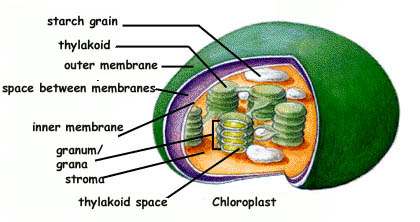
4 Their critical role in life support
The oxygen atmosphere that we depend on was generated by numerous cyanobacteria during the Archaean and Proterozoic Eras. Before that time, the atmosphere had a very different chemistry, unsuitable for life as we know it today.
They were responsible for the initial conversion of the earth's atmosphere from an anoxic state to an oxic state (that is, from a state without oxygen to a state with oxygen) during the period 2.7 to 2.2 billion years ago. Being the first to carry out oxygenic photosynthesis, they were able to produce oxygen while sequestering carbon dioxide in organic molecules, playing a major role in oxygenating the atmosphere.
Cyanobacteria also play a major role in the nitrogen cycle. They are able to convert atmospheric nitrogen into its organic form. All plants use organic nitrogen as a nutrient to promote growth. Without this source of nitrogen, the plants would die. Cyanobacteria are one of the few types of organisms that are able to make this conversion from atmospheric to organic nitrogen.
Sources: Several articles on cyanobacteria.
Thursday, 21 January 2010
Tiktaalik and the Tetrapods
The evolution of tetrapods (4-footed animals) has remained a mystery.
It is absolutely remarkable that evolutionists can even begin to think that fishes evolved into four-footed amphibians, but that is exactly what they think. To be fair, they do admit that the gaps are wide, but they have suddenly become wider.
First, here are a couple of quotes to show that they do admit that the gaps are wide:
“The relationship of limbed vertebrates (tetrapods) to lobe-finned fish (sarcopterygians) is well established,[yeah, Like the coelacanth?] but the origin of major tetrapod features has remained obscure for lack of fossils that document the sequence of evolutionary changes.”
(Edward B. Daeschler, Neil H. Shubin, and Farish A. Jenkins, “A Devonian tetrapod-like fish and the evolution of the tetrapod body plan,” Nature Vol 440: 757-763 (April 6, 2006))
"It has long been clear that limbed vertebrates (tetrapods) evolved from osteolepiform lobefinned fishes3, but until recently the morphological gap between the two groups remained frustratingly wide. The gap was bounded at the top by primitive Devonian tetrapods such as Ichthyostega and Acanthostega from Greenland, and at the bottom by Panderichthys, a tetrapod-like predatory fish from the latest Middle Devonian of Latvia (Fig. 1)."
(Jennifer A. Clack & Per Erik Ahlberg, "A firm step from water to land," Nature 440:747-749 (April 6, 2006); emphasis added)
It is truly astonishing how presumably competent biologists can fool themselves.
There are so many simply gigantic problems involved in the supposed transition from fish to amphibian or reptile that are simply swept under the carpet, it leads one to wonder where these people got their qualifications.
The veriest child knows that any fish, like its goldfish,left out of water, will shortly die.
Its gills are designed to function in water, and simply cannot do so in the air. Therefore, whichever fish the evolutionist cares to choose as the fancied ancestor of amphibian or reptile had to overcome this basic problem first.
To put it simply, it is just plain stupid to think that could happen.
Every day thousands of fish caught by fishermen die in the air. That's thousands of experiments being carried out to show that no fish can survive out of water. NOT ONE SUCH FISH HAS SURVIVED FOR ANY LENGTH OF TIME. Ask any fisherman!
Here's an idiotic statement (typical of this kind of foolish thinking):
"Most scientists believe the amphibians evolved (developed gradually) from the lobe-finned fish. Lobe-finned fish had lungs and enlarged fins supported by bones and muscles. They could use their fins as legs to come out of the water for brief periods. These fins probably developed into amphibian legs.
http://www.worldbook.com/wb/Students?content_spotlight/dinosaurs/creatures_fish
Ever heard such nonsense?
The fish crept out on land for brief periods - and asphyxiated. The faster they asphyxiated, the faster they evolved! It's hard to credit the stupidity of that idea, but because it emerged from some university, it is supposed to be an intelligent concept. The most stupid fisherman could tell those professors that they're wrong, mad, or on mushrooms.
I don't know which. You must choose, dear reader.
But that's not the only problem!
Look at these diagrams of the skeleton of a fish and a tetrapod:

http://www.infovisual.info/02/034_en.html
Let's make the first point here.
Look at the 'pectoral fin' and the 'pelvic fin'.
Do you see that neither of them IS CONNECTED TO THE BACKBONE IN ANY WAY, either directly or indirectly?
OK. That's a typical bony fish.
Now here's the skeleton of a frog, a typical amphibian.

http://www.k-state.edu/organismic/images/frog_skeleton.jpg
See any differences? Yes, of course.
There are bones in the frog's forelimbs, AND THEY ARE CONNECTED TO THE scapula (shoulder blade) WHICH IS A PART OF THE AXIAL SKELETON as it's called.
There is NO connection between the fins of a fish and the axial skeleton.
QUESTION: How the connection ever made?
ANSWER: It wasn't.
Now look at the star performers in the Tetrapod Evolution Circus Parade.

Do you see any connection between these things and the fins of fish? Look back at the fins of the bony fish above, and decide for yourself.
Now suppose, and we'll use Tiktaalik as an example that this fish ever came out on to land. I said 'fish' because that's what the discoverers called it. Here's wiki on the subject:
Tiktaalik is a genus of extinct sarcopterygian (lobe-finned) fish
Give the artists half a chance, and they'd have Tiktaalik flying! Here's a picture of one - just before it dashed back into the water before it dried out! Or is it dead because it dried out?
What reason does it have for being there anyway? After all, its food is in the water and has been for millions of years. Or has it just decided to take a walk to stretch its non-existent legs?

Just listen to Shubin (guess what, he was one of the discoverers of Tikaalik, and is busy hyping it up, with no evidence at all beside his overheated imagination) "It probably had lungs as well as gills, and it had overlapping ribs that could be used to support the body against gravity, Shubin said.
Did you get that? This creature (which, Clack, one of the other discoverers said was more like a fish than anything else) PROBABLY HAD LUNGS AS WELL AS GILLS!
Now what was it doing with both - and most important of all WHY did it have them, and HOW DID IT GET THEM?
There's another serious point which is never mentioned. In most fishes, the pelvic fins are a lot SMALLER than the pectoral fins. In ALL TETRAPODS, the hind limbs are the biggest, usually by a long way. Think of a kangaroo, the most extreme example. How did that arrangement come about?
Marvellous.
But let's now apply the instinct test.
Here's a fish, breathing with gills. It has the instincts to do so.
Here's a creature breathing with lungs AND gills. Allegedly.
Quite apart from the stupidity of a fish evolving the physical structures of lungs - and they are TOTALLY DIFFERENT TO GILLS - which would have filled up with water, drowning the poor brute, where did it get the instincts from TO USE the lungs, if its ancestors had been doing quite well, thank you, with gills before that?
To use our famous little diagram again:
Fish F (using gills) ------ X ------> Tiktaalik (using gills AND LUNGS)
What happened at X?
Tiktaalik was considered to be one of the ancestors of tetrapods, with much blowing of trumpets and evolutionist chortling.
Alas, alas! Woe is them, they are undone!
This very month (Jan 2010) an article was published in Nature which caused one of the editors (Henry Gee) to write this:
The best discoveries are those that overturn current thinking, revealing that what we thought, only yesterday, to have been a coherent and complete picture, is in fact a void that no discoveries can yet fill. Such is the report in tomorrow’s Nature (Niedźwiedzki et al., 463, 43-48, 7 January 2010) of footprints left by tetrapods (four legged land vertebrates) eighteen million years older than the earliest known tetrapod fossils, and ten million years older than the fossils of the creatures thought to be the closest relatives of tetrapods. A fairly complete picture of tetrapod evolution, built up over the past twenty years, has been replaced by a blank canvas overnight.
In other words, it's "Back to the drawing board, fellow evolutionist guessers! It was all wrong, dammit!"
You really must read the article. It's here: http://network.nature.com/people/henrygee/blog/2010/01/05/first-footing
But this tetrapod thing was a major plank in the support for evolution, with new 'transitional fossils' being found at a rate of knots every day!
So what's going to happen next month? Where are you going to run, dear evolutionists, if another major plank is blasted next month?
And they will be. Just you wait and see.
NEW! HOT OFF THE PRESS!!
“HOW DOES INSTINCT EVOLVE”
OR
Evolution's Soft Underbelly
by Asyncritus
AT LAST!
The Argument Darwin Dreaded…
The Argument No-One Has Developed Before…
The Argument to Which There Is
NO ANSWER FROM THE EVOLUTIONISTS!
Nearly 50,000 viewers of my articles can’t all be wrong. Check Google for this subject and see!
http://www.thenakedscientists.com/forum/index.php?board=17.30
Go here for your copy. £4.95
It is absolutely remarkable that evolutionists can even begin to think that fishes evolved into four-footed amphibians, but that is exactly what they think. To be fair, they do admit that the gaps are wide, but they have suddenly become wider.
First, here are a couple of quotes to show that they do admit that the gaps are wide:
“The relationship of limbed vertebrates (tetrapods) to lobe-finned fish (sarcopterygians) is well established,[yeah, Like the coelacanth?] but the origin of major tetrapod features has remained obscure for lack of fossils that document the sequence of evolutionary changes.”
(Edward B. Daeschler, Neil H. Shubin, and Farish A. Jenkins, “A Devonian tetrapod-like fish and the evolution of the tetrapod body plan,” Nature Vol 440: 757-763 (April 6, 2006))
"It has long been clear that limbed vertebrates (tetrapods) evolved from osteolepiform lobefinned fishes3, but until recently the morphological gap between the two groups remained frustratingly wide. The gap was bounded at the top by primitive Devonian tetrapods such as Ichthyostega and Acanthostega from Greenland, and at the bottom by Panderichthys, a tetrapod-like predatory fish from the latest Middle Devonian of Latvia (Fig. 1)."
(Jennifer A. Clack & Per Erik Ahlberg, "A firm step from water to land," Nature 440:747-749 (April 6, 2006); emphasis added)
It is truly astonishing how presumably competent biologists can fool themselves.
There are so many simply gigantic problems involved in the supposed transition from fish to amphibian or reptile that are simply swept under the carpet, it leads one to wonder where these people got their qualifications.
The veriest child knows that any fish, like its goldfish,left out of water, will shortly die.
Its gills are designed to function in water, and simply cannot do so in the air. Therefore, whichever fish the evolutionist cares to choose as the fancied ancestor of amphibian or reptile had to overcome this basic problem first.
To put it simply, it is just plain stupid to think that could happen.
Every day thousands of fish caught by fishermen die in the air. That's thousands of experiments being carried out to show that no fish can survive out of water. NOT ONE SUCH FISH HAS SURVIVED FOR ANY LENGTH OF TIME. Ask any fisherman!
Here's an idiotic statement (typical of this kind of foolish thinking):
"Most scientists believe the amphibians evolved (developed gradually) from the lobe-finned fish. Lobe-finned fish had lungs and enlarged fins supported by bones and muscles. They could use their fins as legs to come out of the water for brief periods. These fins probably developed into amphibian legs.
http://www.worldbook.com/wb/Students?content_spotlight/dinosaurs/creatures_fish
Ever heard such nonsense?
The fish crept out on land for brief periods - and asphyxiated. The faster they asphyxiated, the faster they evolved! It's hard to credit the stupidity of that idea, but because it emerged from some university, it is supposed to be an intelligent concept. The most stupid fisherman could tell those professors that they're wrong, mad, or on mushrooms.
I don't know which. You must choose, dear reader.
But that's not the only problem!
Look at these diagrams of the skeleton of a fish and a tetrapod:

http://www.infovisual.info/02/034_en.html
Let's make the first point here.
Look at the 'pectoral fin' and the 'pelvic fin'.
Do you see that neither of them IS CONNECTED TO THE BACKBONE IN ANY WAY, either directly or indirectly?
OK. That's a typical bony fish.
Now here's the skeleton of a frog, a typical amphibian.

http://www.k-state.edu/organismic/images/frog_skeleton.jpg
See any differences? Yes, of course.
There are bones in the frog's forelimbs, AND THEY ARE CONNECTED TO THE scapula (shoulder blade) WHICH IS A PART OF THE AXIAL SKELETON as it's called.
There is NO connection between the fins of a fish and the axial skeleton.
QUESTION: How the connection ever made?
ANSWER: It wasn't.
Now look at the star performers in the Tetrapod Evolution Circus Parade.
Do you see any connection between these things and the fins of fish? Look back at the fins of the bony fish above, and decide for yourself.
Now suppose, and we'll use Tiktaalik as an example that this fish ever came out on to land. I said 'fish' because that's what the discoverers called it. Here's wiki on the subject:
Tiktaalik is a genus of extinct sarcopterygian (lobe-finned) fish
Give the artists half a chance, and they'd have Tiktaalik flying! Here's a picture of one - just before it dashed back into the water before it dried out! Or is it dead because it dried out?
What reason does it have for being there anyway? After all, its food is in the water and has been for millions of years. Or has it just decided to take a walk to stretch its non-existent legs?

Just listen to Shubin (guess what, he was one of the discoverers of Tikaalik, and is busy hyping it up, with no evidence at all beside his overheated imagination) "It probably had lungs as well as gills, and it had overlapping ribs that could be used to support the body against gravity, Shubin said.
Did you get that? This creature (which, Clack, one of the other discoverers said was more like a fish than anything else) PROBABLY HAD LUNGS AS WELL AS GILLS!
Now what was it doing with both - and most important of all WHY did it have them, and HOW DID IT GET THEM?
There's another serious point which is never mentioned. In most fishes, the pelvic fins are a lot SMALLER than the pectoral fins. In ALL TETRAPODS, the hind limbs are the biggest, usually by a long way. Think of a kangaroo, the most extreme example. How did that arrangement come about?
Marvellous.
But let's now apply the instinct test.
Here's a fish, breathing with gills. It has the instincts to do so.
Here's a creature breathing with lungs AND gills. Allegedly.
Quite apart from the stupidity of a fish evolving the physical structures of lungs - and they are TOTALLY DIFFERENT TO GILLS - which would have filled up with water, drowning the poor brute, where did it get the instincts from TO USE the lungs, if its ancestors had been doing quite well, thank you, with gills before that?
To use our famous little diagram again:
Fish F (using gills) ------ X ------> Tiktaalik (using gills AND LUNGS)
What happened at X?
Tiktaalik was considered to be one of the ancestors of tetrapods, with much blowing of trumpets and evolutionist chortling.
Alas, alas! Woe is them, they are undone!
This very month (Jan 2010) an article was published in Nature which caused one of the editors (Henry Gee) to write this:
The best discoveries are those that overturn current thinking, revealing that what we thought, only yesterday, to have been a coherent and complete picture, is in fact a void that no discoveries can yet fill. Such is the report in tomorrow’s Nature (Niedźwiedzki et al., 463, 43-48, 7 January 2010) of footprints left by tetrapods (four legged land vertebrates) eighteen million years older than the earliest known tetrapod fossils, and ten million years older than the fossils of the creatures thought to be the closest relatives of tetrapods. A fairly complete picture of tetrapod evolution, built up over the past twenty years, has been replaced by a blank canvas overnight.
In other words, it's "Back to the drawing board, fellow evolutionist guessers! It was all wrong, dammit!"
You really must read the article. It's here: http://network.nature.com/people/henrygee/blog/2010/01/05/first-footing
But this tetrapod thing was a major plank in the support for evolution, with new 'transitional fossils' being found at a rate of knots every day!
So what's going to happen next month? Where are you going to run, dear evolutionists, if another major plank is blasted next month?
And they will be. Just you wait and see.
NEW! HOT OFF THE PRESS!!
“HOW DOES INSTINCT EVOLVE”
OR
Evolution's Soft Underbelly
by Asyncritus
AT LAST!
The Argument Darwin Dreaded…
The Argument No-One Has Developed Before…
The Argument to Which There Is
NO ANSWER FROM THE EVOLUTIONISTS!
Nearly 50,000 viewers of my articles can’t all be wrong. Check Google for this subject and see!
http://www.thenakedscientists.com/forum/index.php?board=17.30
Go here for your copy. £4.95
Subscribe to:
Posts (Atom)