Sunday, 24 January 2010

The Cyanobacteria: Evolution's Ignored Nightmare

INTRODUCTION

THE NITROGEN CYCLE

I am, and have long been, impressed with the great cycles in nature.

We see, inter alia, the carbon dioxide cycle, the oxygen cycle, the rain cycle and the nitrogen cycle.

Of these four, the nitrogen cycle has been of the greatest interest to me, because of its colossal importance to the survival of agriculture in all its forms.

We are faced with a tremendous problem, because nitrogen is one of the least reactive gases known, excepting only the rare gases of group 8 in the periodic table, such as helium. It just doesn't combine with anything under ordinary conditions.

The problem arises, of course, because nitrogen is an essential constituent of proteins and other substances, all needed for life to survive. No nitrogen: no proteins, no enzymes, no life. (By the way, when I say 'essential' I mean that survival is impossible without it.)

So how does nitrogen become available to living organisms? How could it?

The Almighty, as usual, has the answer that works perfectly.

Nitrogen becomes available in 3 ways:

1 Lightning discharges, at 30,000 deg C, force the combination of nitrogen and oxygen, to produce nitrogen dioxide, which dissolves in rain water to form nitric and nitrous acids, which then combine with compounds in the soil to produce nitrates and nitrites - which are utilisable by plants. So that's number one.

2 In the root nodules of leguminous plants, the bacterium Rhizobium leguminosarum has a symbiotic relationship with the plant. It 'fixes' atmospheric nitrogen, making it available to the plant, and in return, the plant provides the bacterium with salts etc for its survival. Curiously, haemoglobin is formed in the nodules too. It's role is not yet known with certainty, but researchers agree that it must have a function there.

Which, of course, drips another drop of poison into the evolutionist's already bitter cup: what on earth is haemoglobin doing in such a place? How does evolutionary biochemistry account for its existence? Well, easy. It can't. So nuts to evolutionary biochemistry.

3 By far, the greatest contribution to nitrogen fixation comes from the cyanobacteria. These bacteria have 'evolved (ho ho!)' the ability to take nitrogen from the air, [I wonder how they figured that little trick out???] convert it into their cellular material, and on dying, decompose and make nitrogen available to the soil. Without them, life would surely perish.

Just as an aside, it wasn't until 1918 that Haber and Bosch received  nobel prizes for inventing the process which took nitrogen from the air to make ammonia, using catalysts and very high temperatures. That's how difficult it is to do industrially. Yet, here were these little bacteria doing it for the last n billion years. At ambient temperature, give or take diurnal variation!!! So who deserves that Nobel Prize?

So in the beginning, not only was lack of oxygen a gigantic problem, but the lack of nitrogen was no less so. In order for the anaerobic organisms, whatever they might have been, to generate oxygen in quantity, they simply HAD to have nitrogen in their tissues (as enzymes etc). With nitrogen as unreactive as it is, then how did they fix it? The advanced nitrogen fixers hadn't 'evolved' yet.

So yet another evolutionary brick wall stares us in the face.


The Cyanobacteria - Evolution's Ignored nightmare
Section 1

I had not realised just how titanic a problem the cyanobacteria present to the theory of evolution. It is obvious that the Creator knew what was required for the continuance and maintenance of His Creation, and took all reasonable steps,requiring stupendous intelligence to make sure the Creation got what it needs now, and needed then.

Here is the story of those marvellous little organisms, the Cyanobacteria. Present from the beginning, and exactly the same today as they were then, they furnish us with absolute proof that evolution simply does not work. It doesn’t explain their origin, it hasn’t got the time available for them to originate by the chance combination of nucleotides or whatever, and it cannot explain their stability of design.

Apart from viruses and phages, they are the ‘simplest’ organisms known. And yet, despite their early origin, they possess those most complex substances, DNA, RNA, proteins and most impossible of all for evolution to explain, nitrogenase and chlorophyll. Where did all this complexity come from so early on? The quotes show that they appeared fully formed, and highly complex 3.3 to 3.5 BILLION years ago. The oldest rocks are only 3.8 billion years old – so there isn’t a gap there big enough to allow an evolutionary rat to squeeze through.

Creation is the only explanation of these facts.

Look at this description from JSTOR, which shows the complexity of the organisms.

“Prokaryotic genomes are considered to be ‘wall-to-wall’ genomes, which consist largely of genes for proteins and structural RNAs, with only a small fraction of the genomic DNA allotted to intergenic regions, which are thought to typically contain regulatory signals.” http://nar.oxfordjournals.org/cgi/co...ull/30/19/4264


Section 2

1 Their Extreme Age

"One of the earliest types of bacteria were the cyanobacteria. Fossil evidence indicates that bacteria shaped like these existed approximately 3.3 billion years ago and were the first oxygen-producing evolving phototropic organisms..."

They have the distinction of being the oldest known fossils, more than 3.5 billion years old, in fact! It may surprise you then to know that the cyanobacteria are still around; they are one of the largest and most important groups of bacteria on earth.

The oldest known fossils are cyanobacteria from Archaean rocks of western Australia, dated 3.5 billion years old. This may be somewhat surprising, since the oldest rocks are only a little older: 3.8 billion years old.

2 Their absolute perfection

Cyanobacteria are among the easiest microfossils to recognize. Morphologies in the group have remained much the same for billions of years, and they may leave chemical fossils behind as well, in the form of breakdown products from pigments.

They photosynthesize like all other autotrophic bacteria and are just as efficient.


3 Their Complexity

The cyanobacteria are PROKARYOTES, not eukaryotes like the algae.

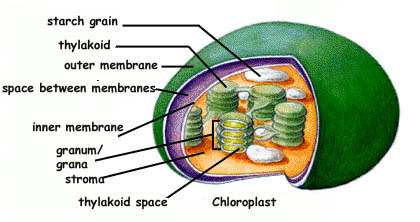
They contain chlorophyll, enclosed in chloroplasts.

Although they are truly prokaryotic, cyanobacteria have an elaborate and highly organized system of internal membranes which function in photosynthesis. Chlorophyll a and several accessory pigments (phycoerythrin and phycocyanin) are embedded in these photosynthetic lamellae, the analogs of the eukaryotic thylakoid membranes. The photosynthetic pigments impart a rainbow of possible colors: yellow, red, violet, green, deep blue and blue-green cyanobacteria are known.

Here's a diagram of a chloroplast:


4 Their critical role in life support

The oxygen atmosphere that we depend on was generated by numerous cyanobacteria during the Archaean and Proterozoic Eras. Before that time, the atmosphere had a very different chemistry, unsuitable for life as we know it today.

They were responsible for the initial conversion of the earth's atmosphere from an anoxic state to an oxic state (that is, from a state without oxygen to a state with oxygen) during the period 2.7 to 2.2 billion years ago. Being the first to carry out oxygenic photosynthesis, they were able to produce oxygen while sequestering carbon dioxide in organic molecules, playing a major role in oxygenating the atmosphere.

Cyanobacteria also play a major role in the nitrogen cycle. They are able to convert atmospheric nitrogen into its organic form. All plants use organic nitrogen as a nutrient to promote growth. Without this source of nitrogen, the plants would die. Cyanobacteria are one of the few types of organisms that are able to make this conversion from atmospheric to organic nitrogen.

Sources: Several articles on cyanobacteria.

Thursday, 21 January 2010

Tiktaalik and the Tetrapods

The evolution of tetrapods (4-footed animals) has remained a mystery.

It is absolutely remarkable that evolutionists can even begin to think that fishes evolved into four-footed amphibians, but that is exactly what they think. To be fair, they do admit that the gaps are wide, but they have suddenly become wider.

First, here are a couple of quotes to show that they do admit that the gaps are wide:

“The relationship of limbed vertebrates (tetrapods) to lobe-finned fish (sarcopterygians) is well established,[yeah, Like the coelacanth?] but the origin of major tetrapod features has remained obscure for lack of fossils that document the sequence of evolutionary changes.”

(Edward B. Daeschler, Neil H. Shubin, and Farish A. Jenkins, “A Devonian tetrapod-like fish and the evolution of the tetrapod body plan,” Nature Vol 440: 757-763 (April 6, 2006))


"It has long been clear that limbed vertebrates (tetrapods) evolved from osteolepiform lobefinned fishes3, but until recently the morphological gap between the two groups remained frustratingly wide. The gap was bounded at the top by primitive Devonian tetrapods such as Ichthyostega and Acanthostega from Greenland, and at the bottom by Panderichthys, a tetrapod-like predatory fish from the latest Middle Devonian of Latvia (Fig. 1)."

(Jennifer A. Clack & Per Erik Ahlberg, "A firm step from water to land," Nature 440:747-749 (April 6, 2006); emphasis added)

It is truly astonishing how presumably competent biologists can fool themselves.

There are so many simply gigantic problems involved in the supposed transition from fish to amphibian or reptile that are simply swept under the carpet, it leads one to wonder where these people got their qualifications.

The veriest child knows that any fish, like its goldfish,left out of water, will shortly die.

Its gills are designed to function in water, and simply cannot do so in the air. Therefore, whichever fish the evolutionist cares to choose as the fancied ancestor of amphibian or reptile had to overcome this basic problem first.

To put it simply, it is just plain stupid to think that could happen.

Every day thousands of fish caught by fishermen die in the air. That's thousands of experiments being carried out to show that no fish can survive out of water. NOT ONE SUCH FISH HAS SURVIVED FOR ANY LENGTH OF TIME. Ask any fisherman!

Here's an idiotic statement (typical of this kind of foolish thinking):

"Most scientists believe the amphibians evolved (developed gradually) from the lobe-finned fish. Lobe-finned fish had lungs and enlarged fins supported by bones and muscles. They could use their fins as legs to come out of the water for brief periods. These fins probably developed into amphibian legs.
http://www.worldbook.com/wb/Students?content_spotlight/dinosaurs/creatures_fish

Ever heard such nonsense?

The fish crept out on land for brief periods - and asphyxiated. The faster they asphyxiated, the faster they evolved! It's hard to credit the stupidity of that idea, but because it emerged from some university, it is supposed to be an intelligent concept. The most stupid fisherman could tell those professors that they're wrong, mad, or on mushrooms.

I don't know which. You must choose, dear reader.

But that's not the only problem!

Look at these diagrams of the skeleton of a fish and a tetrapod:


http://www.infovisual.info/02/034_en.html

Let's make the first point here.

Look at the 'pectoral fin' and the 'pelvic fin'.

Do you see that neither of them IS CONNECTED TO THE BACKBONE IN ANY WAY, either directly or indirectly?

OK. That's a typical bony fish.

Now here's the skeleton of a frog, a typical amphibian.


http://www.k-state.edu/organismic/images/frog_skeleton.jpg

See any differences? Yes, of course.

There are bones in the frog's forelimbs, AND THEY ARE CONNECTED TO THE scapula (shoulder blade) WHICH IS A PART OF THE AXIAL SKELETON as it's called.

There is NO connection between the fins of a fish and the axial skeleton.

QUESTION: How the connection ever made?

ANSWER: It wasn't.

Now look at the star performers in the Tetrapod Evolution Circus Parade.


Do you see any connection between these things and the fins of fish? Look back at the fins of the bony fish above, and decide for yourself.

Now suppose, and we'll use Tiktaalik as an example that this fish ever came out on to land. I said 'fish' because that's what the discoverers called it. Here's wiki on the subject:

Tiktaalik is a genus of extinct sarcopterygian (lobe-finned) fish

Give the artists half a chance, and they'd have Tiktaalik flying! Here's a picture of one - just before it dashed back into the water before it dried out! Or is it dead because it dried out?

What reason does it have for being there anyway? After all, its food is in the water and has been for millions of years. Or has it just decided to take a walk to stretch its non-existent legs?


Just listen to Shubin (guess what, he was one of the discoverers of Tikaalik, and is busy hyping it up, with no evidence at all beside his overheated imagination) "It probably had lungs as well as gills, and it had overlapping ribs that could be used to support the body against gravity, Shubin said.

Did you get that? This creature (which, Clack, one of the other discoverers said was more like a fish than anything else) PROBABLY HAD LUNGS AS WELL AS GILLS!

Now what was it doing with both - and most important of all WHY did it have them, and HOW DID IT GET THEM?

There's another serious point which is never mentioned. In most fishes, the pelvic fins are a lot SMALLER than the pectoral fins. In ALL TETRAPODS, the hind limbs are the biggest, usually by a long way. Think of a kangaroo, the most extreme example. How did that arrangement come about?

Marvellous.

But let's now apply the instinct test.

Here's a fish, breathing with gills. It has the instincts to do so.

Here's a creature breathing with lungs AND gills. Allegedly.

Quite apart from the stupidity of a fish evolving the physical structures of lungs - and they are TOTALLY DIFFERENT TO GILLS - which would have filled up with water, drowning the poor brute, where did it get the instincts from TO USE the lungs, if its ancestors had been doing quite well, thank you, with gills before that?

To use our famous little diagram again:

Fish F (using gills) ------ X ------> Tiktaalik (using gills AND LUNGS)

What happened at X?

Tiktaalik was considered to be one of the ancestors of tetrapods, with much blowing of trumpets and evolutionist chortling.

Alas, alas! Woe is them, they are undone!

This very month (Jan 2010) an article was published in Nature which caused one of the editors (Henry Gee) to write this:

The best discoveries are those that overturn current thinking, revealing that what we thought, only yesterday, to have been a coherent and complete picture, is in fact a void that no discoveries can yet fill. Such is the report in tomorrow’s Nature (Niedźwiedzki et al., 463, 43-48, 7 January 2010) of footprints left by tetrapods (four legged land vertebrates) eighteen million years older than the earliest known tetrapod fossils, and ten million years older than the fossils of the creatures thought to be the closest relatives of tetrapods. A fairly complete picture of tetrapod evolution, built up over the past twenty years, has been replaced by a blank canvas overnight.

In other words, it's "Back to the drawing board, fellow evolutionist guessers! It was all wrong, dammit!"

You really must read the article. It's here: http://network.nature.com/people/henrygee/blog/2010/01/05/first-footing

But this tetrapod thing was a major plank in the support for evolution, with new 'transitional fossils' being found at a rate of knots every day!

So what's going to happen next month? Where are you going to run, dear evolutionists, if another major plank is blasted next month?

And they will be. Just you wait and see.


NEW! HOT OFF THE PRESS!!


“HOW DOES INSTINCT EVOLVE”

OR

Evolution's Soft Underbelly
by Asyncritus


AT LAST!

The Argument Darwin Dreaded…
The Argument No-One Has Developed Before…
The Argument to Which There Is

NO ANSWER FROM THE EVOLUTIONISTS!


Nearly 50,000 viewers of my articles can’t all be wrong. Check Google for this subject and see!
http://www.thenakedscientists.com/forum/index.php?board=17.30

Go here for your copy. £4.95

MY NEW BOOK: HOW DOES INSTINCT EVOLVE


NEW! HOT OFF THE PRESS!!


“HOW DOES INSTINCT EVOLVE”

OR

Evolution's Soft Underbelly
by Asyncritus


AT LAST!

The Argument Darwin Dreaded…
The Argument No-One Has Developed Before…
The Argument to Which There Is

NO ANSWER FROM THE EVOLUTIONISTS!


Nearly 50,000 viewers of my articles can’t all be wrong. Check Google for this subject and see!
http://www.thenakedscientists.com/forum/index.php?board=17.30

140 pages of amazing facts and carefully reasoned arguments. Equip yourself! Give your children the knowledge to defend belief in Creation in class!

Get your copy here.


Published by phillauren.org

THE EVOLUTION OF FLIGHT

Perhaps I may be allowed a few words on this, the most fatal argument against evolution.

Imagine reptile X no feathers, no wings.

Imagine some mutation (systemic, enormous as per Goldschmidt) and lo and behold, we have the first bird, B -as I said, warmblooded, fully feathered, with wings instead of reptile forelimbs, one way lung circulation instead of bellows arrangement, etc etc.

One may well say, that is a creative act, just taken place, but we'll let that pass.

Diagrammatically:

X (reptile) ----Mutation --------> B (bird, with wings etc)

Now what does B do?

One of 2 things:

a. gets eaten by the parent reptile who thinks it's food

b. attempts to fly off into the distance

BUT IT DOES NOT KNOW HOW TO FLY!!!


As we all know, flight training is a complex affair. If we were to put an untrained person into the cockpit of a fighter aircraft, saying 'Get on with it', disaster is guaranteed.

In order to fly, that bird MUST HAVE THE INSTINCTS REQUIRED. Else disaster is guaranteed. Those instincts are complex, and built into every flying bird.

We know that because young fledglings are shoved out of their parents' nests - AND THEY FLY OR DIE.

So we now have 2 diagrams:

X ------- M-------> B (without flight instincts)---> death/extinction)

or

X----M-----I.I ---->B (with flight instincts) ---> gone to Hawaii.

I.I = instinct implantation.

There can be NO intermediate steps. The bird either knew how to fly, or it died. If we postulate a gliding intermediate, then that too requires training/instinct.

I'm sure you would think twice before leaping off the top of a high tree or cliff if you didn't KNOW how to hang-glide.

So the question before us is, who or what implanted that instinct, and how?

NEWS FLASH!


NEW! HOT OFF THE PRESS!!


“HOW DOES INSTINCT EVOLVE”

OR

Evolution's Soft Underbelly
by Asyncritus


AT LAST!

The Argument Darwin Dreaded…
The Argument No-One Has Developed Before…
The Argument to Which There Is

NO ANSWER FROM THE EVOLUTIONISTS!


35,000 viewers of my articles can’t all be wrong. Check Google for this subject and see!
http://www.thenakedscientists.com/forum/index.php?board=17.30

140 pages of amazing facts and carefully reasoned arguments. Equip yourself! Give your children the knowledge to defend belief in Creation in class!

Get your copy here.

Published by phillauren.org

THE BUCKET ORCHID


THE BUCKET ORCHID

Darwin in his book 'On the pollination and fertilisation of Orchids' included a description of the pollination of the Bucket Orchid, Coryanthes speciosa.

He was so surprised on receiving the description that until he checked and found that it was a respectable botanist who had made the report, he would not credit it.

The BBC have filmed it happening, and the film is probably available from them.

The orchid's labellum is shaped as a bucket, and above the bucket, on another petal, is a gland which secretes a liquid, probably water, which drips into the bucket and accumulates in it.
There are some photos here:
http://blogs.salon.com/0001330/categ...006/06/29.html

The bucket possesses three remarkable features.

1 Cut into the outer side of the bucket, away from the main flower structure, is a slit, which functions as an overflow: so when the liquid reaches a level about half a centimetre BELOW the upper edge of the bucket, it overflows, so at no time is it ever full to the brim.

2 On the opposite side, inside the bucket, and below the level of the liquid, is what looks for all the world like a little step.

3 The outer lip of the bucket is made of some material which is intensely attractive to the blue euglossine male bee.

The bees come and struggle to get at the lip of the bucket, and of course, in the struggles one falls in sooner or later.

Because the walls of the bucket are smooth, he cannot get a grip EXCEPT at the point where there is the aforementioned step. Wet and bedraggled, he climbs on to the step and out, right into the heart of the flower.

As he enters the tube formed by the other petals, he is suddenly clamped and held for a few moments, unable to move or escape, and on to his back, the anthers are pressed.


On the anthers, there is a glue, which takes exactly the same amount of time to dry, as he is held motionless. It dries, he buzzes off, and goes to another flower where the process is repeated - and so the pollen from the anthers reaches the stigma, thus fertilising the orchid.

Darwin also noted that a phenomenon known as pollinarium bending occurred. The term refers to the manner in which orchid pollinaria start to bend after an 18- to 20-second interval after attaching to a visiting insect. The bending mechanism prevents self-pollination of the orchid.

It so happens that only one species of bee comes to a particular species of Coryanthes.

The probability of these features coming together by chance is astronomically small.

1 The structure of the labellum as a bucket is remarkable in itself

2 The gland above is obviously placed there to produce the liquid for the bucket. Imagine it producing liquid with no bucket there, or a bucket there with no liquid coming!

3 The overflow is there for the designed purpose of preventing the liquid from flowing out, over the top of the bucket. If it could flow over the top, the bee, when he fell in, could simply float out over the edge, and thus defeat the purpose of the exercise.

4 The little step, contrived and placed there for the express purpose of preventing the bee drowning, also forces him to enter the heart of the flower.

5 The flower has a designed clamping action, with a timer built in, exactly matched to the drying time of the glue on the anthers.

6 The anthers stick to his back, and do not impede his flight to another plant after he has dried off.

7 The stigma of the flower is positioned on the top petal of the flower, to make sure that it is in the correct position to receive the pollen when the bee arrives. If it was on the underside of the flower, then it would never receive any pollen.

We won't go into the complexities of anther construction until the post on mitosis and meiosis are completed.

8 The glue on the anthers is exactly right for the purpose, and its chemical composition known, and the manufaturing technique as well.

Having read all that, it is no wonder that Darwin staggered at the description. He said that the orchids employed a 'beautiful contrivance' to avoid self pollination.

The question of how all this evolved clearly didn't arise in his mind, or else he pushed it to the back of it. But who contrived the contrivance?

Explanations?

NEWS FLASH!


NEW! HOT OFF THE PRESS!!


“HOW DOES INSTINCT EVOLVE”

OR

Evolution's Soft Underbelly
by Asyncritus


AT LAST!

The Argument Darwin Dreaded…
The Argument No-One Has Developed Before…
The Argument to Which There Is

NO ANSWER FROM THE EVOLUTIONISTS!


35,000 viewers of my articles (update 15th June 2010: nearly 50,000 views!!!) can’t all be wrong. Check Google for this subject and see!
http://www.thenakedscientists.com/forum/index.php?board=17.30

100 pages of amazing facts and carefully reasoned arguments. Equip yourself! Give your children the knowledge to defend belief in Creation in class!

Get your copy here.

Published by phillauren.org

THE FIG WASP

THE FIG WASP

I've put up some amazing things, but this is certainly one of the highest ranking. Judge for yourself.

The fig tree has a tightly closed inflorescence, which means that the hundreds of tiny flowers (florets to give them their proper name) are completely inclosed inside the fig. They can't be seen from the outside.


Each species of fig seems to be pollinated by only ONE species of wasp! There are about 730 species of fig so that would seem to require 730 species of wasp- but not all of these are known as yet.

How do the insects find the flowers?

When the tree is ready for pollination, it releases tree-specific volatile substances which the wasp tracks down to their source. Lo and behold, there's the flower, or the inflorescence, rather.

So the female finds the inflorescence. Thousands die in the search process though, because it's a big world out there.

How do they get in?

When she finds it, there is another big hurdle to cross. The entrance to the inflorescence (called the ostiole) is extremely small, and lined with bracts, which are placed there to keep out the unwanted. They fit tightly, and that makes life very difficult for the unwanted, but no less so for the wasp, to get in.

She, however, has been explicitly designed for this very task.

Her head and thorax (chest) are extremely flattened and elongated: just the job for squeezing past the bracts! ('Remarkably adapted' is the description. Ho ho ho!) Her 'teeth', on her mandibular apparatus, point backwards, and she's got teeth on her hind legs, also pointing backwards. They do so in order to prevent her from slipping out!


Her wings very often break off in the struggle to get in - so once in there, there's no way back.

Once inside, she sets about, in complete or nearly complete darkness, to pollinate the stigmas, and to lay eggs in some of the ovules. She distinguishes between those ovules which are going to become seeds, and those which are not.

Those ovules whose styles are too long for her ovipositor to reach the ovule, she simply pollinates.

Those ovules her ovipositor can reach, she leaves unpollinated, so they will only contain her larvae.

This makes certain that the plant will survive, and that her larvae will have food to eat.

What happens then? She dies. Her young never see her alive, and can't copy her actions - but they do exactly the same as she did.

As the eggs develop and hatch out into larvae, the eat the endosperm of the ovules they have been laid in, and they grow into adulthood.

The males mate with the females, and amazingly, chew a hole in the wall of the maturing or matured fig SO THAT THE FEMALES CAN GET OUT.

Then they die.


The females in the meantime, load up with pollen, or get covered in it, and then set off to find another flower inflorescence.

EVOLUTIONARY DIFFICULTIES

1 How do we explain the fact that the young never see the adult in action - and yet they do exactly the same as she does?

2 How do the males know that unless they dig a hole, the females won't get out, the plants won't get pollinated, and their own species will die out?

3 How is it that only the fig wasp pollinates the fig flowers? Without the wasp, as with the bucket orchid, the fig will die out, and without the fig, the wasp will die out?

4 How did the female 'develop' the elongated and flattened shape that enables her to get into the ostiole?

5 How is it thar her ovipositor length has become the determining factor in whether the ovules get pollinated or not? If it was too long, then no pollination would take place. If it was too short, then the eggs would not be laid. So who or what determined that length?

6 How did this relationship, as specific and complicated as it is, ever get started?

7 Where did the plant get the necessary chemical knowledge to produce the volatile substances which attract the wasps, and how did it know that it would attract them anyway?

8 Where did the insects get the brain to figure out that if they followed the scent, they would find a fig they could pollinate?

It happens, that once the fig is pollinated, and the females have left the fig, its colour and smell change, and it becomes attractive to the fruit eating community like birds, bats, monkeys etc etc.

Does God take thought for wasps? And figs? And birds? And monkeys? Obviously, He does!

Here's another account: http://figs4fun.com/Links/FigLink006a.pdf

The common fig is a member of the genus Ficus. Ficus is a large genus with some 2000 tropical and subtropical tree, shrub and vine species distributed around the whole world.

The fruit of all ficus species isthe syconium, an enlarged, fleshy and hollow peduncle bearing closely massed tiny flowers on its inner wall. The true fruits are tiny drupelets which develop from these flowers.

The problem is these flowers are borne on the inside of the syconium. They never open to the outside world like respectable roses, cabbages and oak trees.

How do they get pollinated?

That's their weird sex life. Hold on for this is complicated.

F. carica and some closely related species come in two basic forms: edible figs and caprifigs. Caprifigs are the host of the fig pollinator Blastophages psenes or fig wasp which lays its eggs in the caprifig's short-styled female flowers.

The male fig wasp grows, mates and dies inside the caprifig fruit in which he is born. The female is more adventuresome.

She leaves the caprifig fruit through its ostiole or eye (picking up a lot of pollen in the process) and flies off in search of a new fruit at the right stage of development in which to lay her eggs.

The kicker is this: female fig wasps lay so many eggs in each caprifig fruit that very few, if any, of the female flowers ever produce seeds. Not good for ficus species survival.

Evolution (or God, if you prefer) provided a solution: the edible fig.

The plant and fruit look just like those of the caprifig, but have two important differences: no male flowers, and the female flowers have long styles which prevent the fig wasp from laying her eggs.

If she enters the fruit of an edible fig, she searches desperately for, but finds no suitable female flowers. As she does, she scatters the pollen she picked up leaving the caprifig. And, this pollenizes (or caprifies) the edible fig. When caprified, each fruit will produce several hundred to several thousand seeds per fruit, depending on the variety.

Not so great for the individual fig wasp, but good for the ficus species. Overall, the situation benefits both figs and fig wasps. There are plenty of caprifigs to nourish the fig wasps and plenty of edible figs to produce fig seeds which develop into fig and caprifig plants.

NEWS FLASH!


NEW! HOT OFF THE PRESS!!


“HOW DOES INSTINCT EVOLVE”

OR

Evolution's Soft Underbelly
by Asyncritus


AT LAST!

The Argument Darwin Dreaded…
The Argument No-One Has Developed Before…
The Argument to Which There Is

NO ANSWER FROM THE EVOLUTIONISTS!


35,000 viewers of my articles can’t all be wrong. Check Google for this subject and see!
http://www.thenakedscientists.com/forum/index.php?board=17.30

100 pages of amazing facts and carefully reasoned arguments. Equip yourself! Give your children the knowledge to defend belief in Creation in class!

Get your copy here. Only $19.97 as pdf.
$27 plus $5 p&p in CDR format.


CDR Version


Published by phillauren.org

THE MIRACLE OF ILLOGIC

THE MIRACLE OF ILLOGIC


NEWS FLASH!


NEW! HOT OFF THE PRESS!!


“HOW DOES INSTINCT EVOLVE”

OR

Evolution's Soft Underbelly
by Asyncritus


AT LAST!

The Argument Darwin Dreaded…
The Argument No-One Has Developed Before…
The Argument to Which There Is

NO ANSWER FROM THE EVOLUTIONISTS!


35,000 viewers of my articles can’t all be wrong. Check Google for this subject and see!
http://www.thenakedscientists.com/forum/index.php?board=17.30

100 pages of amazing facts and carefully reasoned arguments. Equip yourself! Give your children the knowledge to defend belief in Creation in class!

Get your copy here. Only $19.97 as pdf.
$27 plus $5 p&p in CDR format.


CDR Version


Published by phillauren.org


I am always amazed when I hear of some anthropologist finding a crude, brutishly made, blunt, prehistoric stone axe. Because, immediately, they leap upon it, with great cries of triumphant glee, crowing happily that our ancestors made it, and it was xyzanthropus wot did it n thousand years ago.

The product of human intelligence they cry! See, hominids made it. Or something else did. And look how advanced it is! Why, there's a slot here for the haft of the axe to fit in! And some indentations where the binding was attached to hold the device together. And look! There's a few skulls nearby with marks of an axe indented into them! That proves that xyzanthropus used tools as weapons! A tool maker, and a weapons maker! A mark of extremely advanced stages of human evolution!

Little realising that this is really a ton of garbage.

That blunt, crude stone axe is mark of human intelligence of very high order for the time, they say.

But then, the same evolutionary palaeontologist finds a fossilised flight feather. Or some tissue with DNA in it.

That flight feather, or fossil thereof, shows considerable amounts of aeronautical engineering skill, enabling us to know that the bird could and did fly. It is clearly designed for the purpose.

In the DNA are millions of coded, precisely detailed instructions, for the construction of that feather, far surpassing anything even modern Homo sapiens can construct.

And yet, they cannot see that that feather, and that DNA could not possibly have evolved. Nobody in their right senses would claim that the stone axe evolved. But they claim the feather and the DNA did.

It takes a Miracle of Illogic to make that leap.