Friday, 23 October 2009

The Bats; flight and echolocation

There are 3 groups of flying animals in existence today: the birds, the bats and the insects. Each of these presents evolution with insuperable problems, but my especial favourite is the bat.

It’s a shame they have had such bad press with such films as Dracula etc, because these creatures possess some of the most stupendous and miraculous pieces of biological engineering on the planet. For those who are convinced that evolution did occur, this will make not the slightest difference. For those who believe otherwise, this will be another club to beat their heads with.

Remember, the title of Darwin’s book was ‘On the Origin of Species’. That was what he set out to do, and it is what he singularly failed to achieve. It is on the origin question where he and his theory have failed most lamentably.

Fossil bats

There aren’t all that many of them, that’s for sure, and that may have something to do with the fact that they are flying animals. But what IS remarkable, is that the very first fossil bat looks remarkably like the bats of today: and has the echo-location apparatus in its head.
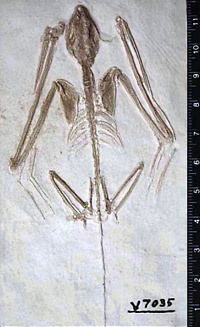


The author says: ‘These fossils represent essentially modern-looking microchiropterans; bats had evolved all of their characteristic features and begun to diversify by this time. In fact, the oldest known complete fossil bat, the Eocene-age Icaronycteris shown at left, shows specializations of the auditory region of the skull that suggest that this bat could echolocate.’

Remember, these are one of the earliest specimens of bat fossils ever found.

Therefore, they could fly. Now a bat does not fly using feathers, it flies using the skin between its fingers. That’s the origin of the name ‘chiropteran’ – hand-wing.

Here is a diagram to show what that means. Notice the vast difference between the bird’s wing and the bat’s:

http://www.nurseminerva.co.uk/adapt/wings.htm#bat


There is absolutely NO indication of any fossil ancestor of the bat, which hopped, jumped or leapt. There is absolutely NO indication of where and how they could have obtained the power of flight. None whatsoever. This, of course, is what the creation model predicts.

They fly at speeds of about 11.14 mph. In itself that doesn’t sound like much, but when we compare that with the body length of the animal, it is quite startling. It’s 234432 times its body length (say 3 inches) per hour, as compared with a car 20 ft long which at the same speed is only traveling 36000 times its length per hour.

Evolution is helpless to explain how this could have arisen so swiftly, so unexpectedly and so perfectly. Dawkins has laughably conceded that this gives the appearance of being designed, and then goes on to propound his pathetic fantasies about how this could have evolved. Have a look in Blind Watchmaker, (starting at page 22 where you'll find this:

The Sonar and Radar pioneers didn't know it then, but all the world
now knows that bats, or rather natural selection working on bats, had
perfected the system tens of millions of years earlier, and their 'radar'
achieves feats of detection and navigation that would strike an engineer
dumb with admiration.)
Pity they didn't strike Dawkins dumb with admiration, but one can't have everything!

Flight is one thing – marvelous as it is – but the echolocation system the animal uses beggars description.

In essence, the bat emits a squeak, which like radar, bounces back to the source. Knowing the speed of the radio wave emitted we can work out very accurately how far away an object is.

That’s us. The bats do this as well, but better than we can.

Let’s say that a bat is not moving, and emits a shriek. The sound wave travels to the insect it’s interested in, hits it, and bounces back. Let’s also say the insect is still. What happens then? We know the speed of sound and can calculate the distance to the object from the time it takes for the shriek to get there and reach back to us.

But the bat doesn’t know the speed of sound. So how can it calculate the distance of the insect? Evolution does not know.

Notice 2 things:

1 It has a sound emitter, and a sound receiver, and a computer connected to the two things which is able to calculate at phenomenal speeds, and immediately communicate those results to the muscles and nervous system.

But recall that both the bat and the insect were still.

That is not the case when the bat is hunting.

The bat is flying at up to 11 mph, and the insect is dodging and on an uncertain flight path. The calculations immediately begin to defy belief. Bear in mind too, that there are other bats emitting shrieks. How does our bat keep track of, and identify its own signal?

Answer, it possesses the necessary equipment. That equipment is of extraordinary high quality, as we’ve seen from the requirements.

From a computational neuroscience perspective, bats are remarkable because of the very short timescale on which they operate. The barrage of returning sonar echoes from a bat's near-environment lasts approximately 30 milliseconds following a sonar emission with the echo from a specific target lasting, at most, a few milliseconds.

From an engineering standpoint, biosonar systems (e.g. bats and dolphins) have inspired the design of very sophisticated sonar and radar systems that can map distant surfaces and track targets with great precision. Even with powerful mathematical tools and decades of experience, however, our best systems still do not rival the perceptual capabilities of dolphins. Many bats demonstrate incredible aerial agility, flying in complete darkness through branches and caves while hunting evasive insects. These animals perform such tasks in real-time with a total power consumption (including flight) measured in Watts, not hundreds of Watts. In addition to the ability to navigate in complete darkness by echolocation, both bats and dolphins live in very social environments using echolocation in group situations without any obvious problems with interference. All of these capabilities are highly desired by current military programs developing unmanned-aerial vehicles (UAV) especially since many of the target environments are in places where Global Positioning System (GPS) signals are unavailable and obstacle locations are not mapped.

It gets extremely technical, as we might guess, but the biggest points are very obvious.

Clearly, there is extremely high order design and implementation in this system. The military want to copy the design – which means that the bats’ system is superior to any of their own.

We have high order flight engineering and acoustic engineering allied to extreme efficiency of power consumption (measured in Watts, not hundreds of watts). And meanwhile, the animal is alive, growing, breathing, excreting, responding, moving, feeding, and reproducing. So successful is the group, that they are one of the most numerous sets of animals on the planet, as far as the numbers of species is concerned. They are estimated to be about 20% of all mammalian species.

There is not even a reputable theory to account for the evolutionary origin of bats that I have been able to find. The writers content themselves with mumbling about the as yet undiscovered ancestors of bats.Too soft, they say. But they've found birds, and jellyfish, and spiders and...

The instincts involved: flight and use of this incredible sonar system are mind boggling. Imagine putting an ignoramus in the cockpit of a modern jet fighter aircraft! Because the bat has a brain the size of a brazil nut, or less.

Evolution has failed miserably here, as usual when presented with a concrete case. The animals scream ‘We are designed’ and each little creature is a small hymn of praise to its Maker.

Thomas Addison said it well: “In reason’s ear, they all rejoice, and utter forth a glorious voice….. the Hand that made us is divine”.

Well said, Thomas.

REFERENCES

http://www.sciencedaily.com/releases/1998/10/981013075520.htm

Dawkins, Richard: The Blind Watchmaker
http://uath.org/download/literature/Richard.Dawkins.The.Blind.Watchmaker.pdf

http://neuroscience.brown.edu/simmons.html

NEW! HOT OFF THE PRESS!!

“HOW DOES INSTINCT EVOLVE”

OR

Evolution's Soft Underbelly
by Asyncritus


AT LAST!

The Argument Darwin Dreaded…
The Argument No-One Has Developed Before…
The Argument to Which There Is

NO ANSWER FROM THE EVOLUTIONISTS!


35,000 viewers of my articles can’t all be wrong. Check Google for this subject and see!
http://www.thenakedscientists.com/forum/index.php?board=17.30

100 pages of amazing facts and carefully reasoned arguments. Equip yourself! Give your children the knowledge to defend belief in Creation in class!

Get your copy here. Only $19.97 as pdf.
$27 plus $5 p&p in CDR format.


CDR Version


The Eumenes Wasp

THE EUMENES WASP

This wasp occurs in my country of origin, so I'm happy to be able to say that I can testify to the accuracy of some of this from what I personally saw. However the full details are taken from various authors, such as Henri Fabre, whose observations carry more weight.

After mating has ocurred, the female wasp begins the process of confounding evolutionists (and amazing me, when I saw it doing this).

She actually builds what looks like a hollow igloo made out of mud, and sticks it on a wall or the underside of a roof. The mud is made of her own spittle, dust, and small stones. It’s quite a structure, too: about 1 cm in diameter, and 1 cm deep.

At the top, she creates an opening, and curves the lip of the opening backwards, much like the lip of a round ornamental vase. She decorates the nest with shiny pebbles too!

She then catches and stings small green grubs.

Now hear this you unbelievers, and marvel with me. She stings them - but does not kill them, merely inducing partial paralysis. This keeps the game fresh and not putrefying. I wonder how many wasps take degrees in anaesthesiology!!

Somehow, the wasp knows what sex her offspring is going to be!!! If male, she catches fewer grubs, and if female she catches more. Here's J H Fabre describing the Ammophila wasp:
http://www.pdbooksonline.com/free_books/The_Wonders_Of_Instinct_by_J_H_Fabre/page_23.php

'But the egg is laid when the provisions are stored; and this egg has a determined sex, though the most minute examination is not able to discover the differences which will decide the hatching of a female or a male.

We are therefore needs driven to this strange conclusion: the mother knows beforehand the sex of the egg which she is about to lay; and this knowledge allows her to fill the larder according to the appetite of the future grub.

What a strange world, so wholly different from ours! We fall back upon a special sense to explain the hunting; what can we fall back upon to account for this intuition of the future? Can the theory of chances play a part in the hazy problem? If nothing is logically arranged with a foreseen object, how is this clear vision of the invisible acquired?'

Fabre asks a question it's impossible for evolution to answer.

But the wonders aren't over yet.

Where is the mother to lay her extremely fragile eggs? If she lays them in the mass of grubs, then they might squash it as they wriggle around.

Fabre says that he and his friends were astonished at the answer, and admits that he was unable to guess it. Before you read further, can you guess it?

The mother suspends the egg by a silken thread from the ceiling, out of reach of the grubs. When it hatches, it is suspended by its hindquarters, and can raise itself out of danger if a grub becomes too frisky.

She has also built an escape route for it, a protecting sheath that he failed to observe initially, because it was so well hidden.

Now wasps have a brain the size of a mustard seed. And yet, the mother is able to do all this - without having been taught - after all, she never sees her own mother, who dies after all the above is done.

How can she possibly

1 know how to make mud?

2 know how to build an igloo?

3 know which grubs to catch?

4 know how much venom to inject, and where to inject it so it paralyses, but doesn't kill?

5 And who thought up the idea of hanging the egg from the ceiling?

6 And how does a wasp learn how to manufacture a silk thread?

7 And how did all that get into the chromosomes?

The only answer is that the whole thing was carefully and competently designed.

And if it was designed, then there was a Designer.

REFERENCES

http://www.pdbooksonline.com/free_books/The_Wonders_Of_Instinct_by_J_H_Fabre/page_23.php

NEW! HOT OFF THE PRESS!!

“HOW DOES INSTINCT EVOLVE”

OR

Evolution's Soft Underbelly
by Asyncritus


AT LAST!

The Argument Darwin Dreaded…
The Argument No-One Has Developed Before…
The Argument to Which There Is

NO ANSWER FROM THE EVOLUTIONISTS!


35,000 viewers of my articles can’t all be wrong. Check Google for this subject and see!
http://www.thenakedscientists.com/forum/index.php?board=17.30

100 pages of amazing facts and carefully reasoned arguments. Equip yourself! Give your children the knowledge to defend belief in Creation in class!

Get your copy here. Only $19.97 as pdf.
$27 plus $5 p&p in CDR format.


CDR Version


The Yucca Moth

NEW! HOT OFF THE PRESS!!

“HOW DOES INSTINCT EVOLVE”

OR

Evolution's Soft Underbelly
by Asyncritus


AT LAST!

The Argument Darwin Dreaded…
The Argument No-One Has Developed Before…
The Argument to Which There Is

NO ANSWER FROM THE EVOLUTIONISTS!


35,000 viewers of my articles can’t all be wrong. Check Google for this subject and see!
http://www.thenakedscientists.com/forum/index.php?board=17.30

100 pages of amazing facts and carefully reasoned arguments. Equip yourself! Give your children the knowledge to defend belief in Creation in class!
Get your copy here. Only $19.97 as pdf.
$27 plus $5 p&p in CDR format.


CDR Version


If you look carefully, you will see her ovipositor entering the ovary


She is placing the pollen on the stigma


The moth is collecting the pollen

THE LIFE HISTORY OF THE YUCCA MOTH

The adult female moth emerges from the ground in June through July, at the time that the yucca plant is in flower (!!!), and mates shortly after emergence.

She collects the pollen of a yucca plant, using her specially shaped mouthparts, shaping it into a kind of horseshoe-shaped mass. She then flies to another inflorescence (on another plant.) There, she selects a flower, inserts her ovipositor through the wall of the carpel, and lays an egg next to the developing ovules.

She then climbs to the top of the style, and, using her specially shaped mouthparts, called maxillary tentacles (which are unique to the yucca moth), she actively transfers the pollen on to the top of the stylar canal. She repeats the process, several times, thus ensuring that the plant is adequately pollinated, and can produce seeds on which the survival of her young, and the plant, depends.

She then drops off the plant and dies.

The eggs hatch out into larvae after 7 -10 days, and they feed on the developing seeds, leaving one uneaten. After about 40 days, the 4th instar larvae eat their way out of the developing fruit, and drop to the ground using a silken thread. They then burrow their way into the soil, pupate after a year or so, and emerge as adults at the time of the flowering of the yucca plant.

The instinctive behaviours in this life history are nothing short of astounding.

Consider:

1 The young never see their mother or father, and therefore cannot copy what they did. They are born with the behaviour somehow programmed into their genes.

2 The female moth somehow knows that pollination of the flower is essential to the formation of the seeds, which are going to become the food for her offspring. She knows where the pollen needs to be placed in order to effect fertilisation.

3 Her mouthparts are shaped precisely to create the mass which is to fit into the stylar canal.

4 She somehow knows that the ovary contains the food her developing larvae will need to eat. If the plant is not pollinated, the seeds cannot develop.

5 The larvae, it has been observed, never eat all of the developing seeds, but always leave one or more to perpetuate the plant.

6 She ensures cross-pollination of the flowers, by flying from one plant to another after collecting the pollen.

7 The larvae, the grubs, pupate. That means, they dissolve entirely into a fluid within the pupal case, and reform into a flying creature, the moth. This by itself is a major, miraculous feat.

8 The pupae hatch out in June/July, at the very time that the yucca plant is in flower. Although they were underground, they are somehow aware of the correct time to hatch out and fly.

I have used the word ‘knows’ several times in this account. A moth cannot ‘know’

1 How to dissolve its grub character into a fluid enclosed in a case which is somehow going to reconstitute itself into a flying moth fully armed with instincts.

2 When to emerge at exactly the right time that the yucca plant is flowering

3 That pollination is essential to the fertilisation of the seeds and the survival of her larvae. How could she know? She never lives long enough to see either take place.

4 That the pollen she collects with her peculiarly shaped mouthparts is shaped exactly correctly to fit the stylar canal.

5 That the ovary contains ovules, which are going to develop into seeds on which her young can feed.

6 That cross pollination will ensure the continuance of the yucca plant

7 If the larvae do not have the silk thread, they would probably perish on impact with the ground.

Without the moth, the yucca species will perish. Without the yucca, the moth will perish. Each is entirely dependent on the other for its survival, because the moth lives on no other plant, and the plant is not fertilised by other insects. No moth, no yucca. No yucca, no moth.

The instinct displayed defies belief. Yet several reputable observers have described the behaviour in detail and published their findings, mithering foolishly about 'co-evolution' when they try to explain the origin of the behaviour.

It's like a lock and a key. Without the key, the lock is useless. Without the lock, the key is useless. Both have to be present at the same time for the device to work - and both are the work of an intelligent designer.

Here, we have several miracles rolled into a single life cycle. The moth would perish without the plant, and the plant would perish without the moth. Which came first? Answer: neither. They appeared there at the same time, fully formed and fully functioning. There's no evolution here, that's for sure.

ACKNOWLEDGEMENTS

Source of photographs:
http://www.morning-earth.org/Graphic-E/INTERLIVE/Images-Interliving/inter_yucca_moth.jpg

One source of the factual material used in this account is here:
http://www.desertusa.com/animals/yucca-moth.html

Thursday, 22 October 2009

Introduction and Purpose of this Blog

Why Another Blog?

I may as well be blunt.

This Blog is intended to put the most powerful ammunition imaginable into the hands of those many people who see evolution as a theory, which is utterly useless at explaining the actual observable facts of Nature.

So that there will be no misunderstandings, I state that I am a believer in Christianity, and believe in Old Earth Creation.

All are invited to contribute intelligently to the debates which will inevitably rage on this Blog.

There are only a few rules, and as the owner of the Blog, I reserve the right to edit unsavoury, abusive and derogatory personals out. Two warnings will be given, and the contributor will then be expelled from the Blog.

If a contributor quotes, the source of the quotation must be given, and the quote must be accurate and unaltered.

Creation Supporters

I believe that supporters of Creation have been pussy-footing round the issue for too long. I believe the facts that I will post on this Blog cannot be controverted. They are the work of highly reputable observers, and can be verified at will. One way to do this is to look up the references where given. They are in reputable textbooks, and elsewhere. Wherever possible, I have quoted from evolutionists, so that I cannot be accused of bias.

The supporters of Creation have contented themselves (in the main) with collecting quotes from reputable scientists who have expressed grave reservations about the theory.

This exposes them immediately to the charge of 'quote-mining' and 'dishonesty' when in fact the opposite is often true. Those making such charges invariably fail to produce evidence that this is really the case.

Such charges will be edited out, unless the original source material is posted with a reasonable amount of surrounding material to demonstrate the truth of the charge. This will be done as fairly as possible, and objections to the decisions will be fairly dealt with.

We will be dealing first with the question of how instinct originated, because Creation supporters have failed to make the maximum use of this fatal weapon in handling the subject of evolution having occurred.

The Origin of Instinct

Instinct is by far the most difficult subject for evolutionists to account for.

Darwin himself knew this very well, and said:

C. Darwin, On the Origin of Species (London: Cassell and Co., Ltd., 1909), p. 189.

"This is by far the most serious special difficulty which my theory has encountered. . . . The problem at first appeared to me insuperable, and actually fatal to my theory."

"No complex instinct can possibly be produced through natural selection except by the slow and gradual accumulation of numerous, slight, yet profitable variations. . . .We ought at least to be able to show that gradations of some kind are possible, and this we certainly can do."

This was a decidedly optimistic statement on his part, because no 'slight yet possible variations' can bring a swallow 7,500 miles to Capistrano from Goya in Argentina on the selfsame date every year -leap years possibly excepted.

The Real Problem with Instinct

The real problem for any evolutionist, is the simple fact that life itself would not be possible without already existing instincts.

Take eating for example. The whole of the animal kingdom eats. The whole of the animal kingdom would perish without eating in one form or another.

But where did the eating instinct come from? The question is so obvious, that it is completely ignored in any consideration of evolution's incapacities.

Here is my first article on instinct. Enjoy.

THE EVOLUTION OF INSTINCT

In my humble opinion, instinct is the most remarkable feature of the natural world: second only to the existence of life itself.

It is the force powering behaviour in animals.

We may argue and dispute about whether something evolved or not, but the one thing that is beyond dispute is the fact that instinct exists, and that there is no evolutionary accounting for its existence.

Looking at the lowliest forms of life the viruses and phages, we see the viruses entering cells, and taking them over, turning them into virus factories. We know the details of how they do this - how they shed their protein coats, invade, and take over the genetic machinery of the cell and compel it to produce more virus material. And so on.

The biochemistry of much of this is well known, but there is one thing that will forever elude description. The WHY of their action. The REASON for what they do.

WHY do they enter the cell? WHY do they take over the genetic machinery?

There is no obvious compulsion for them to do so, yet they are driven to do this, somehow, and by something that cannot be identified. It can be called, even at this level, some form of INSTINCT.

An amoeba approaches a diatom. It's chemotaxis recognises it as food, and it moves toward it, engulfs it, then digests it. But WHY? Why didn't the chemotaxis make it turn in the opposite direction and run away? The amoeba recognises that it is food, it can be 'eaten', it will do it (the amoeba) good. but how does it 'know' this?


INSTINCT again. But what is that? And where does it come from?

If it didn't know all that, it would perish. But somehow it does know. The instinct keeps it alive.

Where did that instinct come from? It cannot have evolved by any step by step process, because every step had to eat! Every step possessed the instinct - and if it didn't, it could not exist. Therefore, that instinct was present in the first Amoeba.

The most startling examples of instinctive behaviour come from the more complex animals, and I will present a few examples of the ones that have startled me the most. In every case, no evolutionary explanation can be sensibly offered. The sheer improbability of what actually happens, the fact that at every step of the way any mistake would have resulted in disaster for the species, argue powerfully that these examples originated in one blow, and not by any gradual evolutionary process. At least none I've ever heard about, but it is up to readers to correct me.

FURTHER READING

An additional few comments on Darwin's attitude to Instinct and it's origin:

http://serendip.brynmawr.edu/exchange/node/3809


NEW! HOT OFF THE PRESS!!

“HOW DOES INSTINCT EVOLVE”

OR

Evolution's Soft Underbelly
by Asyncritus


AT LAST!

The Argument Darwin Dreaded…
The Argument No-One Has Developed Before…
The Argument to Which There Is

NO ANSWER FROM THE EVOLUTIONISTS!


45,000 viewers of my articles can’t all be wrong. Check Google for this subject and see!
http://www.thenakedscientists.com/forum/index.php?board=17.30

100 pages of amazing facts and carefully reasoned arguments. Equip yourself! Give your children the knowledge to defend belief in Creation in class!

Get your copy here. Only £4.97 in PDF format for quick download.