The recent BBC program about eel migration has highlighted another great defeat for evolutionary theory by the phenomenon of instinctive behaviour.
In essence, eels (which grow to maturity in freshwater rivers, pools, streams, ponds) leave their growing areas, and make their way down to the sea. They even swim across wet grasslands in order to get into the rivers which will take them down to the sea.
Question: How do they know that they have to get to the sea, and how do they know that the rivers are flowing to the sea?
When they reach the sea off the coasts of the UK, they are immediately faced with a huge problem.
Salt water is extremely different in physical and chemical properties to fresh water, and usually, an organism which lives in the one kind of water will not survive in the other kind. The osmotic factors alone are very, very different.
But they survive somehow. How did natural selection produce such an organism one wonders.
They then swim to join one of the great south-flowing currents of the ocean, and in that way piggy-back on it, and save energy, and increase their speed of travel.
"The researchers suggest that what they do is swim down to Africa and then hitch a ride on a fast-moving ocean current which helps them to speed up and get the rest of the way much more quickly." http://www.thenakedscientists.com/HTML/content/news/news/1817/
They are headed for the Sargasso Sea, no less, all of 3,000 miles away to the south west.
It has not been observed, but scientists believe that they spawn there - and then, the adults die.
Millions of young eels are produced: transparent slivers of tissue: so transparent in fact that they are called glass eels. One can read a newspaper through them, it is claimed.
And these little pieces of living tissue now begin their 3,000 mile journey back to the freshwater pool, stream, lake where their parents came from. And they make it.
The details are sketchy, but in outline this is what happens, and is well known.
At once, evolution theory is rendered impotent. I have yet to see mention of the word 'evolution' in the accounts I've read - though there's got to be some plank who will mention the E word.There is no number of 'small beneficial variations' which can bring this titanic migration about. Consider - there is a journey of about 6,000 miles involved here. Underwater, at that.
In the air, as with the Capistrano swallows, it may be possible (though unlikely) for the birds to use visible landmarks to help in their navigation - maybe the stars or whatever.
The eels swim at a depth of 3000 feet during the day, and come up to shallower waters during the night:
"But one of the really intriguing bits of data was that the eels change their height in the water column between day and night. So during the daytime, they swim much deeper. They go down to about a thousand metres and at night time, they come up close to the surface." http://www.thenakedscientists.com/HTML/content/news/news/1817/
So stars,landmarks, whatever are unavailable - and yet they do it.
Navigating at a depth of 3000 feet in a submarine is a tricky business, requiring some very sophisticated equipment, especially if the destination is 3000 miles away. Yet this is exactly what the eels do, WITHOUT any equipment at all.
Just as remarkable as the Pacific Golden Plover, which we already described, the young migrate back home with no guidance whatsoever, and make it (apart from those, of course, that die, or are trapped in their millions by fishermen).
There is no way evolution can account for the phenomenon. The information is obviously inborn into the fish. But how did it get there? And again, we note that the whole information packet had to spring full blown to birth, or the eels and their young would have been lost long, long ago in the trackless depths and wastes of the deep ocean.
If the information is correct, there are fossil eels dating back 95 million years. So they haven't got lost in all that length of time. Whether they were making the same journey then is obviously unknown, but there's no good reason to suppose that they didn't.
So we have another evolutionary brick wall. When are we going to discard this useless theory?
http://www.fossil-museum.com/fossils/fosil.php?Id=404
One of the mysteries of the animal kingdom is the long-distance migration (5000–6000 km) of the European eel Anguilla anguilla L. from the coasts of Europe to its spawning grounds in the Sargasso Sea. The only evidence for the location of the spawning site of the European eel in the Sargasso Sea is the discovery by Johannes Schmidt at the beginning of the previous century of the smallest eel larvae (leptocephali) near the Sargasso Sea. For years it has been questioned whether the fasting eels have sufficient energy reserves to cover this enormous distance. We have tested Schmidt's theory by placing eels in swim tunnels in the laboratory and allowing them to make a simulated migration of 5500 km. We find that eels swim 4–6 times more efficiently than non-eel-like fish. Our findings are an important advance in this field because they remove a central objection to Schmidt's theory by showing that their energy reserves are, in principle, sufficient for the migration. Conclusive proof of the Sargasso Sea theory is likely to come from satellite tracking technology.
http://www.thenakedscientists.com/HTML/content/news/news/1817/
Tuesday, 9 February 2010


Tuesday, 2 February 2010
The Peregrine Falcon
by Vishesh Jain
Comments by Asyncritus
I was astonished to read the following blog article today, and take the liberty of reproducing it in its entirety.
The author Vishesh Jain is connected to Harker, which publishes a blog here:harkerbio.blogspot.com/ from which this article is copied in full. It is a marvellous description of this wonderful bird, and gives full rein to the inquirer's questions about just how this creature could have obtained the instinct package which powers its fantastic behaviour.
harkerbio.blogspot.com/
The Peregrine Falcon: Fastest Animal on the Planet
Peregrine Falcons are raptors with keen eyes, strong wings, powerful beaks, and tremendous speed. Outside their nesting season, peregrine falcons earn their name by traveling extensively, as much as 15,500 miles a year. Once endangered by DDT and human development, they have rebounded and are now found all over the world. Though they prefer open spaces such as plains and sea coasts, they live everywhere from tundra to desert to cityscape.
Peregrine falcons are known for their speed. When they plummet to catch an unsuspecting pigeon below them, they can reach velocities over 200 miles per hour (320 km/h). That's over a fourth of the speed of sound. Zoom. But what's also fascinating about these remarkable birds are the adaptations that allow them to use such power.
The Eyes:
If a peregrine falcon is flying or perched over a kilometer in the air, as they often are, it would be useful, perhaps, to be able to see what it's trying to strike. While they're no mantis shrimp in terms of spectral range, they do indeed have some of the keenest eyes on the planet. With full color vision and rapidly focusing lenses, their eyes have a resolving power up to 8 times greater than humans, enabling them to spot prey miles away and keep track of it while approaching at breakneck speed.
The Shape:
To achieve 70 mph speeds in pursuit of prey and 200 mph plummets to attack those below, the peregrine falcon has one of the most streamlined bodies in the air. The curved wings create an air foil effect in multiple dimensions, maximizing maneuverability, lift, and speed.
The Wings:
Besides the streamlined structure of the wings themselves, peregrine falcons maximize speed in every way possible. In pursuit, it can flap its wings up to four times a second, and in its dive it is able to let gravity pull it down with negligible air resistance, locking its wings in place to create minimum drag. The feathers themselves are stiff, slim, and unslotted, allowing them to literally slip through the air as they attack. As in all birds, their wings are hollow, enhancing flight and maneuverability in the air.
The Power:
Small tubercles and bones in the nose prevent the immense air pressure from flowing into and rupturing their respiratory system. In addition to tons of strong red muscle fibers, peregrine falcons have one-way lungs, like most birds, to maximize oxygen intake. To achieve torpedo-like speed both horizontally and vertically, peregrine falcons have an enormous keel, part of the sternum. As the attachment site for flight muscles, the larger the keel, the more powerful the flight, and this makes these birds some of the fastest in the world.
The Attack:
Now, if you were to drop a couple hundred stories, you'd probably be going pretty fast too. The question, then, is whether you'd be able to catch something, halt your dive, and be in a medical condition to eat it. From the muscle, to the talons, to the beak, these raptors are serious predators. When their keen eyes finish guiding their dive into their prey, if the impact of 200mph razor-sharp talons hitting a poor pigeon's back doesn't kill it, the tomial tooth of their strong beak can break the stunned bird's spine in a second. Then the falcon can leisurely eat it in the air or on the ground, after plucking its feathers, of course.
A National Geographic video tracking a peregrine falcon's flight speeds from the air.
-Vishesh Jain
Image Sources and Cool Links:
Speed and Strike:
Extreme Science - Fastest on Earth
HowStuffWorks - How Do Peregrine Falcons Fly So Fast?
National Geographic - High-Velocity Falcons
Endangered:
Science Daily: Peregrine Falcons May Face New Environmental Threat
Royal Belgian Institute of Natural Sciences: The Return of the Peregrine Falcons
Texas Parks and Wildlife: Peregrine Falcon
General:
Cornell Lab of Ornithology - Peregrine Falcon
National Geographic - Peregrine Falcon
University of Wisconsin - BioWeb: Peregrine Falcon
Images:
U.S. Fish and Wildlife Service - Ozzie
Raptor Guide Gallery - Peregrine Falcon
TreeHugger - DDT Redux
Jerry Ting - Peregrine Falcon
Audubon - Signature Species: Peregrine Falcon
Posted by Harker Bio at 10:45 PM
Sunday, 31 January 2010
The Infinite Loop : An Evolutionary Noose
There are very many of these infinite loops in the biological world - and they cannot be closed or broken into apart from divine creation or intervention.
Here is one of the biggest.
The Cyanobacteria
The cyanobacteria are one of the earliest forms of life known, if not the earliest. They date back to 3.5 BILLION YEARS ago. So they say, anyway.
The cyanobacteria perform 2 functions which are absolutely mind-blowing, when you consider that they are probably the earliest form of life on the planet. They are found in huge bundles called stromatolites in many places on the earth's surface.
They carry out photosynthesis - which means that they possess that most complex system of biochemicals which includes chlorophyll.
Even more staggering, they fix atmospheric nitrogen directly. They convert the totally inert gas directly into biological compounds which other living things can use after the c-b's have died.
Now here's the noose, sorry, loop.
DNA is made up of molecules called nucleotides. Nucleotides can't be made without fixed nitrogen, because nitrogen gas simply does not combine with anything - especially not at temperatures at which life can survive.
Also, amino-acids, that essential component of proteins, cannot be made without fixed nitrogen.
So proteins cannot be made without amino-acids, which cannot be made without fixed nitrogen, which cannot be made without cyanobacteria.
The cyanobacteria cannot reproduce or make proteins without DNA, and both proteins and DNA REQUIRE fixed nitrogen.
So the circle closes permanently.
Without cyanobacteria - no fixed nitrogen is available.
Without fixed nitrogen, no DNA, no amino-acids, no protein can be synthesised.
Without DNA, no amino-acids,protein, or cyanobacteria are possible.
There are several other points here, in addition.
These bacteria also photosynthesise (a process requiring a large number of proteins, both in the execution of the reactions, and in the structure of the membranes of the chloroplasts). Let's say 30 for argument's sake.
They fix nitrogen - and so require that marvellous enzyme nitrogenase, which is really a combination of 2 separate enzymes, proteins to be precise.
None of these, as shown above, can be made without fixed nitrogen.
Nitrogen cannot be fixed without them. So which came first, the chicken or the egg?
But wait, cyanobacteria are facultative anaerobes - meaning that they can respire either aerobically or anaerobically.
The complexity of two respiratory cycles is very high: the Krebs cycle alone requiring about 12 enzymes, and the anaerobic requiring somewhat fewer, say 8.
So in order for the cyanobacteria to survive, about 40 enzymes are already involved - none of which can be made without fixed nitrogen. But the c-b's are doing the fixing! So the noose tightens.
Abiogenesis research is time-wasting. There is no way to break into this loop, which is a prime requirement if life originated from non-life.
Of course, it couldn't, and didn't.
Sunday, 24 January 2010
The Cyanobacteria: Evolution's Ignored Nightmare
INTRODUCTION
THE NITROGEN CYCLE
I am, and have long been, impressed with the great cycles in nature.
We see, inter alia, the carbon dioxide cycle, the oxygen cycle, the rain cycle and the nitrogen cycle.
Of these four, the nitrogen cycle has been of the greatest interest to me, because of its colossal importance to the survival of agriculture in all its forms.
We are faced with a tremendous problem, because nitrogen is one of the least reactive gases known, excepting only the rare gases of group 8 in the periodic table, such as helium. It just doesn't combine with anything under ordinary conditions.
The problem arises, of course, because nitrogen is an essential constituent of proteins and other substances, all needed for life to survive. No nitrogen: no proteins, no enzymes, no life. (By the way, when I say 'essential' I mean that survival is impossible without it.)
So how does nitrogen become available to living organisms? How could it?
The Almighty, as usual, has the answer that works perfectly.
Nitrogen becomes available in 3 ways:
1 Lightning discharges, at 30,000 deg C, force the combination of nitrogen and oxygen, to produce nitrogen dioxide, which dissolves in rain water to form nitric and nitrous acids, which then combine with compounds in the soil to produce nitrates and nitrites - which are utilisable by plants. So that's number one.
2 In the root nodules of leguminous plants, the bacterium Rhizobium leguminosarum has a symbiotic relationship with the plant. It 'fixes' atmospheric nitrogen, making it available to the plant, and in return, the plant provides the bacterium with salts etc for its survival. Curiously, haemoglobin is formed in the nodules too. It's role is not yet known with certainty, but researchers agree that it must have a function there.
Which, of course, drips another drop of poison into the evolutionist's already bitter cup: what on earth is haemoglobin doing in such a place? How does evolutionary biochemistry account for its existence? Well, easy. It can't. So nuts to evolutionary biochemistry.
3 By far, the greatest contribution to nitrogen fixation comes from the cyanobacteria. These bacteria have 'evolved (ho ho!)' the ability to take nitrogen from the air, [I wonder how they figured that little trick out???] convert it into their cellular material, and on dying, decompose and make nitrogen available to the soil. Without them, life would surely perish.
Just as an aside, it wasn't until 1918 that Haber and Bosch received nobel prizes for inventing the process which took nitrogen from the air to make ammonia, using catalysts and very high temperatures. That's how difficult it is to do industrially. Yet, here were these little bacteria doing it for the last n billion years. At ambient temperature, give or take diurnal variation!!! So who deserves that Nobel Prize?
So in the beginning, not only was lack of oxygen a gigantic problem, but the lack of nitrogen was no less so. In order for the anaerobic organisms, whatever they might have been, to generate oxygen in quantity, they simply HAD to have nitrogen in their tissues (as enzymes etc). With nitrogen as unreactive as it is, then how did they fix it? The advanced nitrogen fixers hadn't 'evolved' yet.
So yet another evolutionary brick wall stares us in the face.
The Cyanobacteria - Evolution's Ignored nightmare
Section 1
I had not realised just how titanic a problem the cyanobacteria present to the theory of evolution. It is obvious that the Creator knew what was required for the continuance and maintenance of His Creation, and took all reasonable steps,requiring stupendous intelligence to make sure the Creation got what it needs now, and needed then.
Here is the story of those marvellous little organisms, the Cyanobacteria. Present from the beginning, and exactly the same today as they were then, they furnish us with absolute proof that evolution simply does not work. It doesn’t explain their origin, it hasn’t got the time available for them to originate by the chance combination of nucleotides or whatever, and it cannot explain their stability of design.
Apart from viruses and phages, they are the ‘simplest’ organisms known. And yet, despite their early origin, they possess those most complex substances, DNA, RNA, proteins and most impossible of all for evolution to explain, nitrogenase and chlorophyll. Where did all this complexity come from so early on? The quotes show that they appeared fully formed, and highly complex 3.3 to 3.5 BILLION years ago. The oldest rocks are only 3.8 billion years old – so there isn’t a gap there big enough to allow an evolutionary rat to squeeze through.
Creation is the only explanation of these facts.
Look at this description from JSTOR, which shows the complexity of the organisms.
“Prokaryotic genomes are considered to be ‘wall-to-wall’ genomes, which consist largely of genes for proteins and structural RNAs, with only a small fraction of the genomic DNA allotted to intergenic regions, which are thought to typically contain regulatory signals.” http://nar.oxfordjournals.org/cgi/co...ull/30/19/4264
Section 2
1 Their Extreme Age
"One of the earliest types of bacteria were the cyanobacteria. Fossil evidence indicates that bacteria shaped like these existed approximately 3.3 billion years ago and were the first oxygen-producing evolving phototropic organisms..."
They have the distinction of being the oldest known fossils, more than 3.5 billion years old, in fact! It may surprise you then to know that the cyanobacteria are still around; they are one of the largest and most important groups of bacteria on earth.
The oldest known fossils are cyanobacteria from Archaean rocks of western Australia, dated 3.5 billion years old. This may be somewhat surprising, since the oldest rocks are only a little older: 3.8 billion years old.
2 Their absolute perfection
Cyanobacteria are among the easiest microfossils to recognize. Morphologies in the group have remained much the same for billions of years, and they may leave chemical fossils behind as well, in the form of breakdown products from pigments.
They photosynthesize like all other autotrophic bacteria and are just as efficient.
3 Their Complexity
The cyanobacteria are PROKARYOTES, not eukaryotes like the algae.
They contain chlorophyll, enclosed in chloroplasts.
Although they are truly prokaryotic, cyanobacteria have an elaborate and highly organized system of internal membranes which function in photosynthesis. Chlorophyll a and several accessory pigments (phycoerythrin and phycocyanin) are embedded in these photosynthetic lamellae, the analogs of the eukaryotic thylakoid membranes. The photosynthetic pigments impart a rainbow of possible colors: yellow, red, violet, green, deep blue and blue-green cyanobacteria are known.
Here's a diagram of a chloroplast:

4 Their critical role in life support
The oxygen atmosphere that we depend on was generated by numerous cyanobacteria during the Archaean and Proterozoic Eras. Before that time, the atmosphere had a very different chemistry, unsuitable for life as we know it today.
They were responsible for the initial conversion of the earth's atmosphere from an anoxic state to an oxic state (that is, from a state without oxygen to a state with oxygen) during the period 2.7 to 2.2 billion years ago. Being the first to carry out oxygenic photosynthesis, they were able to produce oxygen while sequestering carbon dioxide in organic molecules, playing a major role in oxygenating the atmosphere.
Cyanobacteria also play a major role in the nitrogen cycle. They are able to convert atmospheric nitrogen into its organic form. All plants use organic nitrogen as a nutrient to promote growth. Without this source of nitrogen, the plants would die. Cyanobacteria are one of the few types of organisms that are able to make this conversion from atmospheric to organic nitrogen.
Sources: Several articles on cyanobacteria.
THE NITROGEN CYCLE
I am, and have long been, impressed with the great cycles in nature.
We see, inter alia, the carbon dioxide cycle, the oxygen cycle, the rain cycle and the nitrogen cycle.
Of these four, the nitrogen cycle has been of the greatest interest to me, because of its colossal importance to the survival of agriculture in all its forms.
We are faced with a tremendous problem, because nitrogen is one of the least reactive gases known, excepting only the rare gases of group 8 in the periodic table, such as helium. It just doesn't combine with anything under ordinary conditions.
The problem arises, of course, because nitrogen is an essential constituent of proteins and other substances, all needed for life to survive. No nitrogen: no proteins, no enzymes, no life. (By the way, when I say 'essential' I mean that survival is impossible without it.)
So how does nitrogen become available to living organisms? How could it?
The Almighty, as usual, has the answer that works perfectly.
Nitrogen becomes available in 3 ways:
1 Lightning discharges, at 30,000 deg C, force the combination of nitrogen and oxygen, to produce nitrogen dioxide, which dissolves in rain water to form nitric and nitrous acids, which then combine with compounds in the soil to produce nitrates and nitrites - which are utilisable by plants. So that's number one.
2 In the root nodules of leguminous plants, the bacterium Rhizobium leguminosarum has a symbiotic relationship with the plant. It 'fixes' atmospheric nitrogen, making it available to the plant, and in return, the plant provides the bacterium with salts etc for its survival. Curiously, haemoglobin is formed in the nodules too. It's role is not yet known with certainty, but researchers agree that it must have a function there.
Which, of course, drips another drop of poison into the evolutionist's already bitter cup: what on earth is haemoglobin doing in such a place? How does evolutionary biochemistry account for its existence? Well, easy. It can't. So nuts to evolutionary biochemistry.
3 By far, the greatest contribution to nitrogen fixation comes from the cyanobacteria. These bacteria have 'evolved (ho ho!)' the ability to take nitrogen from the air, [I wonder how they figured that little trick out???] convert it into their cellular material, and on dying, decompose and make nitrogen available to the soil. Without them, life would surely perish.
Just as an aside, it wasn't until 1918 that Haber and Bosch received nobel prizes for inventing the process which took nitrogen from the air to make ammonia, using catalysts and very high temperatures. That's how difficult it is to do industrially. Yet, here were these little bacteria doing it for the last n billion years. At ambient temperature, give or take diurnal variation!!! So who deserves that Nobel Prize?
So in the beginning, not only was lack of oxygen a gigantic problem, but the lack of nitrogen was no less so. In order for the anaerobic organisms, whatever they might have been, to generate oxygen in quantity, they simply HAD to have nitrogen in their tissues (as enzymes etc). With nitrogen as unreactive as it is, then how did they fix it? The advanced nitrogen fixers hadn't 'evolved' yet.
So yet another evolutionary brick wall stares us in the face.
The Cyanobacteria - Evolution's Ignored nightmare
Section 1
I had not realised just how titanic a problem the cyanobacteria present to the theory of evolution. It is obvious that the Creator knew what was required for the continuance and maintenance of His Creation, and took all reasonable steps,requiring stupendous intelligence to make sure the Creation got what it needs now, and needed then.
Here is the story of those marvellous little organisms, the Cyanobacteria. Present from the beginning, and exactly the same today as they were then, they furnish us with absolute proof that evolution simply does not work. It doesn’t explain their origin, it hasn’t got the time available for them to originate by the chance combination of nucleotides or whatever, and it cannot explain their stability of design.
Apart from viruses and phages, they are the ‘simplest’ organisms known. And yet, despite their early origin, they possess those most complex substances, DNA, RNA, proteins and most impossible of all for evolution to explain, nitrogenase and chlorophyll. Where did all this complexity come from so early on? The quotes show that they appeared fully formed, and highly complex 3.3 to 3.5 BILLION years ago. The oldest rocks are only 3.8 billion years old – so there isn’t a gap there big enough to allow an evolutionary rat to squeeze through.
Creation is the only explanation of these facts.
Look at this description from JSTOR, which shows the complexity of the organisms.
“Prokaryotic genomes are considered to be ‘wall-to-wall’ genomes, which consist largely of genes for proteins and structural RNAs, with only a small fraction of the genomic DNA allotted to intergenic regions, which are thought to typically contain regulatory signals.” http://nar.oxfordjournals.org/cgi/co...ull/30/19/4264
Section 2
1 Their Extreme Age
"One of the earliest types of bacteria were the cyanobacteria. Fossil evidence indicates that bacteria shaped like these existed approximately 3.3 billion years ago and were the first oxygen-producing evolving phototropic organisms..."
They have the distinction of being the oldest known fossils, more than 3.5 billion years old, in fact! It may surprise you then to know that the cyanobacteria are still around; they are one of the largest and most important groups of bacteria on earth.
The oldest known fossils are cyanobacteria from Archaean rocks of western Australia, dated 3.5 billion years old. This may be somewhat surprising, since the oldest rocks are only a little older: 3.8 billion years old.
2 Their absolute perfection
Cyanobacteria are among the easiest microfossils to recognize. Morphologies in the group have remained much the same for billions of years, and they may leave chemical fossils behind as well, in the form of breakdown products from pigments.
They photosynthesize like all other autotrophic bacteria and are just as efficient.
3 Their Complexity
The cyanobacteria are PROKARYOTES, not eukaryotes like the algae.
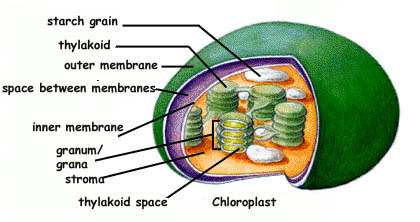
They contain chlorophyll, enclosed in chloroplasts.
Although they are truly prokaryotic, cyanobacteria have an elaborate and highly organized system of internal membranes which function in photosynthesis. Chlorophyll a and several accessory pigments (phycoerythrin and phycocyanin) are embedded in these photosynthetic lamellae, the analogs of the eukaryotic thylakoid membranes. The photosynthetic pigments impart a rainbow of possible colors: yellow, red, violet, green, deep blue and blue-green cyanobacteria are known.
Here's a diagram of a chloroplast:
4 Their critical role in life support
The oxygen atmosphere that we depend on was generated by numerous cyanobacteria during the Archaean and Proterozoic Eras. Before that time, the atmosphere had a very different chemistry, unsuitable for life as we know it today.
They were responsible for the initial conversion of the earth's atmosphere from an anoxic state to an oxic state (that is, from a state without oxygen to a state with oxygen) during the period 2.7 to 2.2 billion years ago. Being the first to carry out oxygenic photosynthesis, they were able to produce oxygen while sequestering carbon dioxide in organic molecules, playing a major role in oxygenating the atmosphere.
Cyanobacteria also play a major role in the nitrogen cycle. They are able to convert atmospheric nitrogen into its organic form. All plants use organic nitrogen as a nutrient to promote growth. Without this source of nitrogen, the plants would die. Cyanobacteria are one of the few types of organisms that are able to make this conversion from atmospheric to organic nitrogen.
Sources: Several articles on cyanobacteria.
Thursday, 21 January 2010
Tiktaalik and the Tetrapods
The evolution of tetrapods (4-footed animals) has remained a mystery.
It is absolutely remarkable that evolutionists can even begin to think that fishes evolved into four-footed amphibians, but that is exactly what they think. To be fair, they do admit that the gaps are wide, but they have suddenly become wider.
First, here are a couple of quotes to show that they do admit that the gaps are wide:
“The relationship of limbed vertebrates (tetrapods) to lobe-finned fish (sarcopterygians) is well established,[yeah, Like the coelacanth?] but the origin of major tetrapod features has remained obscure for lack of fossils that document the sequence of evolutionary changes.”
(Edward B. Daeschler, Neil H. Shubin, and Farish A. Jenkins, “A Devonian tetrapod-like fish and the evolution of the tetrapod body plan,” Nature Vol 440: 757-763 (April 6, 2006))
"It has long been clear that limbed vertebrates (tetrapods) evolved from osteolepiform lobefinned fishes3, but until recently the morphological gap between the two groups remained frustratingly wide. The gap was bounded at the top by primitive Devonian tetrapods such as Ichthyostega and Acanthostega from Greenland, and at the bottom by Panderichthys, a tetrapod-like predatory fish from the latest Middle Devonian of Latvia (Fig. 1)."
(Jennifer A. Clack & Per Erik Ahlberg, "A firm step from water to land," Nature 440:747-749 (April 6, 2006); emphasis added)
It is truly astonishing how presumably competent biologists can fool themselves.
There are so many simply gigantic problems involved in the supposed transition from fish to amphibian or reptile that are simply swept under the carpet, it leads one to wonder where these people got their qualifications.
The veriest child knows that any fish, like its goldfish,left out of water, will shortly die.
Its gills are designed to function in water, and simply cannot do so in the air. Therefore, whichever fish the evolutionist cares to choose as the fancied ancestor of amphibian or reptile had to overcome this basic problem first.
To put it simply, it is just plain stupid to think that could happen.
Every day thousands of fish caught by fishermen die in the air. That's thousands of experiments being carried out to show that no fish can survive out of water. NOT ONE SUCH FISH HAS SURVIVED FOR ANY LENGTH OF TIME. Ask any fisherman!
Here's an idiotic statement (typical of this kind of foolish thinking):
"Most scientists believe the amphibians evolved (developed gradually) from the lobe-finned fish. Lobe-finned fish had lungs and enlarged fins supported by bones and muscles. They could use their fins as legs to come out of the water for brief periods. These fins probably developed into amphibian legs.
http://www.worldbook.com/wb/Students?content_spotlight/dinosaurs/creatures_fish
Ever heard such nonsense?
The fish crept out on land for brief periods - and asphyxiated. The faster they asphyxiated, the faster they evolved! It's hard to credit the stupidity of that idea, but because it emerged from some university, it is supposed to be an intelligent concept. The most stupid fisherman could tell those professors that they're wrong, mad, or on mushrooms.
I don't know which. You must choose, dear reader.
But that's not the only problem!
Look at these diagrams of the skeleton of a fish and a tetrapod:

http://www.infovisual.info/02/034_en.html
Let's make the first point here.
Look at the 'pectoral fin' and the 'pelvic fin'.
Do you see that neither of them IS CONNECTED TO THE BACKBONE IN ANY WAY, either directly or indirectly?
OK. That's a typical bony fish.
Now here's the skeleton of a frog, a typical amphibian.

http://www.k-state.edu/organismic/images/frog_skeleton.jpg
See any differences? Yes, of course.
There are bones in the frog's forelimbs, AND THEY ARE CONNECTED TO THE scapula (shoulder blade) WHICH IS A PART OF THE AXIAL SKELETON as it's called.
There is NO connection between the fins of a fish and the axial skeleton.
QUESTION: How the connection ever made?
ANSWER: It wasn't.
Now look at the star performers in the Tetrapod Evolution Circus Parade.

Do you see any connection between these things and the fins of fish? Look back at the fins of the bony fish above, and decide for yourself.
Now suppose, and we'll use Tiktaalik as an example that this fish ever came out on to land. I said 'fish' because that's what the discoverers called it. Here's wiki on the subject:
Tiktaalik is a genus of extinct sarcopterygian (lobe-finned) fish
Give the artists half a chance, and they'd have Tiktaalik flying! Here's a picture of one - just before it dashed back into the water before it dried out! Or is it dead because it dried out?
What reason does it have for being there anyway? After all, its food is in the water and has been for millions of years. Or has it just decided to take a walk to stretch its non-existent legs?

Just listen to Shubin (guess what, he was one of the discoverers of Tikaalik, and is busy hyping it up, with no evidence at all beside his overheated imagination) "It probably had lungs as well as gills, and it had overlapping ribs that could be used to support the body against gravity, Shubin said.
Did you get that? This creature (which, Clack, one of the other discoverers said was more like a fish than anything else) PROBABLY HAD LUNGS AS WELL AS GILLS!
Now what was it doing with both - and most important of all WHY did it have them, and HOW DID IT GET THEM?
There's another serious point which is never mentioned. In most fishes, the pelvic fins are a lot SMALLER than the pectoral fins. In ALL TETRAPODS, the hind limbs are the biggest, usually by a long way. Think of a kangaroo, the most extreme example. How did that arrangement come about?
Marvellous.
But let's now apply the instinct test.
Here's a fish, breathing with gills. It has the instincts to do so.
Here's a creature breathing with lungs AND gills. Allegedly.
Quite apart from the stupidity of a fish evolving the physical structures of lungs - and they are TOTALLY DIFFERENT TO GILLS - which would have filled up with water, drowning the poor brute, where did it get the instincts from TO USE the lungs, if its ancestors had been doing quite well, thank you, with gills before that?
To use our famous little diagram again:
Fish F (using gills) ------ X ------> Tiktaalik (using gills AND LUNGS)
What happened at X?
Tiktaalik was considered to be one of the ancestors of tetrapods, with much blowing of trumpets and evolutionist chortling.
Alas, alas! Woe is them, they are undone!
This very month (Jan 2010) an article was published in Nature which caused one of the editors (Henry Gee) to write this:
The best discoveries are those that overturn current thinking, revealing that what we thought, only yesterday, to have been a coherent and complete picture, is in fact a void that no discoveries can yet fill. Such is the report in tomorrow’s Nature (Niedźwiedzki et al., 463, 43-48, 7 January 2010) of footprints left by tetrapods (four legged land vertebrates) eighteen million years older than the earliest known tetrapod fossils, and ten million years older than the fossils of the creatures thought to be the closest relatives of tetrapods. A fairly complete picture of tetrapod evolution, built up over the past twenty years, has been replaced by a blank canvas overnight.
In other words, it's "Back to the drawing board, fellow evolutionist guessers! It was all wrong, dammit!"
You really must read the article. It's here: http://network.nature.com/people/henrygee/blog/2010/01/05/first-footing
But this tetrapod thing was a major plank in the support for evolution, with new 'transitional fossils' being found at a rate of knots every day!
So what's going to happen next month? Where are you going to run, dear evolutionists, if another major plank is blasted next month?
And they will be. Just you wait and see.
NEW! HOT OFF THE PRESS!!
“HOW DOES INSTINCT EVOLVE”
OR
Evolution's Soft Underbelly
by Asyncritus
AT LAST!
The Argument Darwin Dreaded…
The Argument No-One Has Developed Before…
The Argument to Which There Is
NO ANSWER FROM THE EVOLUTIONISTS!
Nearly 50,000 viewers of my articles can’t all be wrong. Check Google for this subject and see!
http://www.thenakedscientists.com/forum/index.php?board=17.30
Go here for your copy. £4.95
It is absolutely remarkable that evolutionists can even begin to think that fishes evolved into four-footed amphibians, but that is exactly what they think. To be fair, they do admit that the gaps are wide, but they have suddenly become wider.
First, here are a couple of quotes to show that they do admit that the gaps are wide:
“The relationship of limbed vertebrates (tetrapods) to lobe-finned fish (sarcopterygians) is well established,[yeah, Like the coelacanth?] but the origin of major tetrapod features has remained obscure for lack of fossils that document the sequence of evolutionary changes.”
(Edward B. Daeschler, Neil H. Shubin, and Farish A. Jenkins, “A Devonian tetrapod-like fish and the evolution of the tetrapod body plan,” Nature Vol 440: 757-763 (April 6, 2006))
"It has long been clear that limbed vertebrates (tetrapods) evolved from osteolepiform lobefinned fishes3, but until recently the morphological gap between the two groups remained frustratingly wide. The gap was bounded at the top by primitive Devonian tetrapods such as Ichthyostega and Acanthostega from Greenland, and at the bottom by Panderichthys, a tetrapod-like predatory fish from the latest Middle Devonian of Latvia (Fig. 1)."
(Jennifer A. Clack & Per Erik Ahlberg, "A firm step from water to land," Nature 440:747-749 (April 6, 2006); emphasis added)
It is truly astonishing how presumably competent biologists can fool themselves.
There are so many simply gigantic problems involved in the supposed transition from fish to amphibian or reptile that are simply swept under the carpet, it leads one to wonder where these people got their qualifications.
The veriest child knows that any fish, like its goldfish,left out of water, will shortly die.
Its gills are designed to function in water, and simply cannot do so in the air. Therefore, whichever fish the evolutionist cares to choose as the fancied ancestor of amphibian or reptile had to overcome this basic problem first.
To put it simply, it is just plain stupid to think that could happen.
Every day thousands of fish caught by fishermen die in the air. That's thousands of experiments being carried out to show that no fish can survive out of water. NOT ONE SUCH FISH HAS SURVIVED FOR ANY LENGTH OF TIME. Ask any fisherman!
Here's an idiotic statement (typical of this kind of foolish thinking):
"Most scientists believe the amphibians evolved (developed gradually) from the lobe-finned fish. Lobe-finned fish had lungs and enlarged fins supported by bones and muscles. They could use their fins as legs to come out of the water for brief periods. These fins probably developed into amphibian legs.
http://www.worldbook.com/wb/Students?content_spotlight/dinosaurs/creatures_fish
Ever heard such nonsense?
The fish crept out on land for brief periods - and asphyxiated. The faster they asphyxiated, the faster they evolved! It's hard to credit the stupidity of that idea, but because it emerged from some university, it is supposed to be an intelligent concept. The most stupid fisherman could tell those professors that they're wrong, mad, or on mushrooms.
I don't know which. You must choose, dear reader.
But that's not the only problem!
Look at these diagrams of the skeleton of a fish and a tetrapod:

http://www.infovisual.info/02/034_en.html
Let's make the first point here.
Look at the 'pectoral fin' and the 'pelvic fin'.
Do you see that neither of them IS CONNECTED TO THE BACKBONE IN ANY WAY, either directly or indirectly?
OK. That's a typical bony fish.
Now here's the skeleton of a frog, a typical amphibian.

http://www.k-state.edu/organismic/images/frog_skeleton.jpg
See any differences? Yes, of course.
There are bones in the frog's forelimbs, AND THEY ARE CONNECTED TO THE scapula (shoulder blade) WHICH IS A PART OF THE AXIAL SKELETON as it's called.
There is NO connection between the fins of a fish and the axial skeleton.
QUESTION: How the connection ever made?
ANSWER: It wasn't.
Now look at the star performers in the Tetrapod Evolution Circus Parade.
Do you see any connection between these things and the fins of fish? Look back at the fins of the bony fish above, and decide for yourself.
Now suppose, and we'll use Tiktaalik as an example that this fish ever came out on to land. I said 'fish' because that's what the discoverers called it. Here's wiki on the subject:
Tiktaalik is a genus of extinct sarcopterygian (lobe-finned) fish
Give the artists half a chance, and they'd have Tiktaalik flying! Here's a picture of one - just before it dashed back into the water before it dried out! Or is it dead because it dried out?
What reason does it have for being there anyway? After all, its food is in the water and has been for millions of years. Or has it just decided to take a walk to stretch its non-existent legs?

Just listen to Shubin (guess what, he was one of the discoverers of Tikaalik, and is busy hyping it up, with no evidence at all beside his overheated imagination) "It probably had lungs as well as gills, and it had overlapping ribs that could be used to support the body against gravity, Shubin said.
Did you get that? This creature (which, Clack, one of the other discoverers said was more like a fish than anything else) PROBABLY HAD LUNGS AS WELL AS GILLS!
Now what was it doing with both - and most important of all WHY did it have them, and HOW DID IT GET THEM?
There's another serious point which is never mentioned. In most fishes, the pelvic fins are a lot SMALLER than the pectoral fins. In ALL TETRAPODS, the hind limbs are the biggest, usually by a long way. Think of a kangaroo, the most extreme example. How did that arrangement come about?
Marvellous.
But let's now apply the instinct test.
Here's a fish, breathing with gills. It has the instincts to do so.
Here's a creature breathing with lungs AND gills. Allegedly.
Quite apart from the stupidity of a fish evolving the physical structures of lungs - and they are TOTALLY DIFFERENT TO GILLS - which would have filled up with water, drowning the poor brute, where did it get the instincts from TO USE the lungs, if its ancestors had been doing quite well, thank you, with gills before that?
To use our famous little diagram again:
Fish F (using gills) ------ X ------> Tiktaalik (using gills AND LUNGS)
What happened at X?
Tiktaalik was considered to be one of the ancestors of tetrapods, with much blowing of trumpets and evolutionist chortling.
Alas, alas! Woe is them, they are undone!
This very month (Jan 2010) an article was published in Nature which caused one of the editors (Henry Gee) to write this:
The best discoveries are those that overturn current thinking, revealing that what we thought, only yesterday, to have been a coherent and complete picture, is in fact a void that no discoveries can yet fill. Such is the report in tomorrow’s Nature (Niedźwiedzki et al., 463, 43-48, 7 January 2010) of footprints left by tetrapods (four legged land vertebrates) eighteen million years older than the earliest known tetrapod fossils, and ten million years older than the fossils of the creatures thought to be the closest relatives of tetrapods. A fairly complete picture of tetrapod evolution, built up over the past twenty years, has been replaced by a blank canvas overnight.
In other words, it's "Back to the drawing board, fellow evolutionist guessers! It was all wrong, dammit!"
You really must read the article. It's here: http://network.nature.com/people/henrygee/blog/2010/01/05/first-footing
But this tetrapod thing was a major plank in the support for evolution, with new 'transitional fossils' being found at a rate of knots every day!
So what's going to happen next month? Where are you going to run, dear evolutionists, if another major plank is blasted next month?
And they will be. Just you wait and see.
NEW! HOT OFF THE PRESS!!
“HOW DOES INSTINCT EVOLVE”
OR
Evolution's Soft Underbelly
by Asyncritus
AT LAST!
The Argument Darwin Dreaded…
The Argument No-One Has Developed Before…
The Argument to Which There Is
NO ANSWER FROM THE EVOLUTIONISTS!
Nearly 50,000 viewers of my articles can’t all be wrong. Check Google for this subject and see!
http://www.thenakedscientists.com/forum/index.php?board=17.30
Go here for your copy. £4.95
MY NEW BOOK: HOW DOES INSTINCT EVOLVE
NEW! HOT OFF THE PRESS!!
“HOW DOES INSTINCT EVOLVE”
OR
Evolution's Soft Underbelly
by Asyncritus
AT LAST!
The Argument Darwin Dreaded…
The Argument No-One Has Developed Before…
The Argument to Which There Is
NO ANSWER FROM THE EVOLUTIONISTS!
Nearly 50,000 viewers of my articles can’t all be wrong. Check Google for this subject and see!
http://www.thenakedscientists.com/forum/index.php?board=17.30
140 pages of amazing facts and carefully reasoned arguments. Equip yourself! Give your children the knowledge to defend belief in Creation in class!
Get your copy here.
Published by phillauren.org
THE EVOLUTION OF FLIGHT
Perhaps I may be allowed a few words on this, the most fatal argument against evolution.
Imagine reptile X no feathers, no wings.
Imagine some mutation (systemic, enormous as per Goldschmidt) and lo and behold, we have the first bird, B -as I said, warmblooded, fully feathered, with wings instead of reptile forelimbs, one way lung circulation instead of bellows arrangement, etc etc.
One may well say, that is a creative act, just taken place, but we'll let that pass.
Diagrammatically:
X (reptile) ----Mutation --------> B (bird, with wings etc)
Now what does B do?
One of 2 things:
a. gets eaten by the parent reptile who thinks it's food
b. attempts to fly off into the distance
BUT IT DOES NOT KNOW HOW TO FLY!!!
As we all know, flight training is a complex affair. If we were to put an untrained person into the cockpit of a fighter aircraft, saying 'Get on with it', disaster is guaranteed.
In order to fly, that bird MUST HAVE THE INSTINCTS REQUIRED. Else disaster is guaranteed. Those instincts are complex, and built into every flying bird.
We know that because young fledglings are shoved out of their parents' nests - AND THEY FLY OR DIE.
So we now have 2 diagrams:
X ------- M-------> B (without flight instincts)---> death/extinction)
or
X----M-----I.I ---->B (with flight instincts) ---> gone to Hawaii.
I.I = instinct implantation.
There can be NO intermediate steps. The bird either knew how to fly, or it died. If we postulate a gliding intermediate, then that too requires training/instinct.
I'm sure you would think twice before leaping off the top of a high tree or cliff if you didn't KNOW how to hang-glide.
So the question before us is, who or what implanted that instinct, and how?
NEWS FLASH!
NEW! HOT OFF THE PRESS!!
“HOW DOES INSTINCT EVOLVE”
OR
Evolution's Soft Underbelly
by Asyncritus
AT LAST!
The Argument Darwin Dreaded…
The Argument No-One Has Developed Before…
The Argument to Which There Is
NO ANSWER FROM THE EVOLUTIONISTS!
35,000 viewers of my articles can’t all be wrong. Check Google for this subject and see!
http://www.thenakedscientists.com/forum/index.php?board=17.30
140 pages of amazing facts and carefully reasoned arguments. Equip yourself! Give your children the knowledge to defend belief in Creation in class!
Get your copy here.
Published by phillauren.org
Subscribe to:
Posts (Atom)