Thursday, 21 January 2010

THE EYE OF THE TRILOBITE

NEWS FLASH!


NEW BOOK! HOT OFF THE PRESS!!


“HOW DOES INSTINCT EVOLVE”

OR

Evolution's Soft Underbelly
by Asyncritus


AT LAST!

The Argument Darwin Dreaded…
The Argument No-One Has Developed Before…
The Argument to Which There Is

NO ANSWER FROM THE EVOLUTIONISTS!


45,000 viewers of my articles can’t all be wrong. Check Google for this subject and see!
http://www.thenakedscientists.com/forum/index.php?board=17.30

140 pages of amazing facts and carefully reasoned arguments. Equip yourself! Give your children the knowledge to defend belief in Creation in class!

Get your copy here. Only £4.97 as pdf.
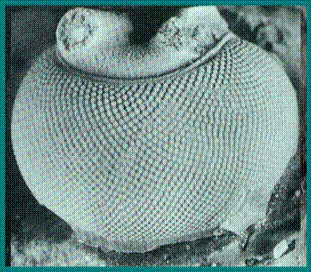

THE EYE OF THE TRILOBITE
A Miracle of Creation


http://shkrobius.googlepages.com/wondersofnature
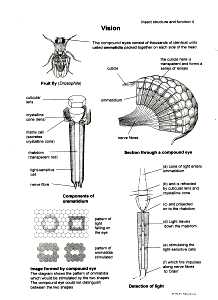

A beautiful drawing can be seen above. The link is here, where it can be viewed at a larger size: http://www.biology-resources.com/insects-02.html


Let’s first get acquainted with a compound eye. Instead of the single eye such as we have, each compound eye consists of a thousand or so individual ‘eyes’ called ommatidia.

Each ommatidium is made up of a lens (more about this later), a crystalline cone under it, and a nerve cell which conducts the electrical impulse to the creature’s brain where it is interpreted.

Around each cone (corresponding to the biscuit of an ice cream cone) is a layer of light absorbing material, which prevents the light in each cone being scattered and degrading the image created by other ommatidia.

All arthropods have this type of eye.

The trilobite’s eye, consisting of millions of honeycomb-shaped tiny particles and a double-lens system, this eye "has an optimal design which would require a well-trained and imaginative optical engineer to develop today". David Raup

”Moreover, the honeycomb eye structure of the trilobite has survived to our own day without a single change. Some insects such as bees and dragon flies have the same eye structure as did the trilobite.”

So, to put it plainly, the design of the trilobite’s eye was so advanced that it exists today, virtually unchanged. That unchanging structure is direct testimony that evolution has not taken place: certainly not in this structure.

I used the word ‘design’ because it clearly meets the criteria for deciding whether or not something was designed: it is a complex structure, it has a specific function, and it employs advanced information in its construction. To reiterate:

1 It is a very complex structure, not a simple one that may have just happened.

2 It has a specific function, which it fulfils well – and we know that because the eye has persisted unchanged for millions of years.

3 It makes use of information – which blind mutations cannot do. The high quality of the information is shown below.

The lens system refracted light incident from any angle into the trilobite vision system. A small wall to keep refracted light from interfering also partitioned the separate lenses. This is a feature of modern cameras: there is a light absorbing layer (usually black) inside the camera’s film chamber – to absorb stray light and prevent it degrading the image.

This is clear evidence of specificity of the design. The Designer knew about light scattering, and specifically prevented it. He knew about lenses, their required curvature, and the aberrations that such lenses produced. And as a direct, required consequence, produced the next invention:

‘The thick lenses in the aggregate eyes of a group of trilobites were doublet structures designed to eliminate spherical aberration.’ http://www.nature.com/nature/journal/v254/n5502/abs/254663a0.html
Nature 254, 663 - 667 (24 April 1975); doi:10.1038/254663a0

“The thick lenses in the aggregate eyes of a group of trilobites were doublet structures designed to eliminate spherical aberration. The shape of the optically correcting interface is in accord with constructions by Des Cartes and Huygens and is dictated by a fundamental law of physics. Trilobites may have evolved such sophisticated eye-lenses to maximise optic neurone response in a dimly lit environment.”

This is even clearer use of information, proving conclusively that design is present. The Designer knew about correcting spherical aberration by using doublets possessing different refractive indices. He was way ahead of DesCartes and Huygens, and knew about the fundamental law of physics governing such correction.

He also knew about amplifying dim light – presumably as Night Vision Goggles are intended to do today, as the authors above said: “…such sophisticated eye-lenses to maximise optic neurone response in a dimly lit environment.”


Here is another article describing the same phenomenon.

“This eye possessed an internal optical-doublet structure together with a refracting interface (comprised of two lenses with differing refraction so they would work together) that corrected focusing - a lens design that human scientists would repeat hundreds of millions of years later.” (In fact courses on optical DESIGN are offered which teach about optical doublets, inter alia). Here if you want to attend one: http://www.imperial.ac.uk/research/optics/msc/syllabus.htm

In case you don’t know, spherical aberration is the blurring of an image that occurs when light from the margin of a lens or mirror with a spherical surface comes to a shorter focus than light from the central portion. The changing focal length is caused by deviations in the lens or mirror surface from a true sphere.

‘The novel eyes of the trilobites were a particularly effective adaptation to underwater sight, and were ostensibly plagued by neither near-sightedness nor far-sightedness. Close and distant food and predators would be simultaneously in focus.

This is a feature of modern wide-angle lenses: which are among the most advanced in the world. And here it is in the eye of a humble trilobite, millions of years ago.

Evolution is helpless to produce such a structure. A Designer, on the other hand, could do it with ease.

THE CAMBRIAN EXPLOSION

Having read a great deal about this ‘explosion’ I want to put before the expanding readership some little facts that they may not know. These facts show that it is far beyond the bounds of credibility for so many, and such varied organisms to have evolved in any step by step fashion.

Simply because they appeared so suddenly and in one fell swoop.

This obviously bothered Darwin, and later on, Gould and many other palaeontologists. There is NO credible evolutionary explanation of the phenomenon, and I am amazed to know that so many informed people (on the subject of the Cambrian explosion, I mean) can look at those facts in the face, and still go along with the ToE.

What does ‘Cambrian’ mean?

Palaeontologists dig down into the earth’s crust, and they have found that there are many layers of rock. They’ve given the layers some very long and fancy names, and the names depend on the kind of fossils in the rock.

The oldest animals/ plants are in the deepest layers, which are the oldest ones, and the newest animals/plants are in the highest ones.

Right at the very bottom of the layers is granite, which cannot and does not contain fossils, and is the oldest of the rocks.

So imagine a pack of cards resting on a granite surface. The granite represents the basement layer of rocks and piled on top of it are the cards, each of which represents a layer of rock. The layer resting on the granite is called the ‘Pre-Cambrian’ layer, and contains a very limited number of fossils: limited both in number and kind.

The layer on top of that one is the ‘Cambrian’ layer, and it is this one we are going to discuss in brief.

What’s in the Cambrian Layer?

To everybody’s astonishment, especially the people who believed in the gradual evolution theory, there are thousands upon thousands of different kinds of animals and plants in that layer, and they weren’t simple ones either.

Here are some famous evolutionists:

Most families, orders, classes, and phyla appear rather suddenly in the fossil record, often without anatomically intermediate forms smoothly interlinking evolutionarily derived descendant taxa with their presumed ancestors.
• Eldredge, N., 1989
Macro-Evolutionary Dynamics: Species, Niches, and Adaptive Peaks
McGraw-Hill Publishing Company, New York, p. 22


The record jumps, and all the evidence shows that the record is real: the gaps we see reflect real events in life's history -- not the artifact of a poor fossil record.
• Eldredge, N. and Tattersall, I. (1982)
The Myths of Human Evolution
Columbia University Press, p. 59


Described recently as "the most important evolutionary event during the entire history of the Metazoa," the Cambrian explosion established virtually all the major animal body forms -- Bauplane or phyla -- that would exist thereafter, including many that were 'weeded out' and became extinct. Compared with the 30 or so extant phyla, some people estimate that the Cambrian explosion may have generated as many as 100. The evolutionary innovation of the Precambrian/Cambrian boundary had clearly been extremely broad: "unprecedented and unsurpassed," as James Valentine of the University of California, Santa Barbara, recently put it (Lewin, 1988).

"This is true of all thirty-two orders of mammals...The earliest and most primitive known members of every order already have the basic ordinal characters, and in no case is an approximately continuous sequence from one order to another known. In most cases the break is so sharp and the gap so large that the origin of the order is speculative and much disputed...

This regular absence of transitional forms is not confined to mammals, but is an almost universal phenomenon, as has long been noted by paleontologists. It is true of almost all classes of animals, both vertebrate and invertebrate...it is true of the classes, and of the major animal phyla, and it is apparently also true of analogous categories of plants.
• Simpson, G. G. (1944)
Tempo and Mode in Evolution
Columbia University Press, New York, p. 105, 107


The gaps in the fossil record are real, however. The absence of a record of any important branching is quite phenomenal. Species are usually static, or nearly so, for long periods, species seldom and genera never show evolution into new species or genera but replacement of one by another, and change is more or less abrupt.
• Wesson, R., 1991
Beyond Natural Selection
MIT Press, Cambridge, MA, p. 45


We could go on collecting these quotes. But I want to underline 2 important things.

1 Darwin was wrong, is wrong, and will continue to remain wrong in THIS MOST IMPORTANT MATTER. The fossils say so. There’s nothing gradual about all this – it was BANNNGGGG!!!! Here we all are.

2 All these diverse forms performed ALL THE FUNCTIONS OF ALL LIVING THINGS.

Therefore they all had the instincts required to perform all these functions.


As we've seen, eating (as an example in the first post on this blog), is powered by instinct.

The animal has to know what is food, what to do with it; how to catch it; where its mouth was; what to do with whatever it used to catch its food. All these are basic instincts. The food had to be processed and absorbed - and it is a form of instinct that does all this.

All these HAD TO BE PRESENT IN THEIR ENTIRETY, or the first such animal would immediately have perished.

Therefore, the Cambrian layer represents not only a vast explosion of physical types, it also represents a vast explosion of instinct implantation.

An evolutionist can, and will argue till the cows come home, about intermediate fossils, the incompleteness of fossilization in the preCambrian etc etc. But if he has a single leg to stand on, it is yanked violently from under him by the fact that he HAS to account for the ORIGIN,and implanting of all of these instincts IN THEIR ENTIRETY in about a billion organisms, at more or less the same time.

I was interested read that Gould was of the opinion that the Cambrian period lasted no more than 5 – 30 million years, but the likelihood is that the figure of 5 million was most likely to be the truth.

So all this incredible diversity arose in a geological eye-blink – which is exactly what the creation model predicts.

No evolution here!

See also:
http://www.wasdarwinright.com/intermediates-f.htm


NEW! HOT OFF THE PRESS!!


“HOW DOES INSTINCT EVOLVE”

OR

Evolution's Soft Underbelly
by Asyncritus


AT LAST!

The Argument Darwin Dreaded…
The Argument No-One Has Developed Before…
The Argument to Which There Is

NO ANSWER FROM THE EVOLUTIONISTS!


35,000 viewers of my articles can’t all be wrong. Check Google for this subject and see!
http://www.thenakedscientists.com/forum/index.php?board=17.30

100 pages of amazing facts and carefully reasoned arguments. Equip yourself! Give your children the knowledge to defend belief in Creation in class!

Get your copy here. Only $19.97 as pdf.
$27 plus $5 p&p in CDR format.


CDR Version


Published by phillauren.org

MEIOSIS. THE WONDERFUL DIVISION

NEWS FLASH!


NEW! HOT OFF THE PRESS!!


“HOW DOES INSTINCT EVOLVE”

OR

Evolution's Soft Underbelly
by Asyncritus


AT LAST!

The Argument Darwin Dreaded…
The Argument No-One Has Developed Before…
The Argument to Which There Is

NO ANSWER FROM THE EVOLUTIONISTS!


35,000 viewers of my articles can’t all be wrong. Check Google for this subject and see!
http://www.thenakedscientists.com/forum/index.php?board=17.30

100 pages of amazing facts and carefully reasoned arguments. Equip yourself! Give your children the knowledge to defend belief in Creation in class!

Get your copy here. Only $19.97 as pdf.
$27 plus $5 p&p in CDR format.


CDR Version


Published by phillauren.org

MEIOSIS

If the process of mitosis was amazing, and shows that design is necessary to produce two new cells containing exactly the same number of chromosomes, then what must we say about meiosis?

Meiosis produces the sex cells.

The process of division in this case, however, doesn’t produce exactly the same number of chromosomes in the daughter cells, but EXACTLY HALF that number.

So if there are 10 chromosomes in the parent cell, the process of meiosis produces 5 in each sex cell.

Whereas mitosis takes A.A B.B C.C D.D E.E

And produces A.A B.B C.C D.D E.E and another set of A.A B.B C.C D.D E.E ,

meiosis takes A.A B.B C.C D.D E.E and produces A B C D E and A B C D E.

The pure astonishment that this creates in the mind of the onlooker is enormous.

As I said before, if in the same organism we have cells with 10 11 12 13 14 etc chromosomes, nothing short of chaos would result.

But here, in the sex cells, we have 5 chromosomes in each new cell, and no chaos results.

That, however isn’t the really astonishing part. The question arises, why does this happen? And the answer is extremely simple.

To produce a new organism with the original 10 chromosomes in each body cell, each parent must contribute exactly half the number ie 5. So the 10 is made up of 5 from one, and 5 from the other. And that is exactly what happens, because of this process of meiosis.

The mechanism of meiosis is in outline broadly similar to mitosis, but the details are quite different, and too technical to include here. There are some nice pictures here:


Source: http://publications.nigms.nih.gov/thenewgenetics/images/ch1_meiosis.jpg

I simply want to make the point that there is purpose, design, counting, and most remarkable of all, foreknowledge in the design of what happens.

Consider:

Somebody knew how to count.

Somebody knew that if 10 chromosomes from A combined with 10 chromosomes from B, there would be 20 in the offspring, which would create chaos.

Somebody therefore decided that the 10 had to be halved, and the halving had to be done properly, so A.A B.B C.C D.D E.E would produce A B C D E and A B C D E , not A A B C D or something else that wouldn’t work.

Somebody knew that in the reproductive process, 1 cell from A would join up with another cell from B.

Somebody, somehow, planted in the chromosomes of every body cell, the DNA programming which would eventually make sure, that even if every other kind of cell would reproduce by mitosis, the sex cells wouldn’t.

Somebody designed the second process (meiosis), not as an afterthought, but having made the decision that that was the way to go. And what an ingenious way it is, too.

Somebody made sure that all the necessary mechanisms needed to ensure that sperm from A would reach the ovum from B – and just how long and complex a story that is, many textbooks on sexual reproduction demonstrate very clearly.

All of which argues purpose, intelligence, design, very deep knowledge of the outcome, and of the biochemical processes that would be needed to produce the desired outcome.

Purpose requires intelligence and knowledge.

The mechanism’s design also demonstrates intelligence and fearsome knowledge.

Therefore, chance is eliminated. No accumulations of random mutations could possibly produce this mechanism, because all this had to exist before mutations could occur!

God did it.

MITOSIS, MEIOSIS AND PURPOSE

Mitosis

For those who may not know, a cell can divide in two ways. It can use a process called mitosis, or it can use the other method called meiosis.

The mechanics of the two processes are quite startling, and are very clearly designed to carry out their absolutely vital functions accurately.

Cells have to reproduce themselves in order for growth to take place, to repair damage, for simple maintenance and other needed functions.

When they divide, the number of chromosomes, and thus the genes on them must be replicated exactly in the new cells, otherwise damage and destruction will take place. A mutation damages the genetic make up of the cell, and such damage is destructive in 99.99% of the cases in which it occurs.

Which is only to be expected. If the plans for say, a car, become damaged in any way, and the construction continues despite the damage, we wouldn’t be too surprised to find the steering wheel up the exhaust pipe, or the engine in the passenger seat! Either way, the car will not function, or at best will be badly impaired.

Continued damage to the plans, does not, or is most unlikely to produce improvement in the car. No matter how many times we tear up and reconstitute the plans for a Honda Civic, we will never get the plans for a Boeing 747.

And there is another problem, the problem of size. A Rolls Royce is not simply a scaled up version of a Honda Civic. It is a completely different animal, whose physics, chemistry and metallurgy are entirely changed. The design of a mud hut cannot simply be enlarged to produce the Empire State Building. It would definitely look a bit odd, for starters.

In the cell, the damage can be of several well known kinds.

1 The chromosome may duplicate itself unnecessarily: so there is one or more than one extra chromosome in the make up.

2 The chromosome may have a section torn off or lost

3 The chromosome may break and rejoin the wrong way round, so instead of the genes being in the order AAABBBCCC, something else appears like CCCAAABBB. This also produces damage, much as if a page of the plans for the car was torn in 3, and the sections glued back in the wrong order.

In every case there is damage of one sort or another. Mutations occur frequently, but beneficial mutations are extremely rare, and never produce new species, far less new genera. Micro-evolution, like the emergence of bacteria resistant to antibiotics, is a very long way indeed from the macro-evolution of a whole new family, or phylum.

But back to mitosis.

In a normal body cell, let’s say there are 10 individual chromosomes. These are in pairs, so there are 5 pairs. In order to make sure that the daughter cells have exactly the same number of chromosomes, this remarkable process takes place.

A.A B.B C.C D.D E.E

Each pair of chromosomes copies itself exactly.

A.A B.B C.C D.D E.E ---> A.A A.A B.B B.B C.C C.C D.D D.D E.E E.E

So for a brief moment, the cell has 20 chromosomes, in 10 pairs. 5 pairs are exact replicas of the other five. The dot in the middle indicates that they are joined at a certain point.

Two structures called centrioles appear, and move to the opposite ends of the cell, and fibres begin to appear: they then join, believe it or not, to form what is called a ‘spindle’. The nuclear membrane disappears.

Amazingly, the chromosomes arrange themselves at the ‘equator’ of the spindle and are attached to the fibres of the spindle.

The spindle pulls them apart, and they separate, going to the opposite ends of the cell. So at each end of the cell there are now 5 pairs of chromosomes. The original number.

The nuclear membrane reforms round the chromosomes, and the cell pinches in the middle, and two new cells are now formed, each containing 5 pairs of chromosomes: A.A B.B C.C D.D E.E once more.

Here are still photographs of the process by Anne Bruce: http://www.microscopy-uk.org.uk/mag/indexmag.html?http://www.microscopy-uk.org.uk/mag/artaug99/mitosis2.html

And here is an animation: http://www.cellsalive.com/mitosis.htm >

There is very clear purpose in every move of this division process.

1 The chromosomes duplicate themselves, as if they knew that the new cell must have a copy.

2 The spindle is constructed, at the right time and in the right place SO THAT it can pull the chromosomes apart from their joint. It is a subject of much research, which is showing much protein involvement in the structure.

3 The nuclear membrane dissolves, with the purpose of getting out of the way so the division can take place.

4 The chromosomes arrange themselves at the ‘equator’ of the spindle, the maximum distance away from the centrioles SO THAT the maximum leverage can be exerted on them to separate them. They separate.

5 They move to opposite ends of the cell, SO THAT each new cell has exactly the same number of chromosomes as the original.

6 But number is not enough. Five DIFFERENT chromosome pairs must be in each daughter cell. This way of doing the division ENSURES that they ARE different.

7 The nuclear membrane reforms when the division is complete, and TO COMPLETE THE PROCESS, the cell wall itself pinches off to make 2 new cells.

At every step of the way, design, foreknowledge and purpose are displayed. The most surprising thing in my view, is that the exact numbers of chromosomes is preserved in each daughter cell. If they weren’t, then chaos would soon result.

Order, purpose, design, and intelligence are displayed in abundance in this process. There is nothing whatsoever left to chance. If it were, there would be, as I have said, chaos in the genetics of the organism, which would result in death, disease or sterility.

The probability of the biochemistry of this process having emerged by chance movement of molecules is ridiculous. The very possibility does not exist. Errors here, and even more so in meiosis, would result in the extinction of life itself.

But we here run up against the old, old evolutionary conundrum. Life could not exist without mitosis, and mitosis could not exist without life. Therefore, life and mitosis could not have come from inert molecules.

God designed them.


NEW BOOK! HOT OFF THE PRESS!!


“HOW DOES INSTINCT EVOLVE”

OR

Evolution's Soft Underbelly
by Asyncritus


AT LAST!

The Argument Darwin Dreaded…
The Argument No-One Has Developed Before…
The Argument to Which There Is

NO ANSWER FROM THE EVOLUTIONISTS!


35,000 viewers of my articles can’t all be wrong. Check Google for this subject and see!
http://www.thenakedscientists.com/forum/index.php?board=17.30

100 pages of amazing facts and carefully reasoned arguments. Equip yourself! Give your children the knowledge to defend belief in Creation in class!

Get your copy here. Only $19.97 as pdf.
$27 plus $5 p&p in CDR format.


CDR Version


Published by phillauren.org

Saturday, 14 November 2009

THE INSTINCTS OF THE PARASOL ANTS


http://www.thewildones.org/Animals/atta.html


THE LEAF CUTTING ANT (PARASOL ANTS)


We have in this example, another phenomenal illustrative piece on the helplessness of the evolution theory to explain observable facts.


These are observable, have been observed, and there is no guesswork or speculation involved. The whole mechanism sprang full blown to birth, or it couldn’t have happened at all. Judge for yourselves.


The parasol ant is a real pest to farmers and causes a lot of damage to crops, because the foraging ants go out in numbers, cut large amounts of leaf material off crop plants, and this costs money.


They go forth, cut the leaves with their specially constructed jaws, and carry them back to their nests. They climb trees up to 100-feet tall and cut out small pieces of leaves. They then carry these fragments, weighing as much as 50 times their body weight, back to their homes. Sometimes they must travel 200 feet, equal to an average human walking about 6 miles with 5,000 lbs. on his/her back! The forest floor is converted to a maze of busy highways full of these moving leaf fragments.

They travel a distance equivalent to a 6 foot man walking 5 miles in a forest. So how do they get home? Incredibly, they leave a trail of pheromone-like substances on their trails.


Back at the nest,
the marvels begin. The ants were once thought to use the ‘parasols’ as covering to shield them from the rain. That, however, is not the case.


The leaf cutters take the material back to their nests, and there, in specially designed underground chambers, cut them up into minute little pieces, spray them with excrement, saliva, and then plant a particular species of fungus on the decaying material.


But that is not the whole story.: http://www.apologeticspress.org/articles/2627

"Incredibly, the ants do not eat the leaves. Rather, they cultivate miniature gardens of fungus on pieces of leaves. which they chew and then store in underground compost piles.

Several million ants usually inhabit their colonies, and the garden chambers can extend as deep as twelve feet underground.

In order to fulfill all the needs of the colony, the ants divide the work among classes. Each class of workers is designed to do a special job. The biggest ants have powerful jaws to cut leaves, flower petals, and blades of grass. They bring these big pieces back to the nest where slightly smaller workers cut and dice the plant material into tiny lumps. The smallest workers chew these up into balls, adding bits of fungus. The ants’ saliva contains ingredients that help the fungus break down the plant material, and also kills harmful bacteria and other fungi.

Small workers strip off wax and other parts of the plants that the fungus cannot use. Workers dump this refuse into special waste chambers. The relationship between the ants and the fungus is symbiotic, meaning that both benefit. The fungus benefits because the ants feed it, protect it, and spread it from place to place. In return, the fungus grows a clump of special hyphae. Each clump is like an instant three-course meal, which the smallest ant workers use to feed the larvae."

This is the only fungus the ants eat and feed the larvae on.


You may recall the difficulties faced when researchers attempted to cultivate the Penicillium fungus in order to produce penicillin in the World War. Fleming, Florey and Chain were awarded Nobel prizes for their discovery (Fleming), extraction and purification of the antibiotic (Chain and Florey). Here are ants who have 'discovered' the single species of fungus that suits them, and 'developed' effective cultivation methods of the fungus.


They have 'discovered' how to obtain and produce the the right composting medium for its growth. They maintain the correct temperature for it's cultivation and growth. Instinct, you see. Perhaps they too should be awarded the Nobel prizes for the animal world!


When the young queen leaves the nest, she takes a piece of the fungus with her to act as seeding material!


While Mueller and Schultz worked on the ants’ relationship to fungi, a team of biologists at the University of Toronto were noting—and wondering about—the presence of a persistent and ravaging mold, called Escovopsis, in attine gardens. How was it, they asked, that this potent parasite didn’t regularly overrun the attine nests? Taking note of a white powder on the undersides of the attine ants, they ultimately identified it as a type of bacteria, Streptomyces, that secretes antibiotics. The antibiotics were keeping the Escovopsis at bay. More important, they were doing so over long periods of time, without the Escovopsis becoming totally resistant.

Evolution cannot account for the origin of this complex organisation, biochemistry, specific knowledge of fungal cultivation, specific knowledge of fungal identification, pre-programmed behaviour patterns of the workers, reccognition of which parts are waste, knowledge that a piece of fungus will act as a cutting which could be used to propagate the only fungus they eat, the scissor like jaws which do the leaf-cutting, the selection of proper leaves which can be used as their composting material, the production of the pheromone-like ‘scent’ which marks their tracks – all this and more.


At every step of their discovery process, error would have caused the extinction of the species. Recall that this is the only species of fungus that they eat.So if they got that wrong, species extinction would have taken place.


Which raises another of these curious anomalies. If this is the only fungus they eat, and this is the only way that the fungus is propagated, then which came first? The ant, or the fungus? The ant depends on the fungus, and the fungus depends on the ant, like the old lock and key analogy. Without the lock, the key is useless, and without the key, the lock is equally so.


Consider the number of individual pieces of instinctive behaviour the ants exhibit, and ask yourself, how did these a. start and b.get into the genome?


1. They know they have to eat. Where did that come from?


2 They can walk. Where did that come from?


3 They have leaf-cutting jaws. Where did that come from? And where did the instincts powering the use of those jaws come from?


4 They 'know' that they must go cut the leaves. Where did that come from?


5 They know they must bring it back to their nest. Where did that come from?


6 They know they mustn't eat the leaves. Where did that come from?


7 They know they have to chew them up and make compost with them. Where did that come from?


8 They know they must excrete on the chewed up leaves to make the compost. Where did that come from?


9 They know they must place spores of the fungus on the compost. Where did that come from?


10 They know how to keep the nest clean, and how to tend the 'gardens' of fungus. Where did that come from?


11 They know how to make tunnels, and keep them at the correct temperature and wetness. Where did that come from?


12 They know that the fungal hyphae must not be eaten. Where did that come from?


13 They know the fungal fruiting bodies are edible, and they eat those. Where did that come from?


14 There is a whole social stratification of ants in the nest. Queen, workers which do one thing, and workers which do another. For example, the leaf-cutting ants cannot chew the leaves up and make the compost. There are smaller ants whose jaws are designed for that purpose.


This is a leaf-cutter. Observe the size of the jaws.


The above are workers creating the compost. Note the small size of the jaws.


15 There are a very large number of other behaviours we could ask the same question about. But the next most remarkable is the fact that when a young queen flies off to start a new colony, she invariably carries a piece of the fungus with her to act as the seed for the new gardens. There is clear purpose in her doing so - but she has a brain the size of a pinhead.


If she didn't do this, she and the species would perish, since new colonies could not form, and the old ones would eventually die out. Species extinction would be the result.


Also note that the eggs she lays, and which hatch out, produce workers (and some males). The workers do NOT need instructions in constructing the fungus gardens, cutting the leaves, and all the other required behaviours. So, the information is somehow programmed into their genes.


'Somehow' is the leading word here. How? And how did it all begin?


As we can clearly see, it's all or nothing. It either worked first time, or the species perished. Since the ant is with us here today, then it worked. First time.


That is a description of an act of creation, not evolution.

The instincts, ants and fungus arose together, and have continued ever since their creation. There are fossil Atta ants in the Miocene (c25 mya) - identifiable ones, 'One of the fossil species of Atta resembles in general form and in the venation of the wings the curious Atta cephalotes of Tropical America'.

http://www.nature.com/nature/journal/v16/n398/abs/016122a0.html


All of those instincts, and many others we haven't mentioned, were implanted in the ants when they were created. No small, beneficial steps could have implanted them.


It is staggering that both sides of the evolution debate have failed to see the importance of this point. The pro-evolutionists DON'T WANT to see it, and the anti-evolutionists have missed it altogether, or at least haven't capitalised sufficiently on it.


I am happy to redress the balance.


Q. How did all that get into their genes?

A. God put it there..


Further reading:

http://www.sasionline.org/antsfiles/pages/atta/Atta.html

http://arjournals.annualreviews.org/doi/abs/10.1146/annurev.micro.55.1.357?cookieSet=1&journalCode=micro


NEW! HOT OFF THE PRESS!!

“HOW DOES INSTINCT EVOLVE”

OR

Evolution's Soft Underbelly
by Asyncritus


AT LAST!

The Argument Darwin Dreaded…
The Argument No-One Has Developed Before…
The Argument to Which There Is

NO ANSWER FROM THE EVOLUTIONISTS!


35,000 viewers of my articles can’t all be wrong. Check Google for this subject and see!
http://www.thenakedscientists.com/forum/index.php?board=17.30

100 pages of amazing facts and carefully reasoned arguments. Equip yourself! Give your children the knowledge to defend belief in Creation in class!

Get your copy here. Only $19.97 as pdf.
$27 plus $5 p&p in CDR format.


CDR Version


Friday, 13 November 2009

The Migration of Birds

"There is good evidence that young birds are equipped with endogenous migratory programs, which tell them roughly how many days and/or nights that they must fly, and in what direction."

In his book La Puissance et la Fragilité, Prof. Pierre Jean Hamburger from René Descartes University describes the extraordinary 24,000-kilometer journey made by the shearwater that lives in the Pacific Ocean:


It sets out from the coast of Australia. From there it flies straight southward to the Pacific. Then it turns north and flies along the coast of Japan until reaching the Bering Sea where it can rest for a while.

Following that break it sets off again, and this time heads south. Crossing the western coast of America, it arrives in California.

It then crosses the Pacific to return to its starting point. The route and timing of this 15,000-mile (24,000-kilometer) figure ‘8’ journey it makes every year never change.

The journey in question lasts a whole six months, always coming to an end in the third week of September on the island it left six months before, at the nest it left six months before.

What comes next is even more astonishing; after their return, the birds clean their nests, mate, and lay a single egg over the last 10 days of October.

The chicks hatch out two months later, grow very fast and are cared for over three months until their parents set out on that stupendous journey. Two weeks later; around the middle of April, it is time for the young birds to take wing on their own journey. They follow exactly the same route as that described above, with no guide.

The explanation is so obvious: These birds must have all the directions for such a journey within the inherited characteristics passed on within the egg. Some people may claim that birds navigate by the Sun and stars or follow the winds prevailing along their route on this journey out and back. But it is clear that these factors cannot determine the journey’s geographical and chronological accuracy."
Pierre Jean Hamburger, La Puissance et la Fragilité, Flammarion Pub., Paris, 1972.

"migratory birds have comprehensive, detailed, innate spatio-temporal programs for successful migration.

Such programs evidently enable even young, inexperienced birds to migrate alone, with no adult guide, to the species- or population-specific winter quarters that they have never seen before.

As will be explained further below, they do this by "vector" navigation: referring to a vector composed of a genetically predetermined migratory direction and to a time-plan, also genetically predetermined, for the course of migration...

It follows that the departure time is programmed by genetic factors... "


Peter Berthold, "Bird Migration: Introductory Remarks and Overall Perspective", Torgos, 1998, Vol. 28, pp. 25-30

Not only is it preprogrammed, but it is preprogrammed to do impossible things!


"Some birds migrate at seemingly impossible altitudes. For instance, dunlin, knot and certain other small migrating birds fly at a level of 7,000 m (23,000 feet), the same altitude used by aircraft. Whooper swans have been seen flying at 8,200 m (27,000 feet). Some birds even reach the stratosphere, the layer of thin atmosphere, at an altitude of between 8 and 40 kilometers (5 and 25 miles).11 Bar-headed geese cross the Himalayas at an altitude of 9,000 meters
(29,529 feet), close to where the stratosphere begins."

What more do we need before we reject this hopeless theory?

The evidence I have been presenting, and which has received no refutation worthy of the name, supports the exceedingly realistic hypothesis that these things were all super-intelligently designed.

Any aeroplane, flying a journey of 1000 miles or so, with fully functioning GPS, at an altitude of 25,000 feet or more at the very edge of the stratosphere, has got to be intelligently designed, or it either wouldn't get there, or would simply perish.

Consider the requirements of survival alone.

The temperature is killing.

The troposphere begins at the Earth's surface and extends up to 4-12 miles (6-20 km) high. This is where we live. As the density of the gases in this layer decrease with height, the air becomes thinner. Therefore, the temperature in the troposphere also decreases with height. As you climb higher, the temperature drops from about 62°F (17°C) to -60°F (-51°C).).

They must be, therefore, extraordinarily well insulated creatures. Which poses yet another problem for the evolutionists. Did they develop their absolutely superior insulation IN ORDER TO FLY THAT HIGH? Or do they fly that high BECAUSE THEY HAVE THE INSULATION? And how did they figure out how to produce it?

But that's just the beginning of the problem. Water freezes at 0 deg C. The liquid covering the eyes of the birds is mainly water. If it is like normal tears, then it should freeze at -0.52 C. But since the birds fly in considerably lower temperatures, the problem becomes very severe. If the liquid froze at -0.52 C, then they could not possibly fly at that height, because their eyes would freeze up. But they do manage it.

Therefore the tears of their eyes must be specially designed with antifreeze built in. So must their nostril linings, and their lungs.

But how is that possible? A bird has no way of knowing what the upper tropospheric temperature will be. Neither does it know what chemicals need to be in its tears to prevent freezing, and least of all does it know how to synthesise that material.

So where did it come from? Design seems the only possible answer.


And then there’s the pressure question. The cabin of an aircraft flying at 26-30,000 feet HAS TO BE PRESSURISED, or all air travellers would die. The atmospheric pressure outside, is far too low to sustain human life. Here is a summary of what happened to James Glaisher, a balloonist who went up to 26,000 feet in the days before we knew all that we know today about the effects of high altitude:


In 1862, James Glaisher and Henry Coxwell ascended to 29,000 feet in an open hot-air balloon. During the ascent, Glaisher described marked neurologic compromises: appendicular and later truncal paralysis, blindness, initially preserved cognition, and subsequent loss of consciousness.

http://www.neurology.org/cgi/content/abstract/60/6/1016

The birds, therefore, MUST have a compensating mechanism built in. But they didn’t know about all this before starting their journeys! So Who knew?


We will discuss the instincts powering flight later on, but let's return to the navigation problem.

Whooper swans fly from Siberia to Britain and return each year - something over 2000 miles. Short-tailed shearwaters, Puffinus tenuirostris migrate from South Australia to the North Pacific and back - a total distance of some 32,000 km (20,000 miles).

"Each year the bulk of the colony (the breeding age birds) return to the nesting grounds on almost the same day. Individuals return to the same nest burrow they occupied the previous year and generally mate with the same partner throughout their breeding life...

In mid April the adult birds commence their Pacific migration leaving the young behind. Hunger begins to bring the chicks from the nest at night, until they eventually set off after the adults. Somehow they find the migratory route without the guidance of the older birds."

http://www.port-fairy.com/shearwaters.htm

This, I thought, was astonishing enough. Maybe the shearwater is unique in this.

But no. Although not over such a great distance, the Pacific golden plover is another phenomenal migrator.

It flies from its breeding grounds in Alaska to its wintering grounds in Hawaii.

That is a distance of about 2,500 miles across open ocean, without any stopping points either available or possible. The birds stock up on food, fattening themselves, and burn it up on the journey. In Alaska, they breed and rear their young.

But that's not the end of the matter.

When the young have reached a reasonably independent state of maturity, the adults fly off and leave them!

Some time later, the young set off on their own, and without parents or any other guides, fly the return 2,500 miles to Alaska. Again across open ocean: no waymarks, no food, no stopping places.

Can you see the nonsense all this makes of evolution?

There are 2 journeys before us, totalling 25,000 miles, which is approximately the circumference of the planet. The plovers strain credulity, but the shearwaters kill it altogether.

And then we find out about the arctic tern - which flies from the top of the world, down to the antarctic every year, and back again.

All this is unbelievable, but comes from the work of highly reputable observers and organisations.

We may as well toss in the fourth unbelievable migration for good measure.

Cliff swallow scouts fly in from the sea, to the village/town of Capistrano in southern California, on the 17th of March every year. The following day, on the 18th March
EVERY YEAR, the main flock arrives. They return to the nests they built last year, squabble and fight and breed, and then on October 23rd, they fly up, circle the town as if saying goodbye, and disappear out to sea once again.

This happens EVERY YEAR, on the same date (apart from leap years) without fail.

For the longest time, they had no idea where the birds came from, or where they went, until modern tracking methods were employed, and the truth came out.

They start their journey in Goya, a town in southern Argentina, and fly 7,500 miles up to Capistrano, and return about 6 months later.

In every case, there is dating accuracy – but the Capistrano swallows take the breath away. Somehow, those little birds have a calendar built in and arrive on the same date EVERY YEAR.


Now consider what the theory of evolution has to account for.


1 The ability to fly, and how that ability came from wingless reptiles. More on this later.


2 The existence in the birds of an amazingly accurate GPS system which somehow navigates them to and from their incredibly distant destinations.


3 The existence of a calendar in their little brains, accurate to the very day.


Instinct, says the evolutionist. Yes, we say – but where did this stupendous instinct come from?


In order for a GPS system to work, there must be navigational satellites ready set up, and accurate to within a few hundred feet. There has to be a receptor device, which will not only read those satellite signals, but also unscramble them and translate the messages into comprehensible materials.


There has to a map of some kind, built in to the navigator device. And lastly there must be a mind with the ability to receive and obey the messages from the satellites.


If any one of these elements missing, the whole thing is useless. Therefore in the birds, all of this had to have arisen AT THE SAME TIME. But a map implies that someone has been there before, who knows the way, and can program the route into the system.


The sheer improbability of all this happening by chance is incalculable. And there’s no use bleating pathetically that evolution is not a random process. Random or not, it cannot reasonably explain the origin of these mighty instincts by any method at all.


It’s no wonder that they never attempt to explain the origin of instinct.


Darwin was right when he said:

C. Darwin, On the Origin of Species (London: Cassell and Co., Ltd., 1909), p. 189.

"This [instinct] is by far the most serious special difficulty which my theory has encountered. . . . The problem at first appeared to me insuperable, and actually fatal to my theory."

"No complex instinct can possibly be produced through natural selection except by the slow and gradual accumulation of numerous, slight, yet profitable variations. . . .We ought at least to be able to show that gradations of some kind are possible, and this we certainly can do."


He was wrong. No amount of ‘numerous, slight yet profitable variations’ can take a bird from Australia to Japan, to the Bering Strait, to California and back across the Pacific ocean to Australia, to arrive there at the same time every year, and nest in the same nest each time. Any errors, and the bird would be as good as dead.


No amount of ‘numerous, slight yet profitable variations’ can take a bird 7,500 miles from Goya in Argentina to Capistrano in California ON THE SAME DATE every year.


And how many of such variations do we need to carry the arctic tern from the top of the world down to the bottom, every year? Or how many do we need to carry the golden plover young 2,500 miles across a trackless ocean and back – without parents, guides and way marks ? At every step of the way an error means death and species extinction.


Yet they are still here doing the same wonderful things year after year.


How much more evidence do we need before we dump this silly theory which is so hopelessly useless at explaining such gigantic phenomena?


NEW! HOT OFF THE PRESS!!

“HOW DOES INSTINCT EVOLVE”

OR

Evolution's Soft Underbelly
by Asyncritus


AT LAST!

The Argument Darwin Dreaded…
The Argument No-One Has Developed Before…
The Argument to Which There Is

NO ANSWER FROM THE EVOLUTIONISTS!


35,000 viewers of my articles can’t all be wrong. Check Google for this subject and see!
http://www.thenakedscientists.com/forum/index.php?board=17.30

100 pages of amazing facts and carefully reasoned arguments. Equip yourself! Give your children the knowledge to defend belief in Creation in class!

Get your copy here. Only $19.97 as pdf.
$27 plus $5 p&p in CDR format.


CDR Version


Thursday, 12 November 2009

The honey bee (part 2)


It's time to resume our evolution bashing endeavours, using the little bee as a diabolically powerful instrument.

First, let's look at the mathematical abilities of the bee.

"The two most efficient packing arrangements are the hexagonal closest-packed structure (hcp) and the cubic closest-packed structure (ccp). This exercise focuses on the hexagonal closest-packed structure, and the next exercise deals with the cubic closest-packed structure."

"In the hexagonal closest-packed structure, a = b = 2r and c = 4(2/3)1/2 r, where r is the atomic radius of the atom. The sides of the unit cell are perpendicular to the base, thus α = β = 90o. The base has a diamond (hexagonal) shape corresponding with γ = 120o."

That is too difficult for me to derive, and I would not have guessed that the hexagonal structure is the most efficient for a storage structure. But it is - and can you imagine the ancestors of the bees sitting somewhere with pencils and paper at the ready, figuring out which shape to use?

No? But it MUST have happened sometime.

To even suggest that a bee, with brain the size of a pinhead, could figure out any such thing is the height of stupidity. To suggest that it took millions of years of evolution to produce such a thing is absurd. The bees would have died out long, long before they ever managed the calculations.

But let's hypothesise that one did figure it out. The next question is devastating. HOW DID THIS ABILITY GET INTO THE GENOME? The instincts possessed by all honeybees are transmitted from generation to generation - presumably in the genetic structure of the insects.

But how did it get in there? No evolutionist even dares guess - it woud expose them to too much ridicule. Here is some idiotic bleating: http://everything2.com/user/eien_meru/writeups/honeycomb

"In nature, evolution is the mother of all design. In order to produce an ounce of beeswax, bees have to collect eight times as much pollen. Collecting pollen is a very dangerous activity, as compared to hanging around the hive. So one could speculate that bees that made efficient use of their wax had more "disposable income" to deal with contingencies, and it just so happens that the honeycomb shape is very, very close to the optimal shape, in terms of unit volume per unit area."

Just so happens. Marvellous. My Mercedes just happened! And evolution is the 'mother of all DESIGN'. Get that? This totally blind process, is the mother of all DESIGN. THEY CAN'T GET AWAY FROM USING THAT WORD - IT'S SO BLINDINGLY OBVIOUS! And yet, have to kow-tow to 'science'. Here he is again:

"Mother Nature is a mathematician at heart. Really, I should say Mother Nature is an engineer, but some things are too elegant to be left to engineers."

And of course, engineers just drop out of trees. And 'too elegant' designs just happen!

"A honeycomb constructed from beeswax is nothing short of a triumph of engineering. It consists of hexagon shaped cylinders (six-sided) that fit naturally side-by-side. It has been proven by mathematicians that making the cells into hexagons is the most efficient shape. The smallest possible amount of wax is used to contain the highest volume of honey. It has also been shown to be one of the strongest possible shapes while using the least amount of material."
http://www.beeswaxco.com/howBeesMakeWax.htm

"Math teachers (and Platonist mathematicians) point to things like the honeycomb as examples of mathematics realized in nature, descended from some higher Form. But bees, as smart as they are — and they're quite intelligent — are only acting on an instinct passed down from generation to generation.

So true. Instinct. Passed down from generation to generation. But we're really inquiring about Bee No.1 - the one who figured all this out. How could it? And how did that 'instinct' evolve - and from what.

The simple answer is that it didn't. Mathematics and engineering do not come about by randomised guesswork. Genetic engineering doesn't either - but that is what the evolutionist must postulate to get this to work.

Bee A (can't make a honeycomb) -----------X----------> Bee B (can make a honeycomb.)

What happened at X?

Let's leave that for the moment and think of another little problem. Well, another dozen really.

WHY does a bee build a honeycomb? Answer, to store honey. But there are a few odd things here.

Back to Bee A (above) who can't make a honeycomb. Did it figure out that it was going to store honey in it? But, what's honey? Do you see that there is purpose involved in this?

Honeycombs without honey are just so much waste of good wax. But equally, honey without honeycombs can't really be stored. And if our evolutionist enemies start shouting that there are bees which don't store honey in combs, then we ask: how did those bees, who don't know how to make honeycombs become bees which have learnt how to do so? And we're right back to square one.

The bees plainly make combs to store their honey in. Equally, they make honey to PUT in the combs. So which came first? The honey or the comb? Evolution has no answer.

The claim is sometimes made that the bees came from wasps, but we've put that to rest in the previous article on bees.

Here's another little problem.

Honey. As you may know, bees go to flowers, slurp up the nectar (how did they ever figure out that there was such a thing? I wonder.)

Most wasps are meat eating - we gave a beautiful illustration in the article on the Eumenes wasp.

Bees eat nectar and honey. The digestion of these entirely different substances is entirely different, requiring a totally different set of digestive enzymes, a totally different stomach wall structure - because the protein digesting enzymes would destroy the walls of a non-protein digesting alimentary canal. Enzymes are tremendously complicated proteins with very, very specialised functions.

A protein digesting enzyme cannot digest sugars such as are in nectar. And a sugar digesting enzyme cannot digest proteins. And to add insult to injury, proteins cannot be made without other proteins to make them! The trap has closed on our poor evolutionist friend.

But here's another problem.

Wasps make paper to buil;d their nests. Bees make wax to build their nests. The chemical structure of these substances is entirely different. Wasps chew timber and make their paper. Bees produce wax from glands under their abdomens.

Paper is a mixture but its main constituent is indigestible cellulose, which is a complex carbohydrate with chemical formula (C6H10O5)n, where n is a very large whole number.

There is a lot more than this, obviously, but even from this (below) you can see that there is nothing simple about it.

The nature of the other lipid constituents can vary greatly with the source of the waxy material, but they include hydrocarbons, sterol esters, aliphatic aldehydes, primary and secondary alcohols, diols, ketones, β-diketones, triacylglycerols, and many more.
  • Tulloch, A.P. Beeswax: structure of the esters and their component hydroxy acids and diols. Chem. Phys. Lipids, 6, 235-265 (1971).
Further, bees produce wax from two glands under their abdomens.


That means, the substances which make the paper made by wasps, NEVER ENTERS THEIR ALIMENTARY CANALS.

That means that the sources of the wax made by bees, enters their alimentary canals, is biochemically processed, and secreted out of the wax glands.

There is nothing common to the processes in wasps and bees. They did not evolve from one another.

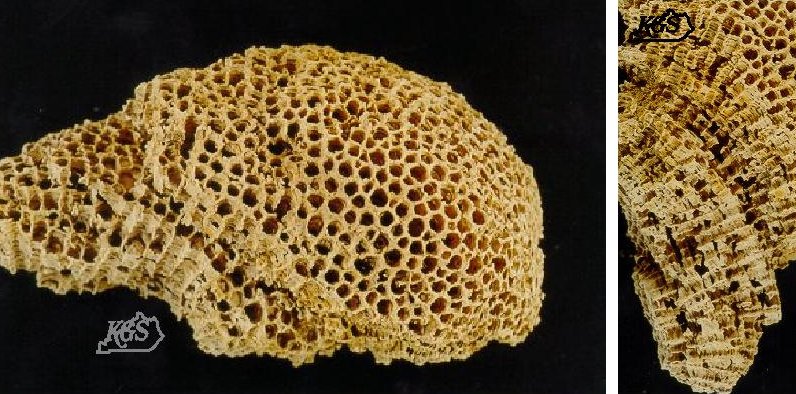
http://www.google.co.uk/imgres?imgurl=http://www.uky.edu/KGS/fossils/images/de_tab_pleuro.jpg&imgrefurl=http://www.uky.edu/KGS/fossils/tabulatemound2.htm&h=394&w=796&sz=113&tbnid=MSAvGDK0hLipNM:&tbnh=71&tbnw=143&prev=/images%3Fq%3Dfossil%2Bwasp%2Bnests%2Bpics&hl=en&usg=__tvRkbqFIsPOAhr054XqJLy6cimI=&ei=mWv8SoKFGdGx4Qawi73fAw&sa=X&oi=image_result&resnum=3&ct=image&ved=0CA0Q9QEwAg


Fossil Wasp nests


Fossil bees nest

http://www.ub.es/dpep/meganeura/ichnol06.jpg

These are pictures of the earliest fossil nests found. They don't look very different to those of today - so we can safely conclude that both bees and wasps had figured these things out right from the very beginning. Like for instance:

1The wasps knew how to make paper and the bees knew how to make wax.

2 They knew how to make honey in the case of the bees.

3 That flowers existed, which were producing nectar for the bees.

Which creates one hell of a conundrum for evolution. Flowers and bees HAD TO HAVE ARISEN AT THE SAME TIME. Otherwise, the plants could not survive, and neither could the bees.

How did that happen? Ah, says our evolutionist triumphantly, Co-evolution! As if a name makes a difference to the total absence of explanations!


On the right is a fossilised bee from 45 million years ago. It's impossible to tell the difference between this one, and a modern bee.(Similarly with the centipede on the left) Have they evolved since then? Clearly not. Did evolution get them there? Equally clearly, no.

S J Gould wrote:
The extreme rarity of transitional forms in the fossil record persists as the trade secret of paleontology . . . We fancy ourselves as the only true students of life's history, yet to preserve our favored account of evolution by natural selection we view our data as so bad that we never see the very process we profess to study. (S. J. Gould, "Evolution's Erratic Pace," Natural History, Vol. 86, No. 5, p. 14, May 1977.)

The above furnishes very clear evidence of the truth of Gould's statement.

We could go on at length about the bees, and will probably do so in subsequent articles, but next, we will look at the phenomenon of bird migration and the absolutely horrendous problems the instincts of those beautiful creatures pose for evolution.


STOP PRESS

(PhysOrg.com) - "Their brains are tiny - about the size of sesame seeds - and yet the behaviour of the humble honey bee is so advanced it has scientists scratching their heads in disbelief.

New Australian research just published by Proceedings of the Royal Society of London has shown that the bee brain has the ability to estimate energy expenditure while foraging for pollen.

"To make honey, bees must gather more nectar from flowers than the energy spent collecting it, so in order to forage efficiently they need to know how much energy each foraging trip costs them," said Dr Andrew Barron, the author of the study and senior lecturer at Macquarie University.

Bees estimate distance visually, by watching the environment pass them during flight. Barron set out to determine whether bees also use this visual information to estimate their flight costs. His first step was to build two tunnels - one 10 metres long and one 20 metres long - and place feeders at the end of each to attract the bees. He then created an optical illusion to trick the bees into believing that the closest feeder was actually the furthest distance away."

Good one, evolution!


NEW! HOT OFF THE PRESS!!

“HOW DOES INSTINCT EVOLVE”

OR

Evolution's Soft Underbelly
by Asyncritus


AT LAST!

The Argument Darwin Dreaded…
The Argument No-One Has Developed Before…
The Argument to Which There Is

NO ANSWER FROM THE EVOLUTIONISTS!


35,000 viewers of my articles can’t all be wrong. Check Google for this subject and see!
http://www.thenakedscientists.com/forum/index.php?board=17.30

100 pages of amazing facts and carefully reasoned arguments. Equip yourself! Give your children the knowledge to defend belief in Creation in class!

Get your copy here. Only $19.97 as pdf.
$27 plus $5 p&p in CDR format.


CDR Version