Friday, 23 October 2009

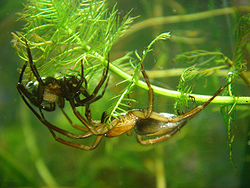
The Bell Spider

Male and female spiders from wiki


THE BELL SPIDER (Argyroneta sp)


Here is a pretty conundrum for the evolutionists.


Spiders areALL land animals. This spider is the ONLY spider to live underwater. How did it learn how to do so? http://www.spiderzrule.com/spider1.htm


The spider, an arachnid, builds a platform between the stalks of underwater plants. It attaches the platform to the stalks by silk threads, and then produces long threads which float in the water, apparently to guide the animal back to its nest. Clever, that. The threads also warn it of the approach of prey.


What now?


The hairs on the spider’s abdomen are specially designed to trap air bubbles. So it goes to the surface, air gets trapped in the hairs, and it submerges again, goes to the nest, and ‘scrapes’ the bubbles off the hairs. The bubbles are trapped by the platform, and forced up by the negative buoyancy of the air trapped in it, and forms a bell shape.


GO here for pictures of this process;

http://www.environmentalgraffiti.com/featured/incredible-aqualung-diving-bell-spider/13855


The spider lives in the bubble and waits in there for its prey to go past.


This extraordinary behaviour, in this the ONLY species to exhibit this behaviour pattern, is nothing short of a death-blow to ANY evolutionary explanations of its origin.


There is no way that this creature, with a brain the size of a pinhead, if that, could have worked out


1 How to make its silk


2 How to construct its underwater platform


3 How to trap air in its hairs


4 How to scrape it off underwater


5 That its prey would come swimming or floating by


6 How to catch it underwater


And why should it have gone underwater in the first place?


The female lays its eggs in the bell, and the juveniles trap some air from the bubbles, dart up to the surface, collect more, and set off to establish their new homes. How did they learn to do this? Instinct, you see!


Evolutionists are renowned for their fertile imaginations, but it is, as I say, impossible even to imagine a way for this to happen.


The theory has been falsified again: it cannot explain ANOTHER observation.


The evolution of spiders is yet ANOTHER example of evolutionary hopelessness. The very earliest fossils show no difference to today's.spiders.


Here is the wikipedia article on the subject, and you will see the pictures and comments there to this exact effect.


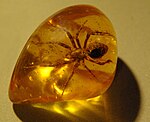
http://upload.wikimedia.org/wikipedia/commons/thumb/c/c8/Spider_in_amber_%281%29.jpg/150px-Spider_in_amber_%281%29.jpg

Wiki;

In addition to preserving spiders' anatomy in very fine detail, pieces of amber show spiders mating, killing prey, producing silk and possibly caring for their young. In a few cases amber has preserved spiders' egg sacs and webs, occasionally with prey attached; the oldest fossil web found so far is 100 million years old.
You note, they knew how to spin silk, make webs, catch insects and feed. They knew how to lay eggs, how to mate.

Every one of those items represents a full grown, perfectly developed INSTINCT, implanted in these little creatures in a state of perfection and completeness. they did not evolve, they could not evolve, and they have not evolved.

So, no change, no evolution, no origin. The first discovered spiders are exactly like their descendants.

We will return to the topic of spiders later, because they also present evolution with absolutely HUGE problems - like everything else in the living world.

Just as a dying tree begins to wither at the very tips, the smallest parts of the plant, just so these apparently insignificant items are really major indicators that the theory of evolution is really dead.


NEW! HOT OFF THE PRESS!!

“HOW DOES INSTINCT EVOLVE”

OR

Evolution's Soft Underbelly
by Asyncritus


AT LAST!

The Argument Darwin Dreaded…
The Argument No-One Has Developed Before…
The Argument to Which There Is

NO ANSWER FROM THE EVOLUTIONISTS!


35,000 viewers of my articles can’t all be wrong. Check Google for this subject and see!
http://www.thenakedscientists.com/forum/index.php?board=17.30

100 pages of amazing facts and carefully reasoned arguments. Equip yourself! Give your children the knowledge to defend belief in Creation in class!

Get your copy here. Only $19.97 as pdf.
$27 plus $5 p&p in CDR format.


CDR Version


Further details about the Bats

THE MIRACLE OF THE BAT ttp://tolweb.org/Chiroptera

Excellent article, pretty comprehensive: http://www.acoustics.hut.fi/u/mairas/pubs/echolocation_in_bats.pdf
Echo-location and flying Mammals

Introduction

We’ve all seen bats flitting about in the night sky, or pouring in massive swarms out of a cave. Two remarkable things are:

1 They miss one another
2 They feed on insects which they can a. detect and b. intercept and c. catch.

But let’s say a few words about this incredible phenomenon.

How do they do it?

‘This sonar [of the bat] is a marvellous discriminator: in a bat–swarm, in cave or night air, a bat can know its own sound among thousands of mobile neighbours, detecting its own signals even if they are 2000 times fainter than background noises. It can “see” prey, such as a fruitfly, up to 100 feet away by echo location and catch four or five in a second. And this whole auditory system weighs a fraction of a gram! Ounce for ounce, watt for watt, it is millions of times more efficient and more sensitive than the radars and sonars contrived by man.”

That excellent description clearly shows the standard features of Design

1 Complexity: the structure of the echo-locating system is miniaturised to fit inside the small skull of a bat, whose brain probably weighs only a few grams (about 15g in many cases). Flight is another complex achievement. NO OTHER MAMMALS CAN FLY.

2 Specificity: the echolocating device is amazingly good at locating insects, obstacles and doubtless predators. The flight mechanism is specifically functional.

3 Information: Highly advanced information is employed as the following shows.

Evolution of the Bat

There is none evidenced.

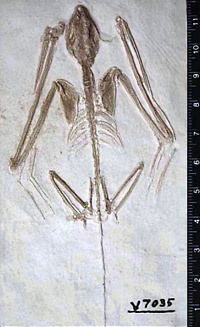
The skeleton of the Eocene bat, 54 million years ago, shows no important differences to those of today’s bats. But remarkably, they show that development which indicates that the sonar apparatus was already in existence.

"Unfortunately, the fossils available only complicate matters. They do not represent transitional morphology between quadrupedal (four-footed) animals and flying bats, and they represent animals nearly as specialized as their modern relatives"
Thewissen, J. G. M., and S. K. Babcock (1992). The Origin of Flight in Bats, BioScience, May, v. 42 n. 5, pp. 340-345.

John Hill says almost the same thing:

"...all fossil bats, even the oldest, are clearly fully-developed bats and so they shed little light on the transition from their terrestrial ancestor"
Hill, John E., and James D. Smith (1984). Bats: A Natural History, University of Texas Press, Austin.

Complexity, specificity and excellence

“We now know that bats have a method of doing synthetic aperture sonar while flying that not only determines the distance and direction of all the objects in a scene, but also reconstructs one specific object's shape. What's really incredible is that they can do both simultaneously."

I might add, at quite some speed too.

"ONR [The Office of Naval Research] would like to get naval sonars, both in listening and in processing the return information, a bit more, well, bat-like," notes ONR's Harold Hawkins.

"We would like to emulate this capability for the quick, accurate detection and classification of buried mines," said Harold Hawkins, a program manager with the biosonar program at the Office of Naval Research in Arlington, Virginia.

Excellence

In experiments, bats separately perceived and processed overlapping echo delays arriving as little as two microseconds - two millionths of a second - apart, an ability roughly three times keener than scientists had believed was possible in the mammals.

This fine-tuned capability, based in the bat's nervous system, allowed the animals to resolve echo-reflecting points on an object as close together as three-tenths of a millimeter, about the width of a pen line on paper. Such image resolution is significantly better than any man-made sonar, say the study authors.

"Using the same sounds as the bat, the best man-made sonar equipment can only process echo delays arriving five to 10 microseconds apart," said study leader James Simmons, professor of neuroscience in the Brown University School of Medicine. "The experiments showed that a bat's sonar resolved echoes that arrived two microseconds apart as easily and routinely as if there were 10 microseconds between them."

Use of Advanced Information

Knowledge of the laws governing sound travelling in air are clearly in evidence here. A bat emits a sound, which hits an object and is bounced back to the originator.

An article published in the Proceedings of the Royal Society on bat echolocation states:

Theory developed from acoustics and sonar engineering permits a strong predictive basis for understanding echolocation performance. Call features, such as frequency, bandwidth, duration and pulse interval are all related to ecological niche.'
http://www.journals.royalsoc.ac.uk/content/c7555003jn246l27/

We note firstly, that the bat knows that the sound IS going to be bounced back.

Secondly, the bat therefore has receptors which can receive the returning signals.

Thirdly, the bat has an onboard computer which calculates instantaneously how far away the object is,

Fourthly, the bat can calculate exceedingly accurately how far it will have moved itself by the time the signal returns. It can also calculate how far its prey will have moved, and its direction of movement. It can then compute a course to intercept the insect, and does so at the rate of 4/5 insects per minute.

Fifthly, it is navigating and flying at the same time. So the onboard computer has numerous functions to carry out simultaneously and additionally, including respiration, heartbeat, and other standard physiological duties.

Such calculations rival those in warplanes today, and just as those warplanes exhibit design, so does the bat. The bat, however can reproduce itself, and in this respect far supersedes any man-made contrivance.

The quotations below are further impressive technical features of bats' echo-location apparatus..

'Quantitative measures were obtained from the vocal signals produced by echolocating bats (Eptesicus fuscus) that were trained to perform in two distinct perceptual tasks, echo delay and Doppler-shift discriminations. (!!!!!)

[One wonders how a bat ever found out about Doppler shifts, and then figured out how to use it, and then constructed the apparatus to use the information, and then fit all that into the genome, and into the walnut-sized brain that it has!]

In both perceptual tasks, the bats learned to discriminate electronically manipulated playback signals of their own echolocation sounds, which simulated echoes from sonar targets. Both tasks utilized a single-channel electronic target simulator and tested the bat's in a two-alternative forced choice procedure. The results of this study demonstrate changes in the features of the FM bats' sonar sounds with echolocation task demands, lending support to the notion that this animal actively controls the echo information that guides its behavior.' ©2000 Acoustical Society of America.

'We used high speed stereo infra-red videography to study the three dimensional flight paths of the big brown bat, Eptesicus fuscus, as it chased erratically moving insects in a dark laboratory flight room. We quantified the bat's complex pursuit trajectories using a simple delay differential equation.

Our analysis of the pursuit trajectories suggests that bats use a constant absolute target direction strategy during pursuit. We show mathematically that, unlike CB [constant bearing], this approach minimizes the time it takes for a pursuer to intercept an unpredictably moving target.

Interestingly, the bat's behavior is similar to the interception strategy implemented in some guided missiles.'


http://biology.plosjournals.org/perlserv/?request=get-document&doi=10.1371/journal.pbio.0040108&ct=1

Further comments on Bat evolution

The bat is a warm-blooded animal, bearing fur, and suckling its young on milk,[i]and flying[/i].

So in order to ‘explain’ their evolution, we have to suppose innumerable small steps, where we see the bat’s supposed ancestors busy climbing trees or rock faces, leaping from the tops, holding their fingers wide apart in the effort to fly while their superb echo-locating apparatus warns them of the swiftly and fatally approaching ground below. It’s no wonder there are so many fossils. They all broke their necks jumping off trees trying to fly.

I said ‘fingers’ – because a bat’s wing is supported between digits, unlike other winged animals. If you look at the skeleton of a pterodactyl, you will see the difference plainly – but the pterodactyl was a reptile. I repeat the impossibility: a bat is a flying mammal.

Such acoustic and aerodynamic engineering capability is far beyond the capacity of chance to generate.

So to summarise, Complexity, Specificity and use of very Advanced Information in the construction of a bat, conclusively show that it cannot have been produced by chance, but by A Designer.

Instinct

We again note that instinct plays an enormous part in every aspect of the bat's natural history.

1 First, getting wings is an impossibility by any known evolutionary method.

2 Second, allowing that a pre-bat somehow DID evolve wings, then what would it do with them, since it didn't have a clue what they were about.

In fact, the bat would be at a very severe disadvantage - because IT HAD COMPLETELY LOST THE USE OF ITS FINGERS which had turned into wings.

3 But that's not all that was new. Suddenly, it had this sonar thing in its head. What to do with it, one wonders. Put an untrained ground crewman in the cockpit of a fighter aircraft which is equipped with the best echolocation apparatus ever invented, and send him out to shoot fast-flying hostiles.

He wouldn't get into the air, in the first place, and in the second wouldn't know how to use his fantastic new equipment.

Given a brain the size of a walnut or smaller in the microchiropteran bats, and given no training in flight or in the use of this unbelievably complex new equipment, I suggest that the new bat wouldn't last long.

The best equipment is useless without the instincts that power its use, and the best instincts are useless without the equipment to use.

BOTH HAD TO APPEAR AT THE SAME TIME - instantaneously, and perfectly functioning - there is absolutely NO WAY that 'gradual evolution' could have occurred.

But immensely advanced technology doesn't just happen. It is created by highly intelligent designers, with major amounts of equipment and materials at their disposal.

So how comes it that a bat 'developed', 'evolved' these fantastic designs which fill aeronautical engineers, acoustical engineers, and the military with such awe that they are even now trying to copy those designs.

And remember, the hardware is one thing - the software is another entirely. Those instincts represent the software - and no-one would dare say that the Windows program happened because there was an explosion in one of Bill Gates' factories.

No, it is obvious, even to someone as blind as a bat, that it was DESIGNED.

And design requires A DESIGNER.

NEW! HOT OFF THE PRESS!!

“HOW DOES INSTINCT EVOLVE”

OR

Evolution's Soft Underbelly
by Asyncritus


AT LAST!

The Argument Darwin Dreaded…
The Argument No-One Has Developed Before…
The Argument to Which There Is

NO ANSWER FROM THE EVOLUTIONISTS!


35,000 viewers of my articles can’t all be wrong. Check Google for this subject and see!
http://www.thenakedscientists.com/forum/index.php?board=17.30

100 pages of amazing facts and carefully reasoned arguments. Equip yourself! Give your children the knowledge to defend belief in Creation in class!

Get your copy here. Only $19.97 as pdf.
$27 plus $5 p&p in CDR format.


CDR Version


MIRACULOUS LIFE CYCLES
The Butterfly

The Life Cycle of all insects presents insuperable problems for the theory of evolution.

This is quite separate from the issue of how insect flight could possibly have evolved. The earliest flying insects were nearly identical to those of today, and they’ve found butterfly fossils in the Cretaceous.

Here is a vastly simplified account for you evolutionists to chew on.

The fertilised female lays her eggs on an appropriate leaf: for instance, the cabbage white butterfly lays her eggs on cabbage plants as the name suggests.

Let me draw out a few of the inexplicables.

First, the phenomenon of meiosis took place in male and female butterflies, in the gonads. As if they knew that the number of chromosomes in the little fertilised ovum had to be the same as in each of the pair, and that half plus half makes one.

Second, the sexual organs of male and female are complementary – meaning that there is a penis and a semen-receptacle in the female.

Third, the antennae are also useful for smell. Female butterflies release pheromones (like a perfume) into the air. The male butterflies of many species can detect the pheromones from as far away as 2 kilometers (over a mile). Depending on the concentration of the pheromones, the male will be able to find the female to mate with her. It's worth noting that some species of moths are sensitive to the presence of the females' pheromones up to five kilometers (about three miles) distant. http://centralamerica.com/cr/butterfly/

Fourth, the eggs are equipped with some kind of glue, which causes them to adhere to the leaf.

The eggs hatch out into larvae or grubs or caterpillars, which as we all know, are about as un-butterfly-looking creatures as elephants. These eat enormous quantities of leafy material, using their specially designed jaws, and then their cellulose-digesting alimentary canals. (Leaf material is tough, but the grubs handle it, despite the fact that the adult can only feed on juices like nectar.)They grow at a prodigious rate.

Then, because they are growing so fast, they molt: i.e. shed their skin, like a snake. Some do this about 4 times.

Then, they wrap themselves in a cocoon, and enter the pupal stage, which in some ways is the most extraordinary of all.

Inside the cocoon, the grub’s stomach produces quantities of digestive juices, which entirely dissolve the grub’s structure. Entirely. There is absolutely nothing left of the grub. Some authorities claim that even the cells themselves dissolve.

Then the wonderful reconstitution takes place, and inside the darkness of the pupa, eyes which have never seen the light, form to function in the light. Wings, which have never flown, or even know of the existence of air, form to take to the air. Reproductive organs, which have never mated, form in order to mate. The wonderful design patterns of the wings, form to give us pleasure; but the butterfly knows not that we exist. A coiled, long proboscis – able to enter into the heart of flowers the developing butterfly knows nothing about - forms, to suck the nectar the insect has never tasted. Antennae form, which can detect pheromones miles (literally) away, not knowing of the existence of such things.

And a butterfly emerges into the world to live for a few days: fluttering brightly, beautifully and erratically in search of flowers for food, and a mate to reproduce.

There is no conceivable way that this life cycle could have evolved. From what? And how?

No. This was designed by the Great Designer.

NEW! HOT OFF THE PRESS!!

“HOW DOES INSTINCT EVOLVE”

OR

Evolution's Soft Underbelly
by Asyncritus


AT LAST!

The Argument Darwin Dreaded…
The Argument No-One Has Developed Before…
The Argument to Which There Is

NO ANSWER FROM THE EVOLUTIONISTS!


35,000 viewers of my articles can’t all be wrong. Check Google for this subject and see!
http://www.thenakedscientists.com/forum/index.php?board=17.30

100 pages of amazing facts and carefully reasoned arguments. Equip yourself! Give your children the knowledge to defend belief in Creation in class!

Get your copy here. Only $19.97 as pdf.
$27 plus $5 p&p in CDR format.


CDR Version


The Evolution of snakes' poison apparatus


THE SNAKE'S POISON APPARATUS

Alan Hayward said that : Professor G A Kerkut of Southampton University, was an evolutionist. His standing was such that he was appointed General Editor of an important series of more than 50 textbooks of Zoology "The International Series of Monographs in Pure and Applied Biology - Zoology Division" published by Pergamon Press, Oxford. His own book in the series was entitled Implications of Evolution.

Kerkut took a very hard look at the theory in his book, and one point that stands out was his recognition that gradual evolution could not explain the origin of the poison apparatus of snakes. If we look at the requirements of the poison apparatus, we can soon see why he took the point of view that he did.

All or nothing

AS we’ve shown on several occasions this blog, there is a very serious number of all or nothing mechanisms. The yucca moth is extraordinary; the eumenes wasp is nearly so; the Bell spider is amazing; the life history of the butterfly is inexplicable – and so we could go on.

The poison apparatus of snakes is no less amazing than these.

As we all know, venomous snakes bite and poison their prey by injecting venom through their fangs. Each one of that short list has serious physical, and biochemical implications which are inexplicable on any but the creationist model.

Whatever else we may think of the mechanics of poisoning its prey, a snake has to possess the necessary instincts required BEFORE any such apparatus is of any use. It somehow has to know that it must identify, kill or stun its prey; it must know how to get near; it must know how to hide, how to camouflage itself etc etc.

Without all these things, the best apparatus would be useless. So since poisonous snakes represent a successful group, the inevitable question arises: where did it get these instincts from, and how did the information enter the genes? And just as important, WHY did they arise when there was no poison apparatus for the animal to use?

The Poison and the Poison Glands

Let’s begin with the poison itself.

Somehow, the poison which is going to be used, is extracted by the poison glands themselves from the blood. This alone represents an enormous biochemical feat. To become a poisoner, one needs to know how to obtain the poison. It is impossible for a snake to learn this deadly skill from its non-poisonous parents or from anywhere else.

It has to take the constituent substances from its own blood, and biochemically manufacture them safely in the poison glands which must be expressly designed for this purpose. The glands are sealed, so that the venom cannot re-enter the blood of the snake once it has been manufactured, which would be really too bad. This is an all or nothing, life or death mechanism – literally.

Not only that, but the glands are surrounded by a double capsule whose outermost and strongest layer is muscular, and is used to contract, and squeeze the gland, and express the venom once the fangs are sunk in the prey’s tissue. Without this layer, the venom would remain in the gland, and useless to the snake. Some snakes eat toads, and amazingly enough take the poisonous substances from the toads, and store them for their own use if this article is to be believed: news.mongabay.com/2007/0129-snake.html

So this process is absolutely fraught with danger to the reptile, and it is a wonder they survive – but survive they do, and successfully. To postulate that such a remarkably ingenious mechanism could possibly arise by chance mutations etc etc is to be absurd.

The Fangs

Not only are the poison glands remarkable – but the fangs are too. There are two sorts, the erectile fangs, which only become bared and upright when the snake is ready to bite, and the permanently erect type which is always upright.

The fangs are hollow, and connected to the poison glands by a tube. Wouldn’t it have been pointless (ho ho!) if the fangs and the glands were not connected? The snake would have starved. And if the fangs were not pointed and capable of entering the prey’s tissues, all the snake would manage to do would be to give it a good lick. But they are pointed AND hollow AND connected to the poison factory. Three mighty statistical impossibilities.

But this isn’t the only problem the original poisonous snake had to solve. Once it had killed the prey, it had to avoid poisoning itself with its own poison that was IN the prey. How did it manage this by chance mutations, one wonders.

The eyes and musculature

The spitting cobra is a most remarkable animal. We have seen on TV series just how far it can spit its venom. The presenters wore sunglasses to prevent the venom getting into their eyes, and the snakes rarely missed.

How did that ability evolve – and from what? Then, of course, there is the question of the snake’s eyesight. It must be able to measure distances to the prey accurately, by sight. A single eyed animal couldn’t do this – so they have 2 eyes. Perfectly functioning, as people who have been bitten will testify only too sadly.

There is a most unusual feature of their eyes, which alone separates them from any supposed ancestor. Here's wikipedia on the point:

"Most snakes focus by moving the lens back and forth in relation to the retina, while in the other amniote groups, the lens is stretched."

In our eyes, when we focus on a near object, the muscles surrounding it (the ciliary muscles) contract, and the lens becomes thicker. When we look at a distant object, the lens becomes thinner. http://www.med.harvard.edu/publications/On...er3/Myopia.html

In the snake's eye, instead of becoming thicker or thinner, the lens is moved forward or backward to adjust the focus on the object.

It is so totally different that Gordon Walls wrote: http://www.jstor.org/pss/1439015

"It has long seemed strange that the eyes of snakes should differ so much from those of lizards considering the closeness of the relationship of the two groups. Indeed, the ophidian (meaning snake) eye exhibits not one solitary structural feature which would enable a comparative ophtalmologist, handed a microscopic preparation of it, to place its owner in the Sauropsidia at all."

Here is a heavy blow in the eye for common descent. Many of the optimistic lineages or alleged connections between the snakes and other groups founder on this single extraordinary fact, which doesn't come from some molecular biochemist's test tube, but from field and anatomical observations. There is no satisfactory evolutionary explanation of this fact available.


The nervous system

There is the question too, of the nervous system of the snake: it has to synchronise, co-ordinate and oversee the whole process: from poison manufacture to getting the snake’s body into the correct position to strike, to injecting the venom, to swallowing the prey whole, and so on.

An enormously complex, and perfectly synchronised operation.

The snake’s jaw

Let me remind readers that the jaw of a snake is doubly hinged, so that the gape is much larger than would be expected from the head size of the animal. It is larger so the serpent can swallow the prey whole. Think of a python swallowing a calf, for example. http://www.biomechanics.bio.uci.edu/_html/...blind/blind.htm
http://rcreptiles.com/blog/index.php/2006/..._to_swallow_suc

It is tempting to try and imagine how many snakes with perfectly functioning poison apparatus starved to death before their jaws opened wide enough!

As we all know, the snake uncoils itself amazingly fast – ‘as fast as a striking snake’ has come into the language. The musculature required to do this must be present. The snake erects itself, the extreme of this being seen in the cobras, most notably the spitting cobras. How could such musculature evolve, and from what?

As usual, nobody knows. “The discovery of a new fossil snake may shed light on the poorly known evolution and ancestry of snakes, paleontologists announced April 16, 1997.” www.sciencedaily.com/releases/2000/03/000317051940.htm

If this finding is confirmed, it means that we have to completely re-think our view of how snakes evolved. It appears that the snakes underwent a rapid radiation in their initial burst of evolution, with a number of different lifestyles appearing at once and then developing independently and in parallel afterwards. Much work remains to be done on the evolution of snakes.http://arachnophiliac.info/burrow/evolution_of_snakes.htm

They don’t seem to learn, do they.


NEW! HOT OFF THE PRESS!!

“HOW DOES INSTINCT EVOLVE”

OR

Evolution's Soft Underbelly
by Asyncritus


AT LAST!

The Argument Darwin Dreaded…
The Argument No-One Has Developed Before…
The Argument to Which There Is

NO ANSWER FROM THE EVOLUTIONISTS!


35,000 viewers of my articles can’t all be wrong. Check Google for this subject and see!
http://www.thenakedscientists.com/forum/index.php?board=17.30

130 pages of amazing facts and carefully reasoned arguments. Equip yourself! Give your children the knowledge to defend belief in Creation in class!

Get your copy here. Only £4.97 as pdf.

The Migration of the green turtle

The Migration of the Green Turtle
http://www.sciencedirect.com/science?

"Green turtles, Chelonia mydas, make lengthy, regular migrations from Brazil to their nesting grounds on Ascension Island, 1400 miles away. The navigational systems used by Chelonia are unknown [heh heh heh!]; but recent measurements of visual acuity in green turtles suggest that they cannot use stars for guidance[heh heh!]. In this paper, we evaluate the possibility that orientation is based, in part, on the detection of some chemical substance originating at Ascension Island."

[What nonsense! Some chemical from Ascension Island, being identified by green turtles, at a distance of 1,400 miles! Must be a pretty powerful pong! And sufficiently powerful to guide a green turtle over a distance of ONE THOUSAND FOUR HUNDRED MILES, in water yet!]

Here is the phenomenon of instinct in full flower.

Let's assume that there IS some chemical emitted by Ascension Island, which reaches the turtle in Brazil. Improbable, but let's assume.

That chemical must trigger some instinctive response in the turtle, which causes it to set off, on this incredibly long journey. Where did that instinct come from? How did it become implanted in the animal's genome?

Then we have the navigational problem.

Suppose you are scuba diving, could withstand any amount of soaking, and had the necessary supplies etc to swim 1,400 miles.

You dive into the water and set off. In which direction are you going to go? Where IS Ascension Island anyway? And how are you going to find it?

I submit that you would probably be dead a long time before you ever found the island, and then faced the return journey.

So how does this turtle do it? And why?

That instinct must have been implanted there, full blown, complete, and functioning. It simply could not have evolved by any method known to man.

NEW! HOT OFF THE PRESS!!

“HOW DOES INSTINCT EVOLVE”

OR

Evolution's Soft Underbelly
by Asyncritus


AT LAST!

The Argument Darwin Dreaded…
The Argument No-One Has Developed Before…
The Argument to Which There Is

NO ANSWER FROM THE EVOLUTIONISTS!


35,000 viewers of my articles can’t all be wrong. Check Google for this subject and see!
http://www.thenakedscientists.com/forum/index.php?board=17.30

100 pages of amazing facts and carefully reasoned arguments. Equip yourself! Give your children the knowledge to defend belief in Creation in class!

Get your copy here. Only $19.97 as pdf.
$27 plus $5 p&p in CDR format.


CDR Version


The Bats; flight and echolocation

There are 3 groups of flying animals in existence today: the birds, the bats and the insects. Each of these presents evolution with insuperable problems, but my especial favourite is the bat.

It’s a shame they have had such bad press with such films as Dracula etc, because these creatures possess some of the most stupendous and miraculous pieces of biological engineering on the planet. For those who are convinced that evolution did occur, this will make not the slightest difference. For those who believe otherwise, this will be another club to beat their heads with.

Remember, the title of Darwin’s book was ‘On the Origin of Species’. That was what he set out to do, and it is what he singularly failed to achieve. It is on the origin question where he and his theory have failed most lamentably.

Fossil bats

There aren’t all that many of them, that’s for sure, and that may have something to do with the fact that they are flying animals. But what IS remarkable, is that the very first fossil bat looks remarkably like the bats of today: and has the echo-location apparatus in its head.


The author says: ‘These fossils represent essentially modern-looking microchiropterans; bats had evolved all of their characteristic features and begun to diversify by this time. In fact, the oldest known complete fossil bat, the Eocene-age Icaronycteris shown at left, shows specializations of the auditory region of the skull that suggest that this bat could echolocate.’

Remember, these are one of the earliest specimens of bat fossils ever found.

Therefore, they could fly. Now a bat does not fly using feathers, it flies using the skin between its fingers. That’s the origin of the name ‘chiropteran’ – hand-wing.

Here is a diagram to show what that means. Notice the vast difference between the bird’s wing and the bat’s:

http://www.nurseminerva.co.uk/adapt/wings.htm#bat


There is absolutely NO indication of any fossil ancestor of the bat, which hopped, jumped or leapt. There is absolutely NO indication of where and how they could have obtained the power of flight. None whatsoever. This, of course, is what the creation model predicts.

They fly at speeds of about 11.14 mph. In itself that doesn’t sound like much, but when we compare that with the body length of the animal, it is quite startling. It’s 234432 times its body length (say 3 inches) per hour, as compared with a car 20 ft long which at the same speed is only traveling 36000 times its length per hour.

Evolution is helpless to explain how this could have arisen so swiftly, so unexpectedly and so perfectly. Dawkins has laughably conceded that this gives the appearance of being designed, and then goes on to propound his pathetic fantasies about how this could have evolved. Have a look in Blind Watchmaker, (starting at page 22 where you'll find this:

The Sonar and Radar pioneers didn't know it then, but all the world
now knows that bats, or rather natural selection working on bats, had
perfected the system tens of millions of years earlier, and their 'radar'
achieves feats of detection and navigation that would strike an engineer
dumb with admiration.)
Pity they didn't strike Dawkins dumb with admiration, but one can't have everything!

Flight is one thing – marvelous as it is – but the echolocation system the animal uses beggars description.

In essence, the bat emits a squeak, which like radar, bounces back to the source. Knowing the speed of the radio wave emitted we can work out very accurately how far away an object is.

That’s us. The bats do this as well, but better than we can.

Let’s say that a bat is not moving, and emits a shriek. The sound wave travels to the insect it’s interested in, hits it, and bounces back. Let’s also say the insect is still. What happens then? We know the speed of sound and can calculate the distance to the object from the time it takes for the shriek to get there and reach back to us.

But the bat doesn’t know the speed of sound. So how can it calculate the distance of the insect? Evolution does not know.

Notice 2 things:

1 It has a sound emitter, and a sound receiver, and a computer connected to the two things which is able to calculate at phenomenal speeds, and immediately communicate those results to the muscles and nervous system.

But recall that both the bat and the insect were still.

That is not the case when the bat is hunting.

The bat is flying at up to 11 mph, and the insect is dodging and on an uncertain flight path. The calculations immediately begin to defy belief. Bear in mind too, that there are other bats emitting shrieks. How does our bat keep track of, and identify its own signal?

Answer, it possesses the necessary equipment. That equipment is of extraordinary high quality, as we’ve seen from the requirements.

From a computational neuroscience perspective, bats are remarkable because of the very short timescale on which they operate. The barrage of returning sonar echoes from a bat's near-environment lasts approximately 30 milliseconds following a sonar emission with the echo from a specific target lasting, at most, a few milliseconds.

From an engineering standpoint, biosonar systems (e.g. bats and dolphins) have inspired the design of very sophisticated sonar and radar systems that can map distant surfaces and track targets with great precision. Even with powerful mathematical tools and decades of experience, however, our best systems still do not rival the perceptual capabilities of dolphins. Many bats demonstrate incredible aerial agility, flying in complete darkness through branches and caves while hunting evasive insects. These animals perform such tasks in real-time with a total power consumption (including flight) measured in Watts, not hundreds of Watts. In addition to the ability to navigate in complete darkness by echolocation, both bats and dolphins live in very social environments using echolocation in group situations without any obvious problems with interference. All of these capabilities are highly desired by current military programs developing unmanned-aerial vehicles (UAV) especially since many of the target environments are in places where Global Positioning System (GPS) signals are unavailable and obstacle locations are not mapped.

It gets extremely technical, as we might guess, but the biggest points are very obvious.

Clearly, there is extremely high order design and implementation in this system. The military want to copy the design – which means that the bats’ system is superior to any of their own.

We have high order flight engineering and acoustic engineering allied to extreme efficiency of power consumption (measured in Watts, not hundreds of watts). And meanwhile, the animal is alive, growing, breathing, excreting, responding, moving, feeding, and reproducing. So successful is the group, that they are one of the most numerous sets of animals on the planet, as far as the numbers of species is concerned. They are estimated to be about 20% of all mammalian species.

There is not even a reputable theory to account for the evolutionary origin of bats that I have been able to find. The writers content themselves with mumbling about the as yet undiscovered ancestors of bats.Too soft, they say. But they've found birds, and jellyfish, and spiders and...

The instincts involved: flight and use of this incredible sonar system are mind boggling. Imagine putting an ignoramus in the cockpit of a modern jet fighter aircraft! Because the bat has a brain the size of a brazil nut, or less.

Evolution has failed miserably here, as usual when presented with a concrete case. The animals scream ‘We are designed’ and each little creature is a small hymn of praise to its Maker.

Thomas Addison said it well: “In reason’s ear, they all rejoice, and utter forth a glorious voice….. the Hand that made us is divine”.

Well said, Thomas.

REFERENCES

http://www.sciencedaily.com/releases/1998/10/981013075520.htm

Dawkins, Richard: The Blind Watchmaker
http://uath.org/download/literature/Richard.Dawkins.The.Blind.Watchmaker.pdf

http://neuroscience.brown.edu/simmons.html

NEW! HOT OFF THE PRESS!!

“HOW DOES INSTINCT EVOLVE”

OR

Evolution's Soft Underbelly
by Asyncritus


AT LAST!

The Argument Darwin Dreaded…
The Argument No-One Has Developed Before…
The Argument to Which There Is

NO ANSWER FROM THE EVOLUTIONISTS!


35,000 viewers of my articles can’t all be wrong. Check Google for this subject and see!
http://www.thenakedscientists.com/forum/index.php?board=17.30

100 pages of amazing facts and carefully reasoned arguments. Equip yourself! Give your children the knowledge to defend belief in Creation in class!

Get your copy here. Only $19.97 as pdf.
$27 plus $5 p&p in CDR format.


CDR Version


The Eumenes Wasp

THE EUMENES WASP

This wasp occurs in my country of origin, so I'm happy to be able to say that I can testify to the accuracy of some of this from what I personally saw. However the full details are taken from various authors, such as Henri Fabre, whose observations carry more weight.

After mating has ocurred, the female wasp begins the process of confounding evolutionists (and amazing me, when I saw it doing this).

She actually builds what looks like a hollow igloo made out of mud, and sticks it on a wall or the underside of a roof. The mud is made of her own spittle, dust, and small stones. It’s quite a structure, too: about 1 cm in diameter, and 1 cm deep.

At the top, she creates an opening, and curves the lip of the opening backwards, much like the lip of a round ornamental vase. She decorates the nest with shiny pebbles too!

She then catches and stings small green grubs.

Now hear this you unbelievers, and marvel with me. She stings them - but does not kill them, merely inducing partial paralysis. This keeps the game fresh and not putrefying. I wonder how many wasps take degrees in anaesthesiology!!

Somehow, the wasp knows what sex her offspring is going to be!!! If male, she catches fewer grubs, and if female she catches more. Here's J H Fabre describing the Ammophila wasp:
http://www.pdbooksonline.com/free_books/The_Wonders_Of_Instinct_by_J_H_Fabre/page_23.php

'But the egg is laid when the provisions are stored; and this egg has a determined sex, though the most minute examination is not able to discover the differences which will decide the hatching of a female or a male.

We are therefore needs driven to this strange conclusion: the mother knows beforehand the sex of the egg which she is about to lay; and this knowledge allows her to fill the larder according to the appetite of the future grub.

What a strange world, so wholly different from ours! We fall back upon a special sense to explain the hunting; what can we fall back upon to account for this intuition of the future? Can the theory of chances play a part in the hazy problem? If nothing is logically arranged with a foreseen object, how is this clear vision of the invisible acquired?'

Fabre asks a question it's impossible for evolution to answer.

But the wonders aren't over yet.

Where is the mother to lay her extremely fragile eggs? If she lays them in the mass of grubs, then they might squash it as they wriggle around.

Fabre says that he and his friends were astonished at the answer, and admits that he was unable to guess it. Before you read further, can you guess it?

The mother suspends the egg by a silken thread from the ceiling, out of reach of the grubs. When it hatches, it is suspended by its hindquarters, and can raise itself out of danger if a grub becomes too frisky.

She has also built an escape route for it, a protecting sheath that he failed to observe initially, because it was so well hidden.

Now wasps have a brain the size of a mustard seed. And yet, the mother is able to do all this - without having been taught - after all, she never sees her own mother, who dies after all the above is done.

How can she possibly

1 know how to make mud?

2 know how to build an igloo?

3 know which grubs to catch?

4 know how much venom to inject, and where to inject it so it paralyses, but doesn't kill?

5 And who thought up the idea of hanging the egg from the ceiling?

6 And how does a wasp learn how to manufacture a silk thread?

7 And how did all that get into the chromosomes?

The only answer is that the whole thing was carefully and competently designed.

And if it was designed, then there was a Designer.

REFERENCES

http://www.pdbooksonline.com/free_books/The_Wonders_Of_Instinct_by_J_H_Fabre/page_23.php

NEW! HOT OFF THE PRESS!!

“HOW DOES INSTINCT EVOLVE”

OR

Evolution's Soft Underbelly
by Asyncritus


AT LAST!

The Argument Darwin Dreaded…
The Argument No-One Has Developed Before…
The Argument to Which There Is

NO ANSWER FROM THE EVOLUTIONISTS!


35,000 viewers of my articles can’t all be wrong. Check Google for this subject and see!
http://www.thenakedscientists.com/forum/index.php?board=17.30

100 pages of amazing facts and carefully reasoned arguments. Equip yourself! Give your children the knowledge to defend belief in Creation in class!

Get your copy here. Only $19.97 as pdf.
$27 plus $5 p&p in CDR format.


CDR Version